




It begins with a ping. A message appears: “Great job!” followed by a thumbs-up emoji. Your manager has replied, but the meaning feels murky. Is it genuine praise or passive-aggressive dismissal? Welcome to the treacherous terrain of workplace communication, where a tiny pictogram can feel like a loaded statement.
In our digital-first era, where more conversations unfold over Slack and Teams than across meeting tables, emojis have quietly commandeered centre stage. Once mere digital decorations, these symbols now reshape how colleagues connect, collaborate—and occasionally collide.

This isn’t simply about miscommunication; it’s about misunderstood intention. In workplaces where tone matters as much as content, such subtle differences can build trust or obliterate it entirely.
The great emoji divide
“Digital communication has become a generational minefield,” observes Sharad Sharma, CHRO, Iris Software, who has witnessed how well-intentioned emojis create confusion, even conflict. “The thumbs-up emoji used to be universally positive, a quick nod of agreement. Now it signals passive-aggression to Gen Z, whose members expect more warmth or specificity.”
“The thumbs-up emoji used to be universally positive, a quick nod of agreement. Now it signals passive-aggression to Gen Z, whose members expect more warmth or specificity.”
Sharad Sharma, CHRO, Iris Software

A simple “Great job!” with a thumbs-up may feel clipped or insincere to someone raised on more expressive digital feedback, such as “Amazing work!” with celebratory emojis. Then there’s the ever-tricky slightly-smiling emoji that many Gen Z workers read not as friendly but as condescending, even sarcastic.
The disconnect stems from how different generations learnt to communicate online. For Gen X and many millennials, emojis entered the workplace as humanising tools—replacing tone of voice and facial expressions with small visual cues. But for younger workers, emojis are integral to language itself. They’re not additions to sentences; they are the sentence. For them, an emoji is less emotional expression than evolving code. When older colleagues deploy these symbols out of sync with their native meanings, it feels tone-deaf or patronising.
When symbols become riddles
Sujiv Nair, group CHRO, Re-Sustainability, likens workplace emojis to a new language that older generations may need to master like the alphabet. “For millennials and below, this has become the norm,” he says. “In future, all millennials and above may need to learn emojis just as they did ABCD.”
“For millennials and below, this has become the norm,” he says. “In future, all millennials and above may need to learn emojis just as they did ABCD.”
Sujiv Nair, group CHRO, Re-Sustainability

Yet whilst basic emotions translate easily (a smiley face for happiness), complexity breeds confusion. The issue isn’t just the emoji itself, but the context and relationship between sender and receiver. Clapping hands from a peer may celebrate success, but the same symbol from a manager—especially after critical feedback—can feel performative or patronising.
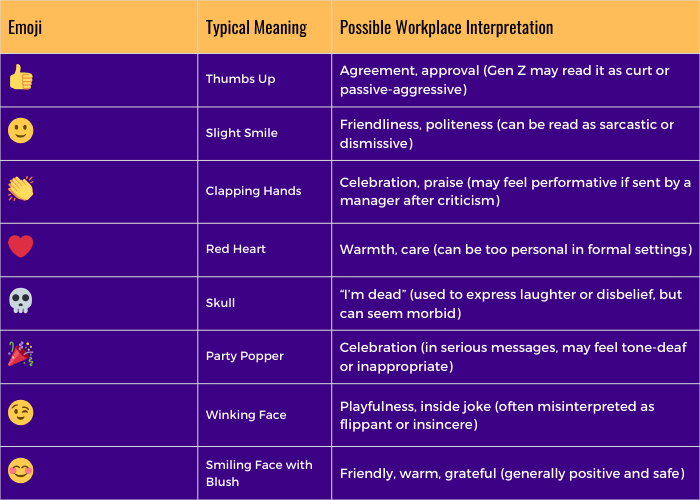
Similarly, a heart emoji may seem overly familiar in formal conversations, whilst a skull used humorously by one team member may appear morbid to another.
“It’s a calibration game,” says Nair. “Emotions are best expressed using our five senses. It gets better with practice—after all, we are humans.”
The hierarchy problem
The danger lies not in emojis themselves but in context. Consider receiving an urgent email titled “Need to fix this by EOD” followed by a party emoji. Or a serious HR update ending with a winky face. These create cognitive dissonance—where the emotion conveyed clashes with the message content.
“If you’re very senior, you don’t keep sending emojis to junior people,” he warns. “It can be misunderstood or misconstrued.”
Satyajit Mohanty, VP-HR, Dabur India

Hierarchy complicates matters further. Satyajit Mohanty, VP-HR, Dabur India, emphasises emotional awareness in professional settings. “If you’re very senior, you don’t keep sending emojis to junior people,” he warns. “It can be misunderstood or misconstrued.”
Mohanty advocates setting soft boundaries. “There are certain norms you can establish. You don’t send emojis to clients, for instance. These are informal guidelines, not rules, but they help maintain decorum.”
He recalls explaining to someone that a particular emoji—used to show warmth—could be interpreted differently. “We all think a smiling face indicates happiness. But many don’t know that in digital communication, the slightly-smiling kind can actually read as sarcasm.”
The empathy imperative
Organisations are responding with informal emoji guidelines—not draconian bans but frameworks encouraging mindful communication. Think of it as tone management for the digital age.
At Iris Software, Sharma has developed awareness sessions focusing on digital tone, generational preferences and inclusive communication. “The goal isn’t to stifle expression but to make it intentional,” he explains.
Nair echoes this, noting that emotional intelligence in communication requires fluency, not just empathy. “Human emotions evolved to help us make rapid judgements. We express emotions nonverbally and learn by observing. In the absence of those cues, emojis are poor substitutes unless used wisely.”
A silent recalibration is occurring. Leaders are learning not just how to communicate what they mean, but how it lands. Digital empathy is no longer a soft skill—it’s a leadership imperative.
The path forward
The solution isn’t eliminating emojis but evolving their usage. As Mohanty suggests, “Before hitting ‘send’, both managers and employees should ask whether the emoji adds clarity or causes confusion—and whether the sentiment could be better expressed in plain language.”
For instance, “Got your update” with a thumbs-up may seem terse or passive-aggressive, especially to younger colleagues. In contrast, “Thanks for sending the update. Looks good. Let’s sync tomorrow” with a smiley face softens the tone whilst providing clarity and direction.
Ultimately, emojis are only as effective as the emotional intelligence behind them. The key lies in emotional posture—letting emojis support, not substitute, genuine communication. In today’s symbol-saturated environment, the onus is on leaders and employees alike to understand that whilst a picture may be worth a thousand words, sometimes words are simply clearer.
So next time you reach for that slightly smiling face, pause and ask: am I smiling with them—or at them?