


Close Menu
    Facebook X (Twitter) Instagram
    • Our Story
    • Partner with us
    • Reach Us
    • Career
    Subscribe Newsletter
    HR KathaHR Katha
    • Exclusive
      • Exclusive Features
      • Perspectives
      • Friday Features
      • herSTORY
      • Case-In-Point
      • Point Of View
      • Research
      • HR Pops
      • Dialogue
      • Movement
      • Profile
      • Beyond Work
      • Rising Star
      • By Invitation
    • News
      • Global HR News
      • Compensation & Benefits
      • Diversity
      • Events
      • Gen Y
      • Hiring & Firing
      • HR & Labour Laws
      • Learning & Development
      • Merger & Acquisition
      • Performance Management & Productivity
      • Talent Management
      • Tools & Technology
      • Work-Life Balance
    • Special
      • HR Forecast 2026
      • Cover Story
      • Editorial
      • HR Forecast 2024
      • HR Forecast 2023
      • HR Forecast 2022
      • HR Forecast 2021
      • HR Forecast 2020
      • HR Forecast 2019
      • New Age Learning
      • Coaching and Training
      • Learn-Engage-Transform
    • Magazine
    • Reports
      • Whitepaper
        • HR Forecast 2024 e-mag
        • Future-proofing Manufacturing Through Digital Transformation
        • Employee Healthcare & Wellness Benefits: A Guide for Indian MSMEs
        • Build a Future Ready Organisation For The Road Ahead
        • Employee Experience Strategy
        • HRKatha 2019 Forecast
        • Decoding and Driving Employee Engagement
        • One Platform, Infinite Possibilities
      • Survey Reports
        • Happiness at Work
        • Upskilling for Jobs of the Future
        • The Labour Code 2020
    • Conferences
      • Leadership Summit 2025
      • Rising Star Leadership Awards
      • HRKatha Futurecast
      • Automation.NXT
      • The Great HR Debate
    • HR Jobs
    WhatsApp LinkedIn X (Twitter) Facebook Instagram
    HR KathaHR Katha
    zoha
    Home»Exclusive Features»HR Pops»Rage Applying: How a TikTok trend became shorthand for employees mentally checking out
    HR Pops

    Rage Applying: How a TikTok trend became shorthand for employees mentally checking out

    Rage applying and the growing gap between staying employed and staying engaged
    mmBy Liji Narayan | HRKathaJune 9, 2026Updated:June 9, 20264 Mins Read213 Views
    Share LinkedIn Twitter Facebook WhatsApp
    Rage Applying, HR Pops
    Share
    LinkedIn Twitter Facebook WhatsApp

    What does ‘rage applying’ mean?

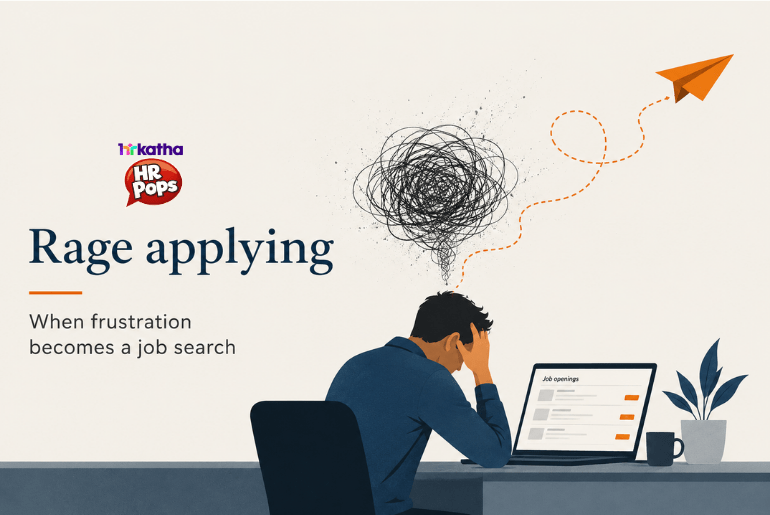
    Rage applying refers to the impulsive act of applying to multiple jobs out of frustration with one’s current workplace.

    Unlike strategic job hunting, rage applying is emotional rather than planned. Employees apply not because they have carefully evaluated opportunities, but because something at work has pushed them beyond their tolerance threshold.

    zoha

    A dismissive manager. A poor appraisal. A denied promotion. A meeting that becomes the final irritation after months of accumulated frustration.

    The trigger may appear small. Usually, it is not.

    Rage applying is rarely about a single bad day. More often, it is the release valve for dissatisfaction that has been building quietly for months.

    Employees open LinkedIn or job portals and begin applying rapidly, sometimes to dozens of roles in one sitting, with little attention to fit or long-term alignment.

    The objective is not necessarily career progression.

    It is escape.

    zoha

    Where did the idea come from?

    The term gained visibility in the early 2020s through TikTok and LinkedIn, where employees openly shared stories of impulsively applying for jobs after frustrating workdays.

    What had previously remained private suddenly became workplace vocabulary.

    The trend accelerated because modern job searching now carries almost no friction. One-click applications, algorithmic job recommendations, and permanently active job platforms allow employees to act on frustration instantly.

    The pandemic intensified the phenomenon further. Burnout, remote-work fatigue, layoffs, toxic workplace cultures, and growing conversations around mental wellbeing created conditions where dissatisfaction surfaced more openly and more quickly.

    Rage applying sits alongside quiet quitting, resenteeism, and career cushioning – each reflecting a different point on the spectrum from disengagement to exit.

    Why is it relevant for HR?

    For HR, rage applying is not merely social media jargon. It is a warning signal.

    Employees rarely rage apply in healthy workplaces. They do it when frustration accumulates to a point where emotional reaction overtakes rational career planning.

    The underlying causes are familiar: poor management, stagnant pay, unclear progression, lack of recognition, burnout, exclusion, or simply feeling invisible inside the organisation.

    What has changed is the speed with which employees can now act on dissatisfaction.
    For organisations, rage applying creates practical challenges. Recruiters face surges in poorly targeted applications. Employees who join impulsively may leave equally quickly after realising the role was never properly evaluated. Workforce stability weakens as emotional decisions replace considered career movement.

    The uncomfortable reality

    Rage applying often exposes something organisations prefer not to acknowledge directly: employees usually disengage emotionally long before they resign formally.

    By the time someone begins applying impulsively, several warning signs have often already been missed.

    A manager who consistently dismisses ideas.

    Career conversations repeatedly postponed.

    Recognition that never arrives.

    Feedback mechanisms that produce no visible change.

    The frustration accumulates quietly until one moment becomes the tipping point.

    What makes rage applying particularly revealing is that many employees do not initially intend to leave. The act itself restores a sense of control. It reminds them they still have options.

    But once interview calls begin arriving, emotional release can quickly become genuine exit planning.

    This is where organisations often misunderstand the problem. They focus on resignation as the issue when the actual breakdown began much earlier.

    What should HR pay attention to?

    Rage applying cannot be solved through retention bonuses or restrictive employment clauses.

    The solution lies further upstream.

    It is up to the HR to identify patterns of frustration before employees mentally disconnect. That requires stronger managers, more responsive feedback systems, clearer career visibility, and workplaces where concerns are acknowledged before resentment hardens into disengagement.

    Most importantly, organisations need to recognise that employees usually signal dissatisfaction repeatedly before leaving. Withdrawal, lower participation, reduced enthusiasm, cynicism, and emotional detachment often appear long before the resignation letter.

    The challenge is whether anyone notices in time.

    The takeaway

    Rage applying is less about job searching and more about accumulated frustration finally finding an outlet.

    It reflects a workforce increasingly unwilling to remain in environments where dissatisfaction builds without resolution.

    For HR, the phenomenon matters because it reveals the moment employees stop believing the organisation will improve.

    And once that belief disappears, resignation often becomes a question of timing rather than intention.

    The real question is not why employees rage apply.

    It is why they became frustrated enough to start looking in the first place.

    apply to many jobs applying to multiple jobs out of frustration with current job clearer career visibility cynicism disengaged employees disengagement Employee employees stop believing the organisation will improve. dissatisfaction employer frustrated employees frustration builds HR HR Pops HRKatha pops HRPops Human Resources rage rage apply rage applying reduced enthusiasm responsive feedback systems restores a sense of control thoughtless application to many jobs at a time Workforce
    Share. LinkedIn Twitter Facebook WhatsApp
    mm
    Liji Narayan | HRKatha

    HRKatha prides itself in being a good journalistic product and Liji deserves all the credit for it. Thanks to her, our readers get clean copies to read every morning while our writers are kept on their toes.

    Leave A Reply Cancel Reply

    Related Posts

    Amazon India is treating employees less like workers and more like ecosystems

    June 9, 2026

    Walmart reassures staff; pitches AI as job booster, not job killer

    June 9, 2026

    US lawmaker proposes new bill to end misuse of H-1B visas

    June 9, 2026

    Infosys focusses on upskilling, not job cuts, amid AI changes

    June 9, 2026
    Editorial

    Why HR becomes conservative when hiring HR

    Hire for potential, not just pedigree. Look beyond industry boundaries. Avoid groupthink. Value transferable capability.…

    The knowledge that retires before the person does

    The logic behind retirement at 60 once made sense. India was younger. Jobs were scarce.…

    EDITOR'S PICKS

    Amazon India is treating employees less like workers and more like ecosystems

    June 9, 2026

    Rage Applying: How a TikTok trend became shorthand for employees mentally checking out

    June 9, 2026

    How companies are using AI to compress hiring timelines

    June 8, 2026

    POV: Is age-based retirement still relevant today?

    June 8, 2026
    Latest Post

    Amazon India is treating employees less like workers and more like ecosystems

    Exclusive Features June 9, 2026

    Employee benefits once followed a simple bargain: pay people reasonably well and they would work.…

    Walmart reassures staff; pitches AI as job booster, not job killer

    Automation June 9, 2026

    As many companies cut jobs citing artificial intelligence (AI), Walmart is presenting a different message.…

    US lawmaker proposes new bill to end misuse of H-1B visas

    Global HR News June 9, 2026

    Chip Roy, Republican congressman of Texas, has introduced a bill in the US congress that…

    Rage Applying: How a TikTok trend became shorthand for employees mentally checking out

    HR Pops June 9, 2026

    What does ‘rage applying’ mean? Rage applying refers to the impulsive act of applying to…

    Asia's No.1 HR Platform

    Facebook X (Twitter) Instagram LinkedIn WhatsApp Bluesky
    • Our Story
    • Partner with us
    • Career
    • Reach Us
    • Exclusive Features
    • Cover Story
    • Editorial
    • Dive into the Future of Work: Download HRForecast 2024 Now!
    © 2026 HRKatha.com
    • Disclaimer
    • Refunds & Cancellation Policy
    • Terms of Service

    Type above and press Enter to search. Press Esc to cancel.