


Close Menu
    Facebook X (Twitter) Instagram
    • Our Story
    • Partner with us
    • Reach Us
    • Career
    Subscribe Newsletter
    HR KathaHR Katha
    • Exclusive
      • Exclusive Features
      • Perspectives
      • Friday Features
      • herSTORY
      • Rising Stars
      • Case-In-Point
      • Point Of View
      • Research
      • HR Pops
      • Dialogue
      • Movement
      • Profile
      • Beyond Work
      • By Invitation
    • Brief News
      • Global HR News
      • Compensation & Benefits
      • Diversity
      • Events
      • Gen Y
      • Hiring & Firing
      • HR & Labour Laws
      • Learning & Development
      • Merger & Acquisition
      • Performance Management & Productivity
      • Talent Management
      • Tools & Technology
      • Work-Life Balance
    • Special
      • Editorial
      • HR Forecast 2026
      • Cover Story
      • HR Forecast 2024
      • HR Forecast 2023
      • HR Forecast 2022
      • HR Forecast 2021
      • HR Forecast 2020
      • HR Forecast 2019
      • New Age Learning
      • Coaching and Training
      • Learn-Engage-Transform
    • Studio
      • The CHRO Playbook
      • Quick HR Insights
      • The Corner Office
    • Reports
      • Whitepaper
        • HR Forecast 2024 e-mag
        • Future-proofing Manufacturing Through Digital Transformation
        • Employee Healthcare & Wellness Benefits: A Guide for Indian MSMEs
        • Build a Future Ready Organisation For The Road Ahead
        • Employee Experience Strategy
        • HRKatha 2019 Forecast
        • Decoding and Driving Employee Engagement
        • One Platform, Infinite Possibilities
      • Survey Reports
        • Happiness at Work
        • Upskilling for Jobs of the Future
        • The Labour Code 2020
    • Forums
      • HRKatha Inner Circle
      • HRKatha Futurecast
      • Leadership Summit 2025
      • Rising Star Leadership Awards
      • HRKatha Futurecast 2025
      • Automation.NXT
      • The Great HR Debate
    WhatsApp LinkedIn X (Twitter) Facebook Instagram
    HR KathaHR Katha
    Home»Exclusive Features»Research»Wider pay gap leads to slower economic growth – ILO
    Research

    Wider pay gap leads to slower economic growth – ILO

    mmBy Dr. Prajjal Saha | HRKathaDecember 28, 20165 Mins Read3795 Views
    Share LinkedIn Twitter Facebook WhatsApp
    Share
    LinkedIn Twitter Facebook WhatsApp

    In India, the top 10 per cent take away around 42.7 per cent of the total wages, whereas the share of the bottom 50 per cent is only 17.1 per cent.

    While inequality in salary is inevitable, it is also said that an excessive inequality is bad for economic growth and for the social fabric of a country. It has an adverse effect on economic growth as it brings down consumption demand. It is also more difficult to eliminate poverty in highly unequal societies.

    In India, this salary gap is better than many other countries but also worse than many more. As per the International Labour Organisation (ILO) report, in India, the top 10 per cent take away around 42.7 per cent of the total wages, whereas the share of the bottom 50 per cent is only 17.1 per cent of all wages paid out.

    In South Africa, the wage gap is even wider — the top 10 per cent take away 49.2 per cent of the total wages while the share of bottom 50 is 11.9 per cent.

    A university degree does not necessarily guarantee a highly paid job. In Russia, there are a surprisingly high proportion of university graduates among lower-paid workers.

    On the contrary, in China, the top one per cent wage earners have a higher percentage of people with an education below university or high-school level.In advanced economies, such as Europe, the highest-paid 10 per cent receive, on an average, 25.5 per cent of the total wages paid to all employees in their respective countries, which is almost as much as what the lowest-paid 50 per cent earn (29.1 per cent).

    In the most recent years, many countries have adopted or strengthened minimum wages, as one way of supporting low-paid workers and reducing wage inequality. However, it is also a fact that during recent decades wage inequality has increased in many countries around the world.

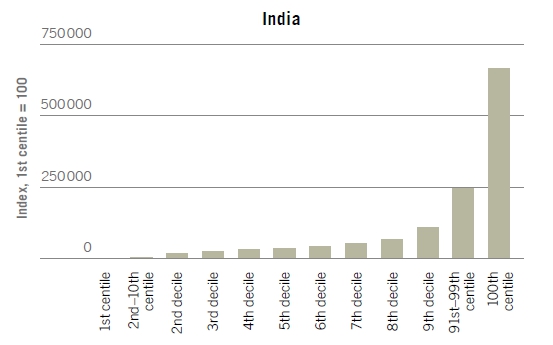
    The ILO report states that in all countries, wages increase fairly gradually except in the top 10 per cent, and especially the top 1 per cent, where they jump sharply and dramatically.

    If we further segregate the data, it’s seen that in Europe, the top 1 per cent earn, on an average, wages that are about eight times higher than those of the lowest 10 per cent, with multiples ranging from four in the Nordic countries to 14 in Romania.

    In Vietnam, the difference is 15 times and for India, it is 33 times.

    However, it doesn’t establish that better skills or higher education ensures better wages.There is also a strong co-relation between the wage gap and other demographics, such as gender, occupation, size of enterprise, nature of contract, and the economic sector.

    In both developed and developing countries a university degree does not necessarily guarantee a highly paid job. For instance, in Russia, there are a surprisingly high proportion of university graduates among lower-paid workers. On the contrary, in China, the top one per cent wage earners have a higher percentage of people with an education below university or high-school level.

    Likewise, the proportion of women continuously declines as one moves towards the higher paid deciles.

    In Europe, women make up 50–60 per cent of workers in the three lowest pay deciles; this share falls to about 35 per cent among the best-paid 10 per cent of employees, and further to 20 per cent among the highest-paid one per cent of employees.

    In some emerging and developing countries, the contrast is even greater. For instance, the proportion of women in India in the bottom two deciles is similar to that in Europe (about 60 per cent), but drops precipitously thereafter, and in the upper half of the distribution women represent no more than 10–15 per cent of wage earners.

    In the Russian Federation, women make up about 70 per cent of workers in lower deciles and this share shrinks to about 40 per cent in the upper deciles.

    In terms of education, the upper deciles include a higher share of university graduates than lower deciles in all the countries sampled, but this pattern is particularly noticeable in South Africa and Argentina.

    Looking at occupation and economic sector, the real-estate and financial sectors are over-represented globally among the top-paid workers as it is in Europe and, unsurprisingly, a majority of the top-paid workers occupy managerial and professional positions. In Chile, private services and trade are the largest employers of workers in the lower-wage deciles, while in Vietnam, workers in the lower deciles are much more likely to be employed in the manufacturing or social services sectors than is the case in either Europe or Chile.

    However, what’s satisfactory is that India has had a decent growth in wages in the last decade – the second best among developing G20 countries and second only to China.

    The average wages more than doubled in China during this period and it increased by about 60 per cent in India and by between 20 and 40 per cent in most other countries in this group. The only country to witness a decline in real wages is Mexico.

    (ILO ranks salaried workers in ascending order of their wages and divides them into ten groups [deciles] or 100 groups [centiles])

    disparity in pay International Labour Organisation Pay Gap Wage structure
    Share. LinkedIn Twitter Facebook WhatsApp
    mm
    Dr. Prajjal Saha | HRKatha

    Dr. Prajjal Saha is a business journalist and the editor-publisher of HRKatha. He writes on the realities of work and organisations, offering a clear-eyed view of how companies translate intent into action—often revealing the gap between the two. With over 25 years of experience, he focuses on interpreting workplace trends and leadership decisions in a way that is both insightful and accessible. He founded HRKatha in 2015 to create a platform for credible, insight-driven analysis of the evolving workplace.

    Leave A Reply Cancel Reply

    Related Posts

    62% of women in tech say AI eases workloads, yet 42% face higher productivity expectations

    November 11, 2026

    76% of tech professionals are satisfied with their jobs, yet 65% would consider switching

    November 4, 2026

    26% frontline employees report negative transformation experiences, nearly 3x the senior management rate

    October 28, 2026

    India’s tech professionals have already decided before you call them

    October 21, 2026
    zoha
    Editorial

    Companies owe their people more than what is legal

    When Canva announced a restructuring affecting 1,271 employees, or 22 per cent of its workforce,…

    Hard work built India’s global reputation. Availability cannot define its future

    I must have been in school when I first heard the slogan. I was passing…

    EDITOR'S PICKS

    Lazy girl jobs: When doing your job became enough

    November 17, 2026

    Birlasoft wants to measure skills by deployment, not learning hours

    November 17, 2026

    POV: Is probation still necessary, or does it undermine trust?

    November 16, 2026

    Companies owe their people more than what is legal

    November 15, 2026
    Latest Post

    Training is not development: MakeMyTrip’s Yuvaraj Srivastava on closing capability gaps

    THE CHRO PLAYBOOK November 17, 2026

    Organisations have never had so many ways to train their employees. Yet capability gaps remain…

    EY India launches sixth board-effectiveness programme for senior leaders

    Brief News November 17, 2026

    EY India is expanding its Board leadership- development initiative with the launch of the sixth…

    IDBI Bank Unions call nationwide strike on 3 December against proposed sale to Fairfax

    Brief News November 17, 2026

    The strike has been called by the United Forum of IDBI Officers and Employees (UFIOE),…

    Himanshu Kapila takes on expanded HR leadership role at Medtronic

    Movement November 17, 2026

    Medtronic has promoted Himanshu Kapila to director, human resources – India Subcontinent. Based in Gurugram,…

    Asia's No.1 HR Platform

    Facebook X (Twitter) Instagram LinkedIn WhatsApp Bluesky
    • Our Story
    • Partner with us
    • Career
    • Reach Us
    • Exclusive Features
    • Cover Story
    • Editorial
    • Dive into the Future of Work: Download HRForecast 2024 Now!
    © 2026 HRKatha.com
    • Disclaimer
    • Refunds & Cancellation Policy
    • Terms of Service

    Type above and press Enter to search. Press Esc to cancel.