




When the whole world is going gaga over ‘anything remotely digital’, almost all of us are getting caught in the madness of trying to evaluate whether we are digital enough, and whether we have the right systems in place. This introspection often ends in either of the two actions — we either go out in the market and start to explore available options for pieces which we find lacking in what we already have, or we look at the last paid invoice of our existing vendor and think we have enough for now and try to make the most of it!
While there is nothing wrong with this approach and you hear lots of leaders sharing their stories of how this mix worked for them (considering the restrictions they faced in their current role — global mandates, lesser local budgets, and so on), this is perhaps the reason why some organisations see exponential results from digital transformations, while others seem to tinker around the ‘acceptable’ benchmark of value created. That’s because, the difference that really matters in such projects is how well we have understood the purpose of deploying such a technology and how smartly we have designed the overall landscape.
This seems pretty simple in concept but in actual practice this is one of the biggest challenges business leaders face in their digital space. We realised this in some of the conversations we had with talent acquisition, HR and business leaders. With the kind of options that the market provides, it is easy to get confused about what would be the best fit for an organisation. Or worse, it is equally easy to get into a piece meal approach, where we try to fix what is broken or missing and leave the rest for later.
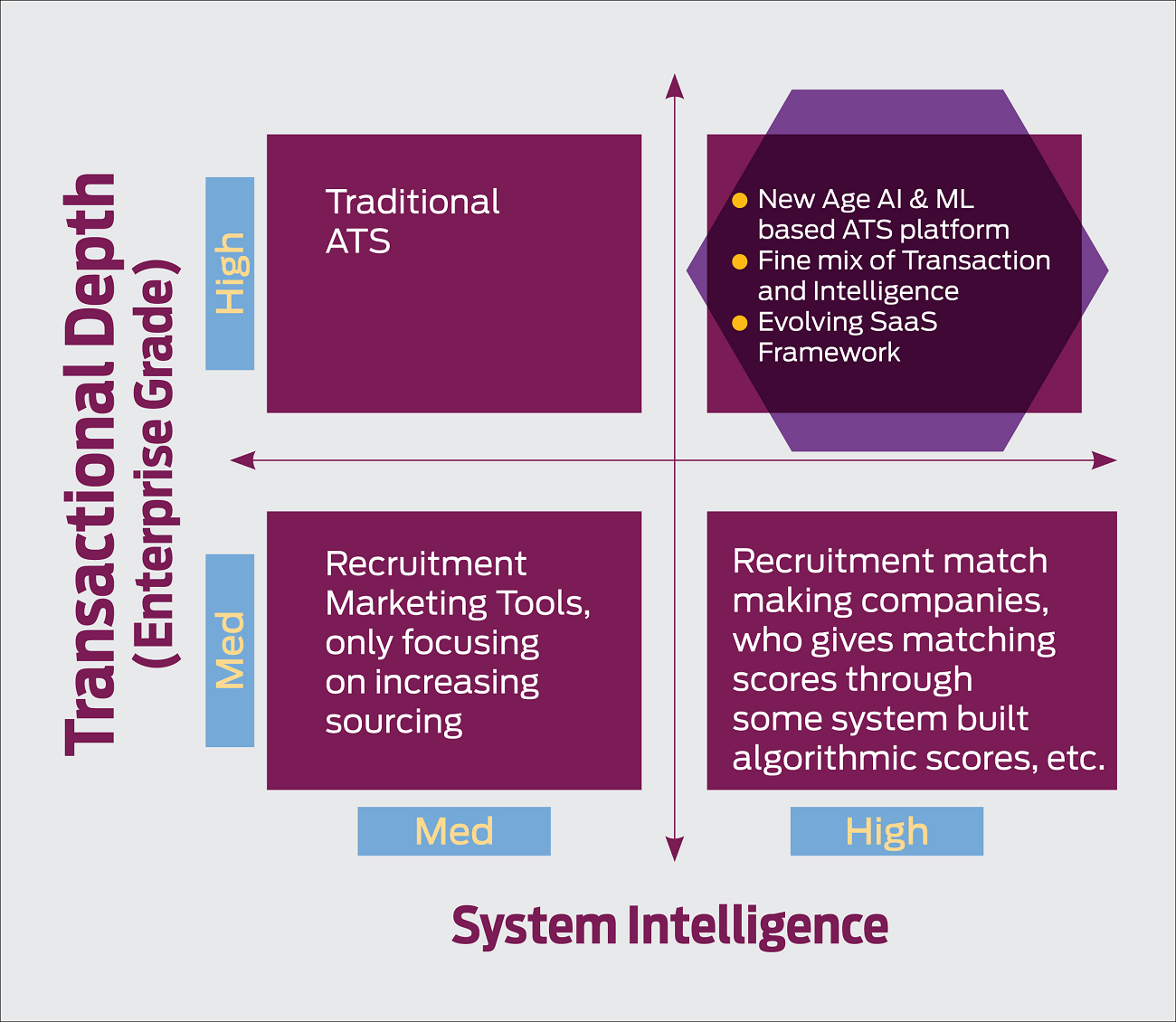
We tried to address this by combining our learning from managing 200+ large enterprises, with the inputs from talent leaders who have been able to navigate better in this maze of different available options. The result has been a 2×2 matrix that seems to work at least for the various scenarios we have heard from our customers and prospects.
Here’s how it looks! We have two major parameters which form the two axes. Transactional depth – that represents the level of complexity that your recruitment process has and system Intelligence – that represents the level of ‘intelligence’ that you are ready to introduce into your digital ecosystem. When you look at both these parameters in a low to high continuum range, four categories of technologies emerge.
Quadrant 1: Low – Medium transactional depth and system intelligence
The recruitment solutions in quadrant 1 are simple-point solutions that are basic recruitment marketing tools, which focus on increasing sourcing. They do not offer the recruiter, or hiring manager any benefit apart from letting them look at profiles. Some organisations will still consider sourcing as the only task required for hiring talent and provide either no or very rudimentary support for the rest of the processes. Hence, while going for solutions that exist in this category, areas such as hiring manager experience, candidate experience and a single view of the entire process, and so on are left unattended. While this may work for MSME or SMEs because there the volumes and complexities of hiring are low, there is only so much impact that one can experience through such systems.
Quadrant 2: High transactional depth and Low-Medium system intelligence
Traditional applicant tracking systems or (ATS) fit into this quadrant. If all the existing recruitment solution providers under this category were to be placed in the matrix, this quadrant will be the most populated one. No doubt, these solutions occupy a majority of the market share. However, they are only transactional in their capabilities and lack any intelligence.
While these solutions may help scrutinise multiple sources to pick up relevant profiles and may also offer some basic additional features enabling easy or advanced search, they do not support the selection process in any way. However, still organisations that have bulk hiring requirements use such services. Businesses in manufacturing, retail, insurance or IT may need to look at thousands of profiles for mass hiring drives, and ATS help. However, solutions from this category do not ensure quality hires as they lack AI-based suggestions and system depth.
Quadrant 3: Low-Medium transactional depth and high system intelligence
This quadrant houses the ambitious new-age recruitment solutions that, in the race to bringing in AI and machine learning-enabled intelligence, have somewhere missed out on the basics. These can be recruitment matchmaking tools that can provide basic match scores using a system algorithm, but lack the intelligence that comes from a stronger database. They will not have the large in-depth reach and understanding of a position and its requirements.
Such systems still lack advanced features, such as skill recommendations for new job postings or providing recruiters with skill-fit and best match suggestions for shortlisting candidates.
Quadrant 4: High transactional depth and high system intelligence
Now here is where the new-age, well-advanced recruitment solutions — which make good use of the strength of data-rich ATS and the intelligence of AI and machine learning— reside. These recruitment solutions not only help source the best by utilising multiple streams, such as the job-boards, social media and their internal database; but also support all involved stakeholders in making better decisions through AI-backed suggestions and allowing anytime, anywhere access and approvals, across the process.
From helping recruiters with suggestions for job posting, defining the required skill sets, composing an accurate job description and matching the best candidates, these solutions become a true recruitment partner across the hiring cycle. Naturally, this allows a seamless user experience and process flow. These make for handy tools for not just recruiters, but hiring managers, candidates and the business SPOCs too.
Well, now that this framework is right in front of you, we hope you will find some sense in the crazy mesh you often find yourself in. So what are you waiting for? Please try it out and let us know what you think!
(P.S. Just in case you were wondering, we at PeopleStrong are specifically crazy about the fourth quadrant. And if you would like to experience how it works please write to us at khushboo.dahiya@peoplestrong.com for a quick demo of Alt Recruit)
Value our content... contribute towards our growth. Even a small contribution a month would be of great help for us.
Since eight years, we have been serving the industry through daily news and stories. Our content is free for all and we plan to keep it that way.
Support HRKatha. Pay Here (All it takes is a minute)