


Close Menu
    Facebook X (Twitter) Instagram
    • Our Story
    • Partner with us
    • Reach Us
    • Career
    Subscribe Newsletter
    HR KathaHR Katha
    • Exclusive
      • Exclusive Features
      • Perspectives
      • Friday Features
      • herSTORY
      • Rising Stars
      • Case-In-Point
      • Point Of View
      • Research
      • HR Pops
      • Dialogue
      • Movement
      • Profile
      • Beyond Work
      • By Invitation
    • Brief News
      • Global HR News
      • Compensation & Benefits
      • Diversity
      • Events
      • Gen Y
      • Hiring & Firing
      • HR & Labour Laws
      • Learning & Development
      • Merger & Acquisition
      • Performance Management & Productivity
      • Talent Management
      • Tools & Technology
      • Work-Life Balance
    • Special
      • Editorial
      • HR Forecast 2026
      • Cover Story
      • HR Forecast 2024
      • HR Forecast 2023
      • HR Forecast 2022
      • HR Forecast 2021
      • HR Forecast 2020
      • HR Forecast 2019
      • New Age Learning
      • Coaching and Training
      • Learn-Engage-Transform
    • Studio
      • The CHRO Playbook
      • Quick HR Insights
      • The Corner Office
    • Reports
      • Whitepaper
        • HR Forecast 2024 e-mag
        • Future-proofing Manufacturing Through Digital Transformation
        • Employee Healthcare & Wellness Benefits: A Guide for Indian MSMEs
        • Build a Future Ready Organisation For The Road Ahead
        • Employee Experience Strategy
        • HRKatha 2019 Forecast
        • Decoding and Driving Employee Engagement
        • One Platform, Infinite Possibilities
      • Survey Reports
        • Happiness at Work
        • Upskilling for Jobs of the Future
        • The Labour Code 2020
    • Forums
      • HRKatha Inner Circle
      • HRKatha Futurecast
      • Leadership Summit 2025
      • Rising Star Leadership Awards
      • HRKatha Futurecast 2025
      • Automation.NXT
      • The Great HR Debate
    WhatsApp LinkedIn X (Twitter) Facebook Instagram
    HR KathaHR Katha
    Home»Exclusive Features»Designations do matter, do they?
    Exclusive Features

    Designations do matter, do they?

    mmBy Puja Bothra | HRKathaJune 4, 2019Updated:June 4, 20194 Mins Read52542 Views
    Share LinkedIn Twitter Facebook WhatsApp
    Share
    LinkedIn Twitter Facebook WhatsApp


    Business organisations now and then initiate internal re-structuring. While, some employees emerge from it unscathed there are others who suffer defeat.

    Employees grieve because they receive pink slips or find themselves on the wrong foot because of a designation change.

    Recently, the telecom industry’s key player Vodafone Idea saw dissatisfaction amongst its employees. Apparently, the employees have been anxious about losing jobs since the two companies announced a merger in August 2018. Their fears came true and about 4000 employees have been displaced since then.

    Moreover, a designation change that has been on cards since then, is now being implemented. The employees are demoralised because the new structure is leading to demotions. This will impact the compensation they have been receiving which is generally linked to designations. Once a sunrise industry – telecom, is now declining rapidly because of severe competition in the market.

    “Benefits are linked to designations. For example, while offering car schemes or telephone allowances the amount is decided by an organisation on the basis of job titles,” says Ramesh Shankar S, former EVP HR, Siemens.

    Organisations often go through re-structuring either because of merger or acquisition or cost cutting. Today, business operates in a very volatile market, devaluation of designations has become a routine task by employers.

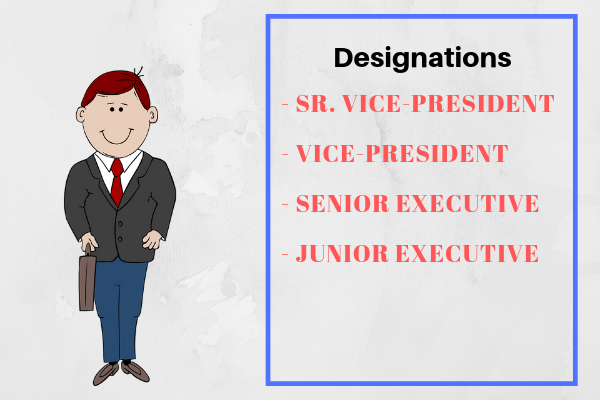
    Right now, tracing the history of job designations is not in our interest, but, since they continue to exist, we can say that they are there because people want them. Moreover, it is seen that employees relate to one another more on the basis of designations and less on any other front at work.

    “This is a phenomenon which is very common in Asia and more so in India, here the organisational structure supports multiple hierarchies between let say role1 and role2,” says Rohit Suri, chief HR & talent officer, South Asia, GroupM.

    Our society is embedded in caste system and social classes represent certain behaviours and that creeps into corporate culture. Shankar says, “If an executive wants to meet a government officer, the designation on the card decides whether he succeeds in getting an appointment or not.”

    Titles can also misguide if they are not put in the right context as different countries and sectors use it differently.

    Organisational restructuring helps when an employee uses one’s designation to calibrate one’s value and compensation over another employee who is far better at work but has a junior designation and is paid lower.

    Interestingly, startup companies operate differently, employees there do not focus on designations, and everyone is just working to build the company. Probably that will be the future of work and very soon we will see job titles fading and becoming fewer.

    “There are organisations that are trying to make their structures flatter, they are not building titles but collaborative teams,” says Suri.

    On a lighter note Shankar says, “Designations are important for marriage proposals, no one cares how ethical is the work in the organisation that you are part of as long as you have a powerful job title.”

    The ideal situation is to have broad designations that help employees to reach out to one another. Having multiple hierarchies within the same role fosters bureaucratic channels of communications and meaningless job titles.

    “Designations should be used to reflect job titles for example a procurement manager is the person you need to go if you need something for him, you really do not need multiple levels of authority within each category,” says Ramesh.

    People are now more concerned about what role they are coming to and not so much the title. “You may have a fancy title but end up doing clerical work, would you be excited about that? I make a company of my own and give myself the title CEO, that is not same as being a CEO of a large organisation,” explains Suri.

    India has a young talent board which is very aspirational and with the economy developing fast, people are focusing more on roles and less on titles.

    “In my opinion, a lot of people who are mid to senior level are keener to know their roles; and whatever their designation be if it is not backed by challenging and fulfilling work, they will not stick around,” says Suri.

    Share. LinkedIn Twitter Facebook WhatsApp
    mm
    Puja Bothra | HRKatha

    She has been a business writer for a decade now. Besides, she also influences people through motivational workshops. Likes to travel long distances with a book in hand and accounts her travels in a blog. She is very passionate about Yoga and calls it her purpose in life.

    Leave A Reply Cancel Reply

    Related Posts

    HR Perspectives by Arindam Chakraborty: “Succession planning must begin two to three levels below the target role”

    October 28, 2026

    26% frontline employees report negative transformation experiences, nearly 3x the senior management rate

    October 28, 2026

    Microaffirmations: The small gestures that build big trust

    October 27, 2026

    For TELUS Digital, the diversity question is no longer how many but where

    October 27, 2026
    zoha
    Editorial

    The rift between the corner office and the floor below

    A general manager at a large Indian steel conglomerate recently described an exchange with his…

    Can India become a skills-first economy while remaining a collar-conscious society?

    Consider two employees beginning their careers. One joins a technology company as a junior analyst.…

    EDITOR'S PICKS

    HR Perspectives by Arindam Chakraborty: “Succession planning must begin two to three levels below the target role”

    October 28, 2026

    26% frontline employees report negative transformation experiences, nearly 3x the senior management rate

    October 28, 2026

    Microaffirmations: The small gestures that build big trust

    October 27, 2026

    For TELUS Digital, the diversity question is no longer how many but where

    October 27, 2026
    Latest Post

    Apple cuts hardware Programme manager roles amid management restructuring

    Brief News October 28, 2026

    Apple has reportedly laid off some hardware programme managers as it moves to reduce management…

    Škoda Auto’s LGBTQ+ employee network marks 5 years amid wider inclusion efforts

    Brief News October 28, 2026

    Škoda Auto’s LGBTQ+ employee network, Škoda Proud, has completed five years, with the automaker receiving…

    HSBC Cuts 4,500 roles in six months as workforce falls to 2,04,330

    Brief News October 28, 2026

    HSBC’s global workforce declined by around 4,500 full-time equivalent employees over the six months to…

    Tamara Leisure Experiences trains next generation of hoteliers through immersive learning programmes

    Brief News October 28, 2026

    Tamara Leisure Experiences (TLE) has concluded the fourth cohort of its Responsible Hoteliers of Tomorrow…

    Asia's No.1 HR Platform

    Facebook X (Twitter) Instagram LinkedIn WhatsApp Bluesky
    • Our Story
    • Partner with us
    • Career
    • Reach Us
    • Exclusive Features
    • Cover Story
    • Editorial
    • Dive into the Future of Work: Download HRForecast 2024 Now!
    © 2026 HRKatha.com
    • Disclaimer
    • Refunds & Cancellation Policy
    • Terms of Service

    Type above and press Enter to search. Press Esc to cancel.