

Close Menu
    Facebook X (Twitter) Instagram
    • Our Story
    • Partner with us
    • Reach Us
    • Career
    Subscribe Newsletter
    HR KathaHR Katha
    • Exclusive
      • Exclusive Features
      • HR Pops
      • herSTORY
      • Perspectives
      • Point Of View
      • Case-In-Point
      • Research
      • Dialogue
      • Movement
      • Profile
      • Beyond Work
      • Rising Star
      • By Invitation
    • News
      • Global HR News
      • Compensation & Benefits
      • Diversity
      • Events
      • Gen Y
      • Hiring & Firing
      • HR & Labour Laws
      • Learning & Development
      • Merger & Acquisition
      • Performance Management & Productivity
      • Talent Management
      • Tools & Technology
      • Work-Life Balance
    • Special
      • Cover Story
      • Editorial
      • HR Forecast 2024
      • HR Forecast 2023
      • HR Forecast 2022
      • HR Forecast 2021
      • HR Forecast 2020
      • HR Forecast 2019
      • New Age Learning
      • Coaching and Training
      • Learn-Engage-Transform
    • Magazine
    • Reports
      • Whitepaper
        • HR Forecast 2024 e-mag
        • Future-proofing Manufacturing Through Digital Transformation
        • Employee Healthcare & Wellness Benefits: A Guide for Indian MSMEs
        • Build a Future Ready Organisation For The Road Ahead
        • Employee Experience Strategy
        • HRKatha 2019 Forecast
        • Decoding and Driving Employee Engagement
        • One Platform, Infinite Possibilities
      • Survey Reports
        • Happiness at Work
        • Upskilling for Jobs of the Future
        • The Labour Code 2020
    • Conferences
      • Leadership Summit 2025
      • Rising Star Leadership Awards
      • HRKatha Futurecast
      • Automation.NXT
      • The Great HR Debate
    • HR Jobs
    WhatsApp LinkedIn X (Twitter) Facebook Instagram
    HR KathaHR Katha
    Home»Exclusive Features»How effective is ‘appreciative inquiry’?
    Exclusive Features

    How effective is ‘appreciative inquiry’?

    mmBy Prajjal Saha | HRKathaJanuary 30, 2015Updated:December 5, 20184 Mins Read6762 Views
    Share LinkedIn Twitter Facebook
    Share
    LinkedIn Twitter Facebook

    This constructionist approach based on conversation, speeds up the decision-making process…

    A large Mumbai-based pharmaceutical company hired a senior marketing professional from Germany. Still in his early 30s, this V-P marketing had people reporting to him who were almost 10 years older to him. This affected the working environment in the team. First, it was about the two diverse cultures to which the boss and his subordinates belonged. Second, there was a reverse age gap between the two reporting levels.

    To bridge the gap between the division head and the team members, an HR tool— appreciative inquiry (AI)—came very handy. In layman’s terms, it implies — ‘Appreciatively, I will inquire into something.’

    The tool questioned the division head on his achievements in the last six months and whether he had been successful in implementing his ideas with the current team. It also questioned the V-P marketing on the positives of the current team. The idea was to evaluate the positives of the two points of the spectrum and bridge the gap.

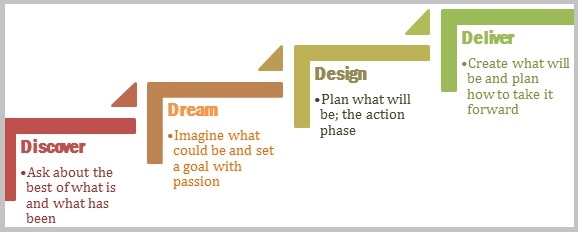
    Usually, there are four stages of AI. The first stage is ‘discovery’, where one evaluates the positives in an individual or a situation.

    Following the identification of all positive attributes, one moves to the ‘dream’ stage. Here, based on the inputs from the discovery stage, one thinks about what can be built further on this — what can one have as a dream. The objective is to discover the strength and then set a goal for the person or the team, which can be pursued with a passion.

    Next comes the ‘design’ stage, which chalks out a game plan to make the dream a reality. It answers questions, such as ‘What is the plan?’; ‘What should be the timeline?’, ‘Who should be responsible?’ and finally ‘What can happen?’ This is the phase of action and the next step to delivery.

    The ‘delivery’ phase, which is the fourth stage, deals with ‘how the entire idea can be taken forward’ and ‘which team members can be the stakeholders of this change, going forward’.

    This simple 4D model helps a team gain from a constructive discussion. For instance, if four people in a team are sitting together to dig into the quantitative data to come to a business proposition, chances are that each one will come up with a different interpretation of the data.

    Instead, if AI is used as a tool, it will allow each member to talk about his or her own experiences and emotions associated with it. As a result, it is likely that they will take less time to come to a consensus. However, there has to be someone to facilitate this process or train the leader on how to use this tool effectively. The tool brings in a whole lot of human elements.

    AI is a multipurpose tool, which can be used in various implementation processes within an organisation, one of them being the employee engagement cycle. It is also useful as an organisation development tool as it is based on how to frame some questions in order to look at the strengths in a given situation.

    Suman Nair

    Suman Nair, managing director, Atiitya Training and HR Consultants, tells HR Katha, “It can also be used for hiring, but managers have to be trained to use it effectively for hiring candidates.”

    AI as a model for analysis and problem solving was first proposed in an article by David Cooperrider and Suresh Srivastava, of Case Western Reserve University, in 1987. They argued that the problem solving approach did not foster analysis and understanding, focussing instead on problems while limiting discussions. They proposed a constructionist approach based on conversation instead, and called the new method appreciative inquiry.

    Since then, AI has gained ground around the world. British Airways, Verizon and NASA have already made it a part of their organizational culture. In India, while many NGOs have adopted it, its uptake in business circles as a management tool has been rather slow.

    However, there are quite a few practitioners, who promote this tool voluntarily through a group called TAPIN (The Appreciative Inquirer’s Network). The group engages frequently on social media. Besides, the positive aspect is that there has been an increasing curiosity around this tool, especially when companies are getting oriented towards and realising the need to engage the employees beyond hikes and promotions.


    Appreciative Inquiry Atiiya Training and HR Consultants British Airways David Cooperrider HR Tool NASA Suresh Srivastava Tapin The Appreciative Inquirer's Network Verizon
    Share. LinkedIn Twitter Facebook
    mm
    Prajjal Saha | HRKatha

    Dr. Prajjal Saha, editor and publisher of HRKatha since 2015, leverages over 25 years of experience in business journalism, writing, and editing. He founded HRKatha to provide insightful analysis on the evolving workplace. With expertise spanning HR, marketing, distribution, and technology, Saha has a deep understanding of business dynamics. His authorship of the acclaimed Marketing White Book highlights his versatility beyond HR. A trusted voice across industries, his clear and thoughtful commentary has earned him a reputation for thought leadership, making him a reliable source of knowledge and insights for professionals navigating the complexities of the business world.

    2 Comments

    1. Sanjay Tikoo on May 19, 2015 9:55 am

      I am looking for a training program on Appreciative inquiry in Mumbai.Kindly help.

      Reply
    2. SAMIR on December 16, 2015 1:07 pm

      Kindly send us the training program on Appreciative inquiry

      Reply
    Leave A Reply Cancel Reply

    Related Posts

    Union Budget 2026-27: 15 key takeaways for HR, workplaces & employees

    February 6, 2026

    The meeting that should have been an email (and vice versa)

    February 6, 2026

    herSTORY: Babita Basak, HR leader

    February 5, 2026

    Case-in-Point: Personal expression vs professional loyalty

    February 5, 2026
    Editorial

    Why “Remove HR” goes viral every few years, and why it never happens

    Last week, workforce strategist Amanda Goodall reignited the cycle by calling to “remove 90 per…

    What Davos revealed about work: Five uncomfortable truths

    Harvard economist Gita Gopinath delivered Davos’s most uncomfortable statistic: since the 1980s, only 30 per…

    EDITOR'S PICKS

    Union Budget 2026-27: 15 key takeaways for HR, workplaces & employees

    February 6, 2026

    The meeting that should have been an email (and vice versa)

    February 6, 2026

    herSTORY: Babita Basak, HR leader

    February 5, 2026

    Case-in-Point: Personal expression vs professional loyalty

    February 5, 2026
    Latest Post

    Karnataka HC allows salary payments for Winzo staff

    IR & Labour Laws February 6, 2026

    The Karnataka High Court has given relief to employees of online gaming platform Winzo by…

    The Sleep Company gets Udhaya Shankar M as CHRO

    Movement February 6, 2026

    The Sleep Company, the mattress brand, has roped in Udhaya Shankar M as its new…

    Union Budget 2026-27: 15 key takeaways for HR, workplaces & employees

    Exclusive Features February 6, 2026

    On 1 February , 2026, Finance Minister Nirmala Sitharaman presented the Yuva Shakti Budget—Rs 32,666…

    The meeting that should have been an email (and vice versa)

    Friday Features February 6, 2026

    If aliens ever study corporate life, they’ll be baffled by one thing above all: our…

    Asia's No.1 HR Platform

    Facebook X (Twitter) Instagram LinkedIn WhatsApp Bluesky
    • Our Story
    • Partner with us
    • Career
    • Reach Us
    • Exclusive Features
    • Cover Story
    • Editorial
    • Dive into the Future of Work: Download HRForecast 2024 Now!
    © 2026 HRKatha.com
    • Disclaimer
    • Refunds & Cancellation Policy
    • Terms of Service

    Type above and press Enter to search. Press Esc to cancel.