
Close Menu
    Facebook X (Twitter) Instagram
    • Our Story
    • Partner with us
    • Reach Us
    • Career
    Subscribe Newsletter
    HR KathaHR Katha
    • Exclusive
      • Exclusive Features
      • Perspectives
      • Friday Features
      • herSTORY
      • Rising Stars
      • Case-In-Point
      • Point Of View
      • Research
      • HR Pops
      • Dialogue
      • Movement
      • Profile
      • Beyond Work
      • By Invitation
    • News
      • Global HR News
      • Compensation & Benefits
      • Diversity
      • Events
      • Gen Y
      • Hiring & Firing
      • HR & Labour Laws
      • Learning & Development
      • Merger & Acquisition
      • Performance Management & Productivity
      • Talent Management
      • Tools & Technology
      • Work-Life Balance
    • Special
      • HR Forecast 2026
      • Cover Story
      • Editorial
      • HR Forecast 2024
      • HR Forecast 2023
      • HR Forecast 2022
      • HR Forecast 2021
      • HR Forecast 2020
      • HR Forecast 2019
      • New Age Learning
      • Coaching and Training
      • Learn-Engage-Transform
    • Magazine
    • Reports
      • Whitepaper
        • HR Forecast 2024 e-mag
        • Future-proofing Manufacturing Through Digital Transformation
        • Employee Healthcare & Wellness Benefits: A Guide for Indian MSMEs
        • Build a Future Ready Organisation For The Road Ahead
        • Employee Experience Strategy
        • HRKatha 2019 Forecast
        • Decoding and Driving Employee Engagement
        • One Platform, Infinite Possibilities
      • Survey Reports
        • Happiness at Work
        • Upskilling for Jobs of the Future
        • The Labour Code 2020
    • Conferences
      • Leadership Summit 2025
      • Rising Star Leadership Awards
      • HRKatha Futurecast
      • Automation.NXT
      • The Great HR Debate
    WhatsApp LinkedIn X (Twitter) Facebook Instagram
    HR KathaHR Katha
    Home»Special»HR Forecast 2020»“Future compensation will be linked to skills not levels” Ramesh Shankar Swaminathan
    HR Forecast 2020

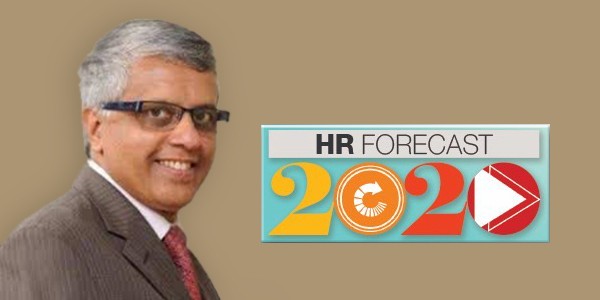
    “Future compensation will be linked to skills not levels” Ramesh Shankar Swaminathan

    HRK News BureauBy HRK News BureauMarch 9, 2020Updated:March 9, 20204 Mins Read69960 Views
    Share LinkedIn Twitter Facebook WhatsApp
    Share
    LinkedIn Twitter Facebook WhatsApp


    Technology, data, employee experience: What’s high on agenda

    Technology, as it will continue to disrupt industries across domains. However, digitalisation may make life simpler. Every sector of the economy is getting impacted by digitalisation. This means, the HR fraternity has to anticipate the technologies impacting their industry and strategise how to cope with it.

    The other agenda for companies will be skill development. On one hand, employees will experience disruption in their careers and their lives, and they should be ready to adapt to change faster than they can imagine. On the other hand, skills required for the future may not exist in organisations today nor be available in the market. Therefore, the competitive advantage will lie in the ability of organisations to proactively evolve technologies and skills that will keep them ahead of their competitors.

    Balancing humanity and technology

    It is critical for CHROs to be the bridge between employees and the organisation, as digital disruption will challenge employees’ careers and earning potential. They need to handle this sensitively so as to create win-win situations for employees. While organisations themselves will find it difficult to survive in a disruptive world, employees will find it more stressful to manage their careers and lives. The challenge will be to survive and grow in a changing workplace.

    The stress and strain on careers will have a social impact in society, and this will, in turn, have an impact on organisations in managing talent sensitively. Attraction and retention will be a challenge as organisations will continue to look for flexible manpower costs to manage the dynamics of the marketplace. Social institutions, such as family and marriages may get strained and organisations will need to understand the effect it may have on the employee.

    Ladder-shaped to pulse-shaped compensation mechanism
    Yes, organisations will benefit from compensations linked to business cycles, as they will challenge even the basic survival of companies. Conventional compensation and traditional hierarchies may be a thing of the past, and companies will have to link their compensation design to business models and business cycles.

    Companies will also need to link employee value addition to their compensations. A fixed compensation, linked to cost of living for everyone, and rest of the compensation linked to business performance, business cycles and employee value addition to customers, will be the order of the day. Thus, what will emerge is that employees will draw compensation linked to value addition and skills possessed, rather than their level in the organisation. This will be a challenge for HR managers in the future.

    Individualism may impact team work and this has to be taken care of, with appropriate reward systems. The social impact of differential compensation will also be visible for organisations to manage.

    Internal equality and internal equity

    Internal equity will be the norm as digitalisation ensures transparency of data, and hence, managements cannot hide behind smoke screens. This, coupled with corporate governance and reporting, will make it more mandatory than an option for organisations. Socialism was the norm in the past. That means, people with similar levels and designations earned almost the same compensation. But this may be challenged in the future.

    Differential compensation will create inequalities within the organisation. So, internal equity has to be linked to value addition rather than designations or organisation levels. The gap between CEO salaries and employees at the lowest level will also be monitored through corporate governance norms. Today, salaries are sometimes disproportionate across levels in the organisation. This may soon become a thing of the past, as transparency to shareholders will ensure that organisations manage compensation across levels, based on equity, fairness and value addition only, and not by other norms.

    (This article was published first in HRKatha print magazine)

    Share. LinkedIn Twitter Facebook WhatsApp
    HRK News Bureau

    Leave A Reply Cancel Reply

    Related Posts

    AI-native workers are forcing managers to earn their relevance

    September 7, 2026

    Employees are redesigning work before their companies do

    August 31, 2026

    “My door is always open” is an expensive sentence in leadership

    August 24, 2026

    Promotion decisions in most organisations are announcements dressed up as processes

    August 16, 2026
    zoha
    Editorial

    AI-native workers are forcing managers to earn their relevance

    They did not arrive announcing themselves. They joined as analysts, engineers, content writers, recruiters and…

    Employees are redesigning work before their companies do

    Nobody announced that work would change this way. There was no strategy document, pilot programme…

    EDITOR'S PICKS

    POV: Should organisations hire for culture fit or culture add?

    September 7, 2026

    AI-native workers are forcing managers to earn their relevance

    September 7, 2026

    The career lessons hiding in unfamiliar territory

    September 4, 2026

    Case-in-Point: The pregnancy disclosure dilemma

    September 3, 2026
    Latest Post

    Hi-Tech Radiators appoints Gaurav Vani as group CFO

    Movement September 7, 2026

    Hi-Tech Radiators, the global manufacturer of transformer radiators and tanks, has appointed Gaurav Vani as…

    Kanika Sharma returns to BCG as India HR manager

    Movement September 7, 2026

    After nearly five years at Bain & Company, Kanika Sharma has returned to Boston Consulting…

    Delnaz Desai joins Mahindra Group as VP– group talent head

    Movement September 7, 2026

    Delnaz Desai has joined Mahindra Group as vice president – group talent head, taking charge…

    Telangana to strengthen Employees’ Health Scheme with 354 empanelled private hospitals

    News September 7, 2026

    Telangana is set to strengthen the implementation of its Employees’ Health Scheme (EHS), with 354…

    Asia's No.1 HR Platform

    Facebook X (Twitter) Instagram LinkedIn WhatsApp Bluesky
    • Our Story
    • Partner with us
    • Career
    • Reach Us
    • Exclusive Features
    • Cover Story
    • Editorial
    • Dive into the Future of Work: Download HRForecast 2024 Now!
    © 2026 HRKatha.com
    • Disclaimer
    • Refunds & Cancellation Policy
    • Terms of Service

    Type above and press Enter to search. Press Esc to cancel.