



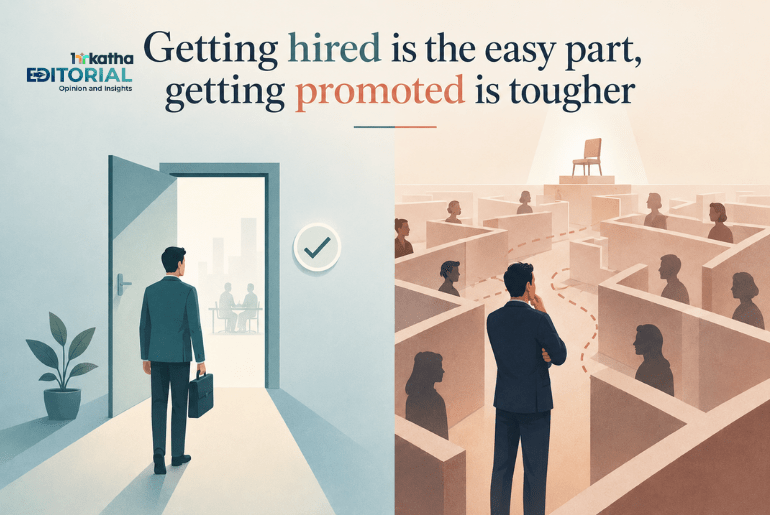
Organisations have spent decades making hiring more structured, more consistent and more defensible. The promotion decision has received no comparable attention.
A candidate being hired knows they are being assessed. They broadly understand what they are being evaluated on and have a formal opportunity to make their case. An employee being considered for promotion has none of these things reliably. The criteria are vague, the process is inconsistent, the decision is made by people who have formed opinions over years, and the outcome is typically announced rather than explained.
The harder interview was never the one that determined whether someone joined an organisation. It is the one that determines whether they move up. And in most organisations, nobody is told it is happening.
When promotion interviews actually happen
Before examining how promotion interviews work, it is worth asking how often they happen at all. The answer is less often than most employees assume.
In many Indian organisations, promotion is an announcement. Management decides, HR processes the paperwork and the employee is informed. There is no interview and no formal opportunity for the candidate to make their case. The decision was made in a room the employee was never invited into, based partly on evidence the employee may not have known was being gathered.
When something resembling a promotion interview does occur, it is usually because there are multiple internal contenders for a single role, a formal internal job-posting system requires one, or a skip-level conversation is needed before the decision is confirmed. Some larger organisations and MNCs have structured internal application processes where employees can formally put themselves forward for open roles. In smaller organisations, this feels unnecessary because senior leaders believe they know everyone. In both cases, the interview that does happen is often less about discovering something unknown and more about testing a judgement the organisation has already begun to form.
That distinction matters. A hiring interview begins with genuine uncertainty about the candidate. A promotion interview begins with accumulated certainty, some of it justified and some of it not.
The announcement model and what it reveals
The fact that promotions are so often announced rather than applied for reveals something about how organisations think about their people.
The model rests on a belief, sometimes explicit but often not, that management knows its people well enough to identify who deserves to move up. Promotion is something the organisation bestows rather than something an employee earns through a visible and legible process.
The weakness appears when someone is passed over. There is rarely a formal record explaining why one person was chosen over another. The feedback is too generic to be useful. The unsuccessful employee remains in the same organisation, reporting to the same manager, working alongside the colleague who was elevated, without ever fully understanding what made the difference. Giving genuinely honest feedback in that situation requires explaining things that are either political or difficult to articulate within the language of performance management. So the feedback stays vague. The employee stays confused.
The announcement model protects the organisation’s discretion. It does considerably less for the employee’s development.
The bias that enters before the interview begins
A promotion interview carries a structural problem that a hiring interview does not: the interviewer already knows the candidate.
An external candidate arrives with a CV and a few preliminary impressions. They have genuine freedom to shape how the panel sees them. The internal candidate arrives carrying years of organisational history. The interviewer has watched them work, heard other people’s opinions and formed judgements that may be difficult to revise. The conversation does not introduce the candidate. It confirms or disrupts a perception that already exists.
Confirmation bias works in both directions. If the interviewer already believes someone is ready, ambiguous evidence will be interpreted favourably. If doubts have accumulated, an excellent conversation may not erase them. The halo effect means strong performers receive the benefit of the doubt on ambiguous evidence while others are held to a higher standard of proof.
Relationship bias is perhaps the most uncomfortable to acknowledge. People find it easier to advocate for colleagues they like and trust. Familiarity, sponsorship and access therefore enter the decision even when none appears in the formal promotion criteria. None of this necessarily makes the eventual decision wrong. It does make the idea of a level playing field considerably harder to sustain.
The real criteria nobody states
Most organisations have formal promotion criteria. Performance, potential and competencies appear in frameworks, talent reviews and development conversations. They are not irrelevant. They are simply an incomplete description of what increasingly determines who moves up.
As careers progress, four other considerations become more important, and they are rarely stated explicitly.
Influence is the first. Not authority, which is conferred by the organisation, but influence built through relationships, credibility and the quality of thinking demonstrated over time. At higher levels, an organisation is not promoting someone to do more of what they currently do. It is giving them responsibility for shaping what others do. Evidence that they can already influence beyond the boundaries of their current role matters more than most employees realise.
Trust is the second. The promotion decision tests whether the organisation can entrust someone with greater authority, more resources, more visibility and access to sensitive decisions. That trust is built through the accumulated record of how someone behaved when situations became difficult, ambiguous or politically complicated. It cannot be manufactured in the weeks before a promotion decision.
Reputation is the third. In a promotion process, reputation is the sum of what every person who has worked with, above and below the candidate thinks about them. It has been forming since their first day. It includes perceptions formed in meetings where the candidate was not at their best and conclusions drawn from situations they may barely remember. Reputation cannot be revised in the run-up to a promotion decision. It can only be built, over time, through consistent behaviour.
Judgement is the fourth. Senior roles contain fewer problems with obvious answers. The question shifts from whether someone can execute well to whether they make sensible decisions when the information is incomplete and the consequences are larger. Judgement is demonstrated through actual decisions made under uncertainty, not through hypothetical answers given in structured interviews.
Sponsorship belongs in this conversation too. Having someone willing to make the case in the room where the decision is actually made becomes increasingly important as people move upwards. Organisations are often uncomfortable acknowledging this because it sounds political. Pretending it does not exist does not make promotion more meritocratic. It simply makes one of its real mechanisms invisible.
What the interview should actually evaluate
If the promotion interview is to serve a genuine purpose rather than provide procedural cover for a decision already forming, it needs to surface something the organisation does not already know.
The immediate manager already knows the candidate’s technical competence, output and working style. An interview that reviews these things is not adding information. It is confirming what the organisation has already gathered.
What the promotion interview should evaluate is evidence of next-level thinking that may not be visible in day-to-day performance. Has the candidate begun framing challenges in terms of organisational implications beyond their immediate team? Have they influenced outcomes they did not formally control? How do they respond when their judgement proves wrong? At senior levels, the ability to recognise a mistake and change course can matter more than the ability to appear certain about everything.
On the question of who should conduct the interview, the immediate manager has the richest evidence but the greatest potential bias. A neutral panel brings distance but may end up assessing interview performance rather than years of actual contribution. A skip-level leader sits most usefully between the two. The most rigorous processes combine all three: structured evidence from the immediate manager, a skip-level conversation focused on next-level readiness, and where possible, peer perspectives that capture influence and reputation more broadly.
How the game changes by level
At junior to mid-level, the criteria are most legible. Performance against targets, demonstrated competence and basic readiness for additional responsibility carry considerable weight. The bias problem exists but the evidence is usually more visible.
The shift from mid to senior level changes the equation significantly. Technical competence becomes assumed rather than assessed. Judgement, influence, organisational presence and the ability to navigate ambiguity begin to matter more. Many strong mid-level professionals struggle at this transition not because they lack capability but because they continue demonstrating mastery of their current role when the organisation has begun looking for evidence they can operate at the next one. They are answering a question that is no longer being asked.
At CXO level, the formal interview matters least of all. The decision is built through years of business outcomes, accumulated perception, board relationships and advocacy at the highest levels. By the time any formal conversation takes place, the conclusion is usually well advanced. The interview at this level is rarely a genuine assessment. It is a final confirmation of something already decided.
The internal candidate’s peculiar disadvantage
When an internal candidate competes with an external one for a senior role, the dynamics shift in ways most organisations do not acknowledge openly.
The internal candidate should have the advantage. The organisation knows what they have delivered, how they behave under pressure and whether they can be trusted. Yet familiarity carries its own penalty. The organisation has also watched every weakness develop in real time. The candidate’s growth can become almost invisible precisely because it happened gradually in front of everyone.
The outsider arrives differently. Their strengths are assembled in a CV and supported by references. Their limitations remain undiscovered. Novelty can therefore inflate the unknown candidate while familiarity discounts the known one.
Organisations that pass over strong internal candidates in favour of external hires often pay twice: once when the internal candidate disengages or leaves, and again when the external hire spends months becoming effective. Both costs are real. Neither is always visible at the point of decision.
How employees should prepare
The most important thing to understand about preparing for a promotion is that the preparation is not the interview.
The evidence was produced over the preceding months and years. If influence has not been built, trust not earned, reputation not developed and judgement not demonstrated through actual work, interview technique will not compensate. The preparation for a promotion interview begins the day someone joins an organisation, not the week before the conversation.
Understanding the real criteria matters more than polishing answers to competency questions. What does the next level genuinely require in this specific organisation? Who currently holds those roles and what do they have in common? What does the organisation consistently reward when it promotes?
Knowing who will advocate matters enormously. The candidate who enters a promotion decision without a sponsor is at a significant disadvantage regardless of their interview performance. Understanding who that person is, and whether they genuinely believe in the candidate’s readiness, is among the most important things a candidate can know before any formal process begins.
Finally, the perception gap matters. There is almost always a difference between how employees see themselves and how the organisation sees them. The promotion interview will not close that gap. Knowing what the gap is before walking in, through honest conversations with people willing to tell the truth, is more valuable than any amount of interview preparation.
What this means for HR
Promotion receives a fraction of the design attention organisations give to hiring, and the gap shows.
Hiring has job descriptions, competency frameworks, structured interviews and formal feedback mechanisms. Promotion frequently operates with vaguer criteria, inconsistent processes and decisions that are difficult to explain to unsuccessful candidates without resorting to feedback so generic it becomes useless.
HR’s task is not to remove judgement from promotion. Senior roles require precisely the qualities that resist reduction to a score. Nor should organisations pretend that influence, reputation and sponsorship do not matter simply because they sit awkwardly inside the language of meritocracy.
The task is to make the judgement more legible. If influence matters, say so. If next-level readiness matters more than excellence in the current role, define what that looks like. If reputation across stakeholders shapes the decision, employees should discover that during development conversations rather than after being passed over.
Greater transparency creates greater accountability, which is precisely why organisations often resist it. Once criteria are explicit, departures from them become harder to justify. The opacity of promotion systems is not always an accidental design flaw. It can also be what preserves managerial discretion.
The interview that has been happening for years
The promotion interview, where it exists at all, is rarely the moment when the decision is made. It is the moment when a decision already in progress is confirmed or, occasionally, disrupted.
Getting hired requires performing well for a few hours in front of people who do not know you. Getting promoted requires having performed well for years in front of people who do.
The real promotion interview happened when a project failed and someone watched how the response was handled. When a senior leader was challenged. When a judgement call was made without enough information. When a colleague needed help and there was nothing in it for anyone. When a name came up in a room where the person being discussed was not present.
By the time the formal conversation arrives, much of the assessment is already over. Organisations call that final conversation a promotion interview. Often, it is merely the moment when years of accumulated judgement are finally revealed to the person being judged.
The harder interview was never the one that determined whether someone joined. It was the one they did not know they were attending.