



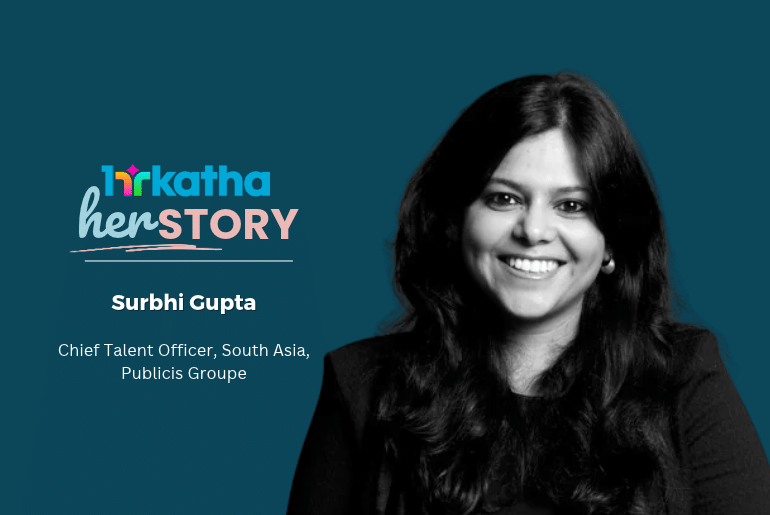
Two transitions, one new beginning
For Surbhi Gupta, chief talent officer, South Asia, Publicis Groupe, HR was a second career. She spent the first part of her professional journey on the business side, building brands for Unilever, P&G and Cadbury, before moving into HR in 2008.
The transition came just after she became a mother. Finding her feet in an unfamiliar function while adjusting to motherhood and keeping pace with a fast-moving industry was demanding. It taught her to adapt quickly, prioritise what mattered and give herself, as well as the people she supported, room to navigate change.
Along the way, Gupta also discovered that greater visibility does not necessarily translate into an equal voice. Representation, allies and sponsors could make a considerable difference to whose perspectives were heard.
Rather than waiting for permission or the perfect role, she took on assignments that stretched her capabilities, gradually moving from agency HR leadership to shaping the people agenda across Publicis Groupe South Asia.
The experience reinforced her belief that professional ambition need not be abandoned simply because life takes an unexpected direction.
“My role is to set a clear direction and the desired output, not to prescribe every step.”
From directing to coaching
Gupta’s years on the business side shaped her understanding of leadership. She learnt early that people decisions cannot be separated from business decisions, and that talent strategy must be closely connected to growth.
“In a creative organisation, you cannot lead entirely through structure or hierarchy. You need to influence, collaborate and leave enough room for individuality,” she observes.
Her own leadership style has evolved from directing to coaching, from feeling the need to have the answers to helping teams find them. In an industry where challenging a brief and experimenting with ideas are integral to the work, she believes people need the freedom to exercise their judgement.
At the same time, leading across 10 agencies with a workforce of over 4,000 people has taught her the importance of clarity and accountability at scale.
“My role is to set a clear direction and the desired output, not to prescribe every step,” she says.
Her definition of success has changed too. When Gupta entered HR, it was about establishing herself in a new profession. Today, it is less about her individual achievements and more about the opportunities she can create and the impact she can enable through others.
“Be resilient, but also know when to reinvent yourself. Pauses, pivots and second acts can still add up to a fulfilling career.”
Flexibility needs a foundation
Gupta does not see structure and flexibility as opposing forces. Clear expectations and fair principles, she believes, give managers the confidence to exercise judgement and employees the freedom to do their best work.
This becomes particularly important when personal circumstances change.
“Our wellbeing ecosystem and initiatives such as Working With Cancer recognise that people need different support at different stages of life,” she says.
Flexibility, in her view, should not depend on who an employee’s manager happens to be. It needs to be supported by equitable policies and systems rather than individual discretion alone.
The challenge is to find an arrangement that works for employees, clients and the business. That requires trust, not a separate policy for every possible situation.
Quick fire round
A campaign you are proud to be a part of?
Jaise bhi daag ho, Surf Excel hai na!
One HR policy you’d pitch like a 30-second commercial?
Work Your World: six weeks, any Publicis office in the world, same role, new view.
Coffee or brainstorming, what fuels your day more?
Brainstorming, with a coffee in hand.
If HR had a tagline in advertising, what would yours be?
The right people. The right environment. Room to thrive.
From uncertainty to agency
At Publicis Groupe, digital capabilities have long been part of the business. Gupta’s focus is on strengthening that foundation as AI changes the nature of creative work and the skills it demands.
“As AI and automation change roles, workflows and the skills our industry values, I see HR’s role as helping people move from uncertainty to agency,” she says.
For employees, that means finding answers to practical questions: how their roles will change, what they need to learn and where they can contribute more.
Gupta believes teams need to participate in redesigning work, with opportunities for continuous learning and experimentation within clear boundaries.
She also sees automation as an opportunity for HR to move beyond its traditional identity as the custodian of policies and processes. As routine transactions become increasingly automated, the function can devote more attention to work that requires judgement, insight and human connection.
“We need to get better at making HR’s impact tangible,” she says.
The measure of success, therefore, is not how many programmes HR runs, but whether people are growing into new roles, talent is being retained and the organisation is better equipped to deliver on its ambitions.
Welcome the detours
“Don’t wait to feel fully ready. Don’t expect a perfectly planned career,” is Gupta’s advice to young women entering the profession.
Her own experience of moving from brand management to HR has convinced her of the value of understanding how a business competes, makes money and creates value. She encourages younger professionals to remain curious, particularly as AI changes the capabilities expected of them.
She also makes a distinction between accumulating professional contacts and building genuine relationships with people who can offer guidance, challenge assumptions and speak candidly.
“Seek mentors, and then become one, creating opportunities for the women who follow,” she suggests.
For Gupta, resilience is not simply about persevering along a chosen path. Sometimes, it is about recognising when that path needs to change.
“Be resilient, but also know when to reinvent yourself. Pauses, pivots and second acts can still add up to a fulfilling career.”
It is advice that carries particular weight coming from someone whose own professional journey took an entirely different direction just as her personal life was changing.