


Close Menu
    Facebook X (Twitter) Instagram
    • Our Story
    • Partner with us
    • Reach Us
    • Career
    Subscribe Newsletter
    HR KathaHR Katha
    • Exclusive
      • Exclusive Features
      • Perspectives
      • Friday Features
      • herSTORY
      • Rising Stars
      • Case-In-Point
      • Point Of View
      • Research
      • HR Pops
      • Dialogue
      • Movement
      • Profile
      • Beyond Work
      • By Invitation
    • Brief News
      • Global HR News
      • Compensation & Benefits
      • Diversity
      • Events
      • Gen Y
      • Hiring & Firing
      • HR & Labour Laws
      • Learning & Development
      • Merger & Acquisition
      • Performance Management & Productivity
      • Talent Management
      • Tools & Technology
      • Work-Life Balance
    • Special
      • Editorial
      • HR Forecast 2026
      • Cover Story
      • HR Forecast 2024
      • HR Forecast 2023
      • HR Forecast 2022
      • HR Forecast 2021
      • HR Forecast 2020
      • HR Forecast 2019
      • New Age Learning
      • Coaching and Training
      • Learn-Engage-Transform
    • Studio
      • The CHRO Playbook
      • Quick HR Insights
      • The Corner Office
    • Reports
      • Whitepaper
        • HR Forecast 2024 e-mag
        • Future-proofing Manufacturing Through Digital Transformation
        • Employee Healthcare & Wellness Benefits: A Guide for Indian MSMEs
        • Build a Future Ready Organisation For The Road Ahead
        • Employee Experience Strategy
        • HRKatha 2019 Forecast
        • Decoding and Driving Employee Engagement
        • One Platform, Infinite Possibilities
      • Survey Reports
        • Happiness at Work
        • Upskilling for Jobs of the Future
        • The Labour Code 2020
    • Forums
      • HRKatha Inner Circle
      • HRKatha Futurecast
      • Leadership Summit 2025
      • Rising Star Leadership Awards
      • HRKatha Futurecast 2025
      • Automation.NXT
      • The Great HR Debate
    WhatsApp LinkedIn X (Twitter) Facebook Instagram
    HR KathaHR Katha
    Home»Exclusive Features»Research»66% of leaders allow AI to write to core systems without approval. Only 33% have fully implemented decision limits
    Research

    66% of leaders allow AI to write to core systems without approval. Only 33% have fully implemented decision limits

    Four in five leaders expect human accountability to remain or increase as AI takes on more decisions. Yet formal controls and employee preparation lag behind.
    mmBy Liji Narayan | HRKathaNovember 18, 2026Updated:November 18, 20264 Mins Read1632 Views
    Share LinkedIn Twitter Facebook WhatsApp
    Research story: based on Kyndryl reports_What happens to human accountability as AI takes more decisions
    Share
    LinkedIn Twitter Facebook WhatsApp

    In two-thirds of the organisations surveyed, AI can update core business records without human approval. If it makes a mistake, who answers for it: the employee expected to validate the result, the manager overseeing the process or the executive who approved the system?

    The survey does not ask. It finds that 66 per cent of leaders say their organisations permit AI to read and write to core systems of record without human approval, while only 33 per cent report fully implemented policies specifying which decisions AI cannot make autonomously. These are separate measures, not proof that the same organisations lack safeguards.

    The figures come from Kyndryl’s 2026 People Readiness Report, a commercially commissioned survey conducted by Edelman Intelligence among 1,100 business and technology leaders in eight countries between 24 March and 30 April 2026. Kyndryl provides enterprise technology and AI consulting services. Half the respondents were C-suite executives; India, Japan and the US contributed 200 each. The results describe leaders’ assessments, not independently verified organisational practices. The published methodology does not explain respondent recruitment or country weighting.

    Authority ahead of confidence

    Eighty-one per cent expect autonomous AI agents to make decisions with material business impact within 12 months. Yet only 25 per cent completely trust AI systems that decide or act without human oversight; for agents interacting with customers without employee supervision, the figure is 24 per cent.

    These answers do not establish that autonomous decisions are unsafe. They do reveal a tension between the authority organisations are granting AI and the confidence leaders express in its unsupervised actions. When a system changes a record or affects a customer, someone must be able to recognise an error and intervene.

    Rules lag behind

    Only 23 per cent of leaders consider their governance and compliance capabilities ready to support AI. Forty-one per cent are completely confident in their organisations’ AI safeguards. Beyond the 33 per cent with fully implemented decision-limit policies, just 27 per cent report a central registry and monitoring system covering all AI systems in their environment.

    A policy defines where automated authority ends; a registry identifies the systems operating; monitoring helps track their actions. None automatically settles who is responsible for a harmful decision. Nor do the survey’s separate questions establish how many organisations allow AI to act without safeguards.

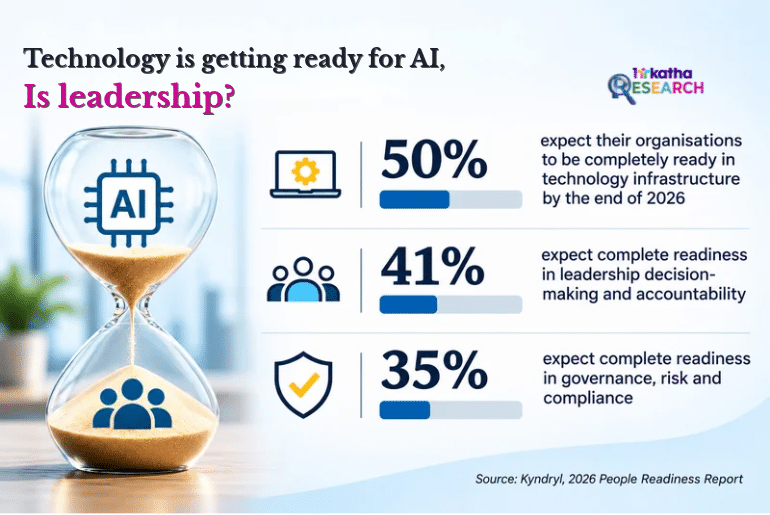
    The readiness expectations point in the same direction. Fifty per cent anticipate complete readiness in technology infrastructure by the end of 2026, compared with 41 per cent for leadership decision-making and accountability structures and 35 per cent for governance, risk and compliance.
    Research - Kyndryl_humans_validating_AI decisions

    Responsibility without preparation

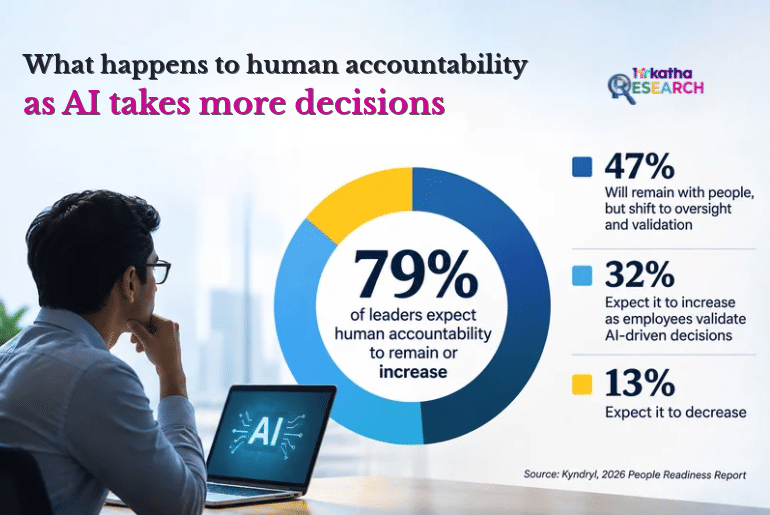
    Forty-seven per cent of leaders expect human accountability to remain but shift from execution towards oversight and validation. Another 32 per cent expect it to increase as employees validate AI-driven decisions; 13 per cent expect it to decrease. Thus 79 per cent foresee accountability remaining with people or growing, even as machines undertake more decisions.

    But oversight is not control. An employee asked to validate a system’s decision needs enough information to judge it, authority to challenge it and a clear route to intervene. The survey does not establish whether those conditions exist.

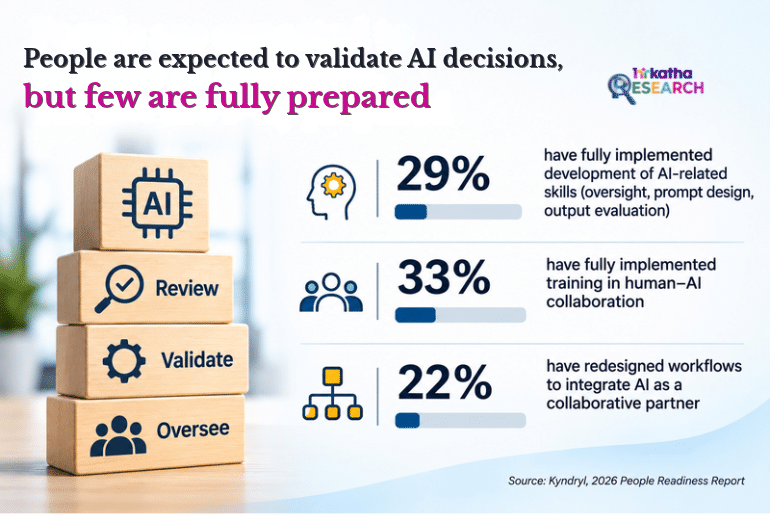
    Preparation is uneven. Only 29 per cent report fully implemented development of AI-related skills, including oversight and output evaluation. Thirty-three per cent have fully implemented training in human-AI collaboration, and 22 per cent have redesigned workflows to make AI a collaborative partner.

    Those below the C-suite report greater obstacles: 55 per cent identify skills or talent gaps as a major challenge, against 43 per cent of executives. On redesigning roles and workflows for human-AI collaboration, the figures are 48 and 42 per cent respectively.
    Research_Kyndryl_tech ready for AI but not leaders?

    Who does the overseeing?

    The division of work is becoming less clear even in accountability-related activities. Asked where organisational value will primarily come from over the next three years, only 41 per cent expect people to remain the primary source in oversight and accountability for outcomes, compared with 51 per cent in complex decision-making. Thirty per cent expect people and AI to contribute equally to oversight and accountability; 28 per cent expect AI to contribute more.

    This measures expectations about value, not who bears legal or managerial responsibility. AI may increasingly perform checks while a person remains answerable for their consequences.

    Four in five leaders expect human accountability to remain or increase. Yet fewer than half expect their leadership decision-making and accountability structures to be completely ready this year. Organisations are expanding AI’s authority faster than they expect to be ready to govern it.

    accountability structures AI Accountability AI accountability gap AI adoption AI agents AI and management AI compliance AI controls AI decision-making AI ethics AI governance AI in the workplace AI leadership AI oversight AI policy AI readiness AI Regulation AI risk management AI safeguards AI skills AI talent gaps AI training AI trust AI workforce readiness AI-enabled workplaces AI-powered decision making autonomous AI autonomous systems Business transformation decision rights digital governance employee accountability Enterprise AI enterprise risk management Future of work future workplace skills. Governance and Compliance HITL HR and AI HRKatha research human accountability Human in the Loop human-AI collaboration Kyndryl People Readiness Report Leadership Accountability organisational readiness oversight and validation responsible AI responsible deployment of AI workflow redesign workforce transformation Workplace Governance
    Share. LinkedIn Twitter Facebook WhatsApp
    mm
    Liji Narayan | HRKatha

    HRKatha prides itself in being a good journalistic product and Liji deserves all the credit for it. Thanks to her, our readers get clean copies to read every morning while our writers are kept on their toes.

    Leave A Reply Cancel Reply

    Related Posts

    Sridhar Sukumaran to play CHRO, Boeing Commercial Airplanes

    November 19, 2026

    herSTORY: Surbhi Gupta, Chief Talent Officer, South Asia, Publicis Groupe

    November 19, 2026

    Layoffs and favouritism? Qualcomm’s job cuts trigger questions over fairness

    November 19, 2026

    Salesforce layoffs reach India as restructuring continues

    November 19, 2026
    zoha
    Editorial

    Companies owe their people more than what is legal

    When Canva announced a restructuring affecting 1,271 employees, or 22 per cent of its workforce,…

    Hard work built India’s global reputation. Availability cannot define its future

    I must have been in school when I first heard the slogan. I was passing…

    EDITOR'S PICKS

    herSTORY: Surbhi Gupta, Chief Talent Officer, South Asia, Publicis Groupe

    November 19, 2026

    Case-in-Point: When a client wants an employee off the account

    November 19, 2026

    66% of leaders allow AI to write to core systems without approval. Only 33% have fully implemented decision limits

    November 18, 2026

    HR Perspectives by Arijit Pal Choudhury: “If succession planning begins when a role becomes vacant, you are already too late”

    November 18, 2026
    Latest Post

    Sridhar Sukumaran to play CHRO, Boeing Commercial Airplanes

    Movement November 19, 2026

    Boeing has picked Sridhar Sukumaran to play chief human resources officer for Boeing Commercial Airplanes.…

    herSTORY: Surbhi Gupta, Chief Talent Officer, South Asia, Publicis Groupe

    herSTORY November 19, 2026

    Two transitions, one new beginning For Surbhi Gupta, chief talent officer, South Asia, Publicis Groupe,…

    Case-in-Point: When a client wants an employee off the account

    Case-In-Point November 19, 2026

    Company: StratEdge Consulting (fictitious), a strategy advisory firm with 900 employees, advising large corporates and…

    Layoffs and favouritism? Qualcomm’s job cuts trigger questions over fairness

    Discrimination November 19, 2026

    Qualcomm’s ongoing workforce-reduction exercise in India has sparked debate over how employees were selected for…

    Asia's No.1 HR Platform

    Facebook X (Twitter) Instagram LinkedIn WhatsApp Bluesky
    • Our Story
    • Partner with us
    • Career
    • Reach Us
    • Exclusive Features
    • Cover Story
    • Editorial
    • Dive into the Future of Work: Download HRForecast 2024 Now!
    © 2026 HRKatha.com
    • Disclaimer
    • Refunds & Cancellation Policy
    • Terms of Service

    Type above and press Enter to search. Press Esc to cancel.