



An organisation can have a successor identified for every critical leadership position and still be unprepared when one of those positions becomes vacant. Names on a succession chart offer reassurance, but they say little about whether the people identified have developed the judgement, confidence and experience to assume greater responsibility.
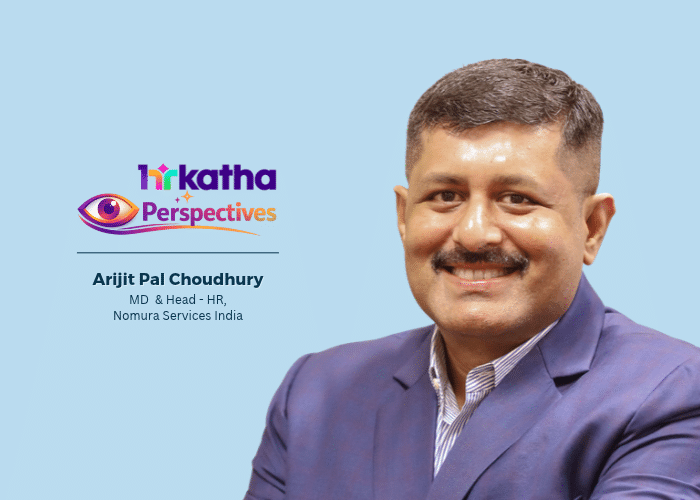
For Arijit Pal Choudhury, managing director and head of human resources at Nomura Services India, this is the distinction between succession planning as an administrative exercise and succession planning as a genuine investment in leadership capability. Readiness must be developed before the opportunity arises, not after a vacancy creates urgency.
Operating at the intersection of global financial services and technology-driven change, Nomura Services India faces the challenge of developing leaders who can navigate uncertainty without losing sight of risk and accountability. In conversation with HRKatha, Choudhury discusses why wisdom is becoming more valuable as information becomes abundant, why innovation requires both psychological safety and discipline, and why the most urgent AI conversation for CHROs concerns the preparedness of people.
Readiness, not replacement
Many organisations have succession charts identifying potential replacements for critical roles. How can they tell whether those names represent genuine bench strength rather than reassurance on paper?
If succession planning begins when a role becomes vacant, you are already too late. Succession plans lose their purpose when they become a backup exercise. Names against critical roles create comfort on paper but not necessarily capability on the ground. Real bench strength is about readiness, not replacement.
We may not control when the next opportunity arises, but we can control how ready our people are when it does. Potential leaders need to be placed in situations that stretch them: exposed to unfamiliar problems, entrusted with responsibilities before the title follows.
A strong succession pipeline takes shape when people begin preparing as next leaders before the organisation formally appoints them.
The most complex part of preparedness is building a driven mindset. Skills can be taught, exposure can be created and doors can be opened. But the hunger to walk through those doors must come from within.
Succession plans are ultimately tested when leadership transition actually happens. If the organisation experiences continuity, the bench strength is real. If there is disruption, all you had were names on a slide.
“Authority may give you the power to make decisions. Leadership gives you the responsibility to own their consequences.”
Information is abundant. Wisdom is scarce
Technology is giving leaders access to more information and faster insights than ever before. What capabilities will distinguish the next generation of leaders when information itself is no longer scarce?
We have more information at our fingertips than ever before. But has that made us wiser? Information is abundant. Wisdom is scarce. That distinction will define the next generation of leaders.
Technology can provide credible insights at a speed and scale that was unimaginable earlier. What it cannot replace is leadership judgement: the wisdom to interpret signal from noise, navigate ambiguity and help others see possibilities where most see uncertainty. That will become an increasingly valuable leadership currency.
Leaders with a global mindset who can navigate multicultural nuances, challenge the status quo and have the courage to disrupt rather than be disrupted are needed.
Equally, they must be able to manage the human anxiety that accompanies disruption. With multiple generations coexisting in the workplace, the ability to influence across generations and bring people along has become as important as any technical capability.
Developing such leaders has to go beyond conventional training. They need greater orientation to evolving technologies, exposure to unfamiliar situations that test their judgement and build their confidence, and deliberate preparation to lead through uncertainty rather than simply around it.
“Are our people ready to grow with AI? Technology will continue to evolve. Our real challenge is to ensure human capability does not get left behind.”
Safety without licence
In financial services, employees must be encouraged to challenge established thinking while remaining accountable for risk. How can psychological safety and the discipline of compliance coexist?
Innovation thrives on confidence, not fear. People challenge convention in a culture where curiosity is encouraged and experimentation is embraced.
At its core, that requires psychological safety, where people feel safe enough to question what exists, bold enough to experiment with what could be better and empowered enough to imagine what comes next.
Psychological safety, however, cannot become a licence to operate without accountability. HR has a defining role in creating that balance: encouraging informed risk-taking while reinforcing the accountability that comes with it.
The responsibility is to ensure that risk does not become a barrier to innovation. Be clear on the non-negotiables and give people enough room to explore new ideas with the confidence that a genuine failure will not be held against them.
The strongest cultures create the confidence to pursue innovation without compromising the discipline that financial services demands.
“The strongest cultures create the confidence to pursue innovation without compromising the discipline that financial services demands.”
The urgent conversation CHROs are not having
Much of the AI discussion focuses on business transformation and productivity. What are CHROs overlooking about the impact of AI on employees and their sense of professional relevance?
There is extensive conversation about what AI will do to business. There is not enough about what it will do to people.
AI will not only change operating models and productivity. It will challenge careers, skills and, more fundamentally, people’s sense of their own relevance.
The awareness phase is behind us. It is time to shift the conversation to human preparedness. CHROs need a people plan for AI, one that answers how technology and human capability will evolve together.
Reskilling alone will not build readiness. People need to be equipped with the mindset to continuously reinvent themselves.
It becomes the leader’s responsibility to turn anxiety into confidence, uncertainty into possibility and disruption into an opportunity for people to discover what else they are capable of.
The urgent question for CHROs is therefore not simply whether the organisation is ready for AI. It is whether people are ready to grow with it.
Technology will continue to evolve. Our real challenge is to ensure human capability does not get left behind.
“Information is abundant. Wisdom is scarce. That distinction will define the next generation of leaders.”
On difficult decisions and boundaryless thinking
As leadership responsibilities grow, decisions become more consequential and rarely offer perfect answers. What principles have guided your most difficult calls, and what has shaped your own growth as a leader?
The hardest decisions rarely come with perfect answers. In those moments, the larger interest of the organisation should come first. But organisations are ultimately built by people, so every difficult decision must also stand the test of fairness and empathy.
What works in one geography, business or context may not work in another. Understanding those nuances, listening to different perspectives, removing biases and building consensus, without losing sight of what is right for the larger organisation, is the discipline that difficult decisions require.
The higher you go, the wider the consequences of your decisions become. Authority may give you the power to make decisions. Leadership gives you the responsibility to own their consequences.
If there is one thing that has consistently shaped my own journey, it is boundaryless thinking.
I have never put limits around my contribution or confined myself to what my role formally required. Every time I stepped beyond the boundaries of my role, it expanded the boundaries of what I thought I could do.
That is how I learnt, reinvented myself and grew.
“Succession plans are tested when leadership transition actually happens. If the organisation experiences continuity, the bench strength is real.”