



Probation has long been a standard feature of employment, giving organisations a window to assess whether a new hire is suitable before confirming their appointment. But hiring itself has become an increasingly elaborate exercise, involving multiple interview rounds, assessments and background checks. If organisations have already invested so much in determining whether someone is right for a role, what exactly is probation meant to establish?
For employers, it offers a measure of protection against hiring mistakes. For employees, it can introduce uncertainty about job security, expectations and whether they truly belong. A standard three- or six-month period also assumes that suitability can be established within a predetermined timeframe, even though different roles have very different learning curves.
The more important question is whether probation should remain a test employees must pass or become a structured transition in which both sides establish whether the relationship is working.
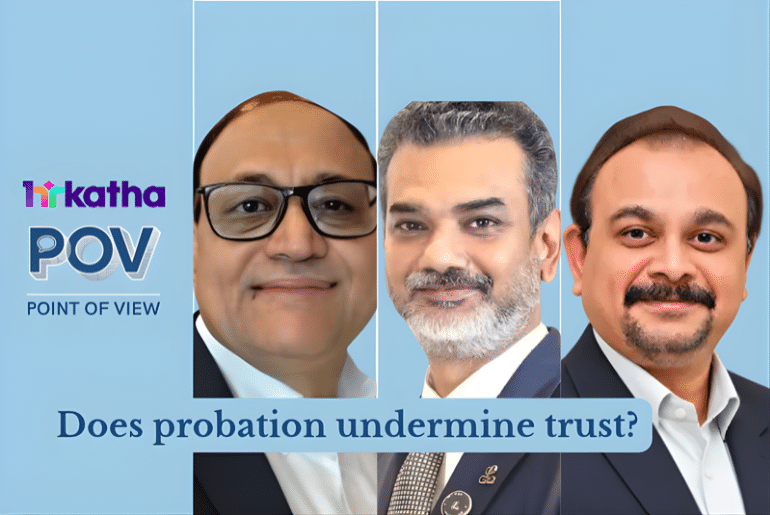
Three HR leaders offer their perspectives.
Gautam Srivastava, group chief human resources officer, Phoenix Mills
It is time to rethink, and perhaps even retire, probation as we know it.
Across industries, roles and levels of complexity, employees face very different learning curves. A standard three- or six-month probation period is therefore an artificial measure of suitability.

Organisations certainly need to manage hiring risk, but the emphasis should shift from whether an employee has “cleared probation” to whether the organisation hired the right talent, defined the role sharply, provided meaningful work, enabled the right learning and support, and established clear measures of success.
The first few months should test the organisation and the manager as much as the employee. Managers must be accountable for the quality of hiring, role clarity, onboarding, coaching and regular feedback. It cannot be the employee alone who is expected to demonstrate suitability when the organisation also has a responsibility to create the conditions for success.
In today’s Indian workplace, even the language of “probation” can feel hierarchical and dated. It would be better replaced by a role-specific integration and assessment period, where progress is measured through demonstrated capability, contribution and mutual fit rather than simply the passage of time.
Takeaway: Probation should not be a test employees alone must pass; organisations and managers must also provide the clarity, support and environment new hires need to succeed.
Udbhav Ganjoo, global head-HR, Viatris
Yes, but as a two-way validation, not a second round of assessment.

Today’s hiring process is comprehensive, involving assessments, multiple interviews and background verification. In such a scenario, probation should not become another assessment exercise in which employees are simply confirmed or let go. It is better viewed as an opportunity to validate whether the judgements made during hiring hold true in a real work environment, and whether the employee is a good cultural fit for the organisation and team.
Importantly, that evaluation should work both ways. Just as employers assess performance and cultural fit, employees should have the opportunity to assess leadership, workplace culture, growth opportunities and role expectations. They, too, are deciding whether the organisation is the right place for them.
Structured onboarding matters more than probation itself. Clear goals, regular feedback and manager check-ins create greater value for employees. Transparency is critical. Employees should understand the success measures, evaluation criteria and timelines so that the transition creates less anxiety and greater trust.
While the traditional six-month period may work for some roles, its duration should reflect role complexity, skill requirements and business needs. A uniform approach may not be appropriate across different functions and levels.
Successful organisations treat probation as a structured transition that builds productivity and long-term commitment to the organisation’s mission and culture. It should help employees integrate rather than leave them wondering whether they will be retained.
Takeaway: Probation should be a two-way validation, not an extension of hiring; transparent expectations, structured onboarding and regular feedback make it meaningful for both sides.
Aniruddha Khekale, group chief human resources officer, Varee Group
Rename it. An immersion period shifts the mindset from assessment to assimilation.
Calling it an “immersion period” rather than a probation period is a small change that can shift the mindset from assessment to assimilation.

An immersion period helps new talent understand an organisation’s cultural nuances, work practices, principles and processes, enabling them to perform better in their new environment. The emphasis is on helping employees understand how the organisation functions and what is expected of them, rather than making them feel they are constantly being evaluated.
Instead of creating uncertainty, it creates a shared understanding, for both the employee and the organisation, of how to take the responsibility forward.
When done well, this is one of the most useful and least-used tools in the employee lifecycle. Organisations often devote considerable attention to hiring the right talent without giving equal importance to what happens after someone joins. Yet the initial period can significantly influence how effectively an employee integrates into the organisation.
Organisations that make this process transparent, structured and two-way can manage hiring risk more effectively while giving new employees a reason to stay. The objective should be to build familiarity, confidence and alignment rather than simply determine whether someone deserves confirmation.
Takeaway: Reframing probation as immersion shifts the emphasis from judging new hires to helping them assimilate, which strengthens integration and retention.