



Company: UrbanCare Hospitals (fictitious), a multi-speciality healthcare chain with 4,800 employees across twelve hospitals in six cities, offering tertiary care in cardiology, oncology, neurology and critical care.
Background
Dr Meera Iyer has been a senior cardiologist at UrbanCare Hospitals for nine years. One of the department’s most experienced clinicians, she handles complex cases and plays an important role in training junior doctors.
For the past eight months, the cardiology department has been operating with two unfilled positions. Patient volumes have remained high, leaving the remaining specialists to absorb additional shifts, consultations and clinical responsibilities. The hospital has managed to maintain services, but the pressure on its doctors has steadily increased.
Three weeks ago, Dr Meera approached the HR head with a formal request to reduce her shifts and patient load. She submitted documentation from her psychiatrist confirming severe burnout symptoms and an anxiety disorder. Her treating doctor had recommended a temporary reduction in clinical hours as part of her treatment.
The medical recommendation was clear. The operational solution was not.
UrbanCare was already running close to capacity. Reducing Dr Meera’s clinical responsibilities would require other cardiologists to absorb some of her patients and shifts. These were colleagues who had already been compensating for the department’s vacancies for months.
The alternative was equally troubling. Continuing to assign Dr Meera her existing workload, despite medical advice recommending a reduction, could aggravate her condition. In a speciality where clinical judgement, concentration and timely decisions are critical, that carried implications beyond employee wellbeing.
The clinical leadership was concerned about patient waiting times, continuity of care and the additional pressure any redistribution would place on the remaining specialists. Hiring temporary specialist cover was possible, but finding appropriately qualified cardiologists at short notice would be difficult and expensive.
The CHRO now had to decide how much accommodation the hospital could realistically provide without creating another problem elsewhere.
The dilemma
Should HR approve Dr Meera’s request for reduced shifts and a lighter patient load, recognising the medical recommendation and the potential consequences of requiring her to continue working at full capacity?
Or should the hospital limit the adjustment, arguing that patient safety, specialist availability and the workload of other clinicians make the requested reduction difficult to accommodate immediately?
And if neither response adequately addresses the problem, should the CHRO propose a phased, time-bound arrangement, supported by clinical leadership, while escalating the department’s staffing shortage as an urgent operational concern?
What’s really at stake
This is a question about what happens when an organisation’s duty of care extends to several groups whose needs cannot easily be reconciled.
Hospitals are built around the responsibility to care for people experiencing illness and vulnerability. That responsibility does not disappear when the person seeking support is an employee rather than a patient. Dr Meera has approached the organisation with a documented medical condition and a recommendation from her treating doctor. Her request deserves serious consideration.
But the hospital’s responsibility does not end with her.
The patients awaiting treatment also depend on UrbanCare’s ability to maintain safe and timely clinical services. So do the other cardiologists, who have already spent months managing additional responsibilities. An accommodation that simply transfers Dr Meera’s workload to equally exhausted colleagues may solve one immediate problem while increasing the risk of another.
This makes the decision more complicated than a choice between compassion and operational efficiency.
There is also a clinical question that HR cannot resolve independently. Dr Meera’s treating doctor has recommended reduced hours, but the hospital must work with appropriate clinical leadership to determine which responsibilities can safely be modified, how continuity of care will be maintained and what temporary cover may be required. Any assessment should respect the confidentiality of her medical information.
The department’s staffing situation adds another dimension. Two specialist positions have remained vacant for eight months, while patient demand has continued. These conditions may have contributed to Dr Meera’s difficulties, although the precise causes of her condition cannot be established from the staffing situation alone.
What is clear is that the department has been operating under sustained pressure.
If the CHRO treats the matter solely as an individual accommodation request, the hospital may miss a wider operational risk. Other clinicians could be approaching similar limits without having raised concerns. Equally, a decision to reduce Dr Meera’s workload without addressing staffing capacity could intensify those pressures.
The legal position also requires careful consideration. Depending on the nature and impact of her condition, the applicable disability and employment framework may impose relevant obligations. A documented diagnosis does not, by itself, establish the precise accommodation legally required, but neither can the hospital assume that operational difficulty automatically justifies refusing the request.
There are costs on both sides. Temporary specialist cover may be expensive and difficult to arrange. Yet prolonged absence, the possible loss of an experienced cardiologist and disruption to patient care could prove more costly.
The CHRO must therefore help leadership assess not simply whether the hospital can afford to accommodate Dr Meera, but whether its existing staffing arrangements are sustainable.
The deeper question is whether a hospital can protect the wellbeing of one clinician without compromising the wellbeing of those expected to take on her responsibilities.
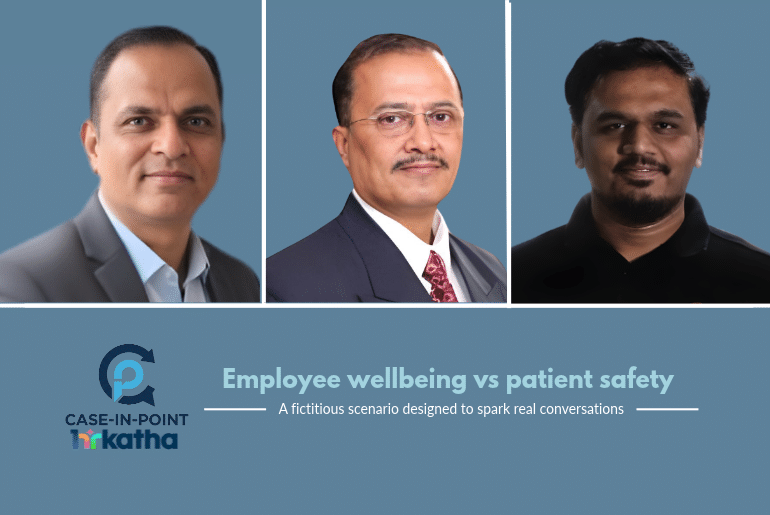
We asked three HR leaders how they would approach this dilemma.
What HR leaders said
Rishi Mohan, CHRO, Iskon Balaji Foods
“The first step is to understand whether Dr Meera’s situation is a consequence of a temporary workload surge or a more deep-rooted staffing challenge. The distinction matters because the response in each case would be different.
If the pressure is due to a sudden spike in patient demand, temporary support from colleagues can help absorb it until things stabilise. However, in a hospital setting, that support must come from appropriately qualified professionals. A cardiologist’s clinical responsibilities cannot be redistributed to doctors from unrelated specialisations.
The situation becomes more complicated when the workload results from prolonged understaffing. If a department requires ten people to function effectively but has only seven, with positions unfilled for months, the existing team will inevitably be stretched beyond reasonable limits. Employees may manage this for a short period, but expecting them to sustain it indefinitely is unrealistic. Over time, dissatisfaction builds and experienced clinicians begin to leave, which only increases the pressure on those who remain.
It is also worth examining whether Dr Meera’s responsibilities can be partially restructured. Certain administrative activities, documentation and supporting processes could potentially be handled by trained support staff, allowing her to focus on the clinical work that requires her expertise and judgement. Patient consultations and procedures that require a qualified cardiologist cannot be delegated, but reducing the administrative burden may provide some immediate relief.
The organisation must distinguish between a temporary spike and a structural staffing problem. Temporary support can address the former. Sustained understaffing requires a more permanent intervention. Otherwise, the organisation risks losing an experienced doctor altogether.”
Shailesh Banaeet, CHRO, Softdel
“I would approach Dr Meera’s request with empathy and a clear commitment to finding a workable arrangement. An experienced clinician seeking support, backed by medical advice, deserves a timely and considered response. At the same time, the hospital has a responsibility to maintain safe and dependable care for its patients. Both responsibilities must shape the decision.
My preference would be to explore a temporary adjustment in consultation with Dr Meera and the clinical leadership. This could involve reducing her patient load, offering more predictable working hours or modifying her on-call responsibilities, depending on medical advice and clinical requirements. The arrangement should have a defined duration and review dates, while ensuring that her health information remains confidential.
The more difficult leadership question concerns the additional workload. Before redistributing responsibilities, we need to understand what her colleagues can reasonably absorb. Their willingness to help should be respected, not treated as an automatic extension of the staffing plan.
From a business perspective, this requires an honest assessment of costs and capacity. Temporary specialist cover carries a visible financial cost. But prolonged absence, losing an experienced cardiologist and disruptions to patient care carry costs too. HR must make these trade-offs visible and help leadership arrive at a decision that can be adequately resourced and sustained.
A wellbeing policy earns credibility when an employee can ask for help and the organisation makes room to respond. If similar cases keep recurring, that should prompt a closer examination of staffing levels and workloads with the same seriousness given to other business risks. Supporting an employee’s mental health cannot come at the cost of simply transferring the pressure to colleagues.”
Shailesh Singh, senior HR leader
“There is a genuine problem here that needs to be addressed. A senior doctor has come forward with a medical concern, and the first responsibility of HR is to listen and act.
HR must examine the documentation, understand the nature of Dr Meera’s condition and assess what support she requires. But the objective should not be limited to finding a temporary fix. The organisation must also understand what has gone wrong in the system to bring an experienced cardiologist to this point.
Is she facing excessive workloads? Are administrative responsibilities consuming time that should be devoted to clinical work? Are there gaps in staffing or processes that are adding to the pressure? HR needs to investigate these questions rather than treat this as an isolated individual issue.
The immediate requirement is to support the doctor. A caring organisation would temporarily redistribute responsibilities and make the necessary adjustments. I would also recommend reviewing the arrangement every two to three weeks to assess progress and whether further intervention is needed.
But the larger question is whether the operating model is sustainable. If the hospital continues to meet increasing demand by relying on existing employees without adding the required resources, the system will eventually break down. This may appear to be a cost-saving measure in the short term, but it creates much larger problems over time.
There are two distinct responsibilities. The first is to ensure that Dr Meera receives immediate support. The second is to identify and address the root cause so that similar situations do not keep recurring. A caring organisation must go beyond accommodating an individual and examine the system that contributed to the problem.”
If you were the CHRO at UrbanCare Hospitals
Dr Meera has requested reduced clinical hours on medical advice. Her department is already operating with two vacancies, and her colleagues have been carrying additional responsibilities for eight months.
What would you do?
- Approve the requested accommodation, with defined review dates, and arrange temporary specialist cover even if it means additional expenditure and some disruption to patient schedules?
- Offer a more limited adjustment initially, reducing administrative and on-call responsibilities while working with clinical leadership to determine how much of her patient load can safely be reassigned?
- Escalate the matter as an urgent clinical staffing issue, seeking a coordinated decision on temporary accommodation, patient scheduling and specialist recruitment rather than leaving HR to resolve the request in isolation?
Or is the bigger question this:
When a hospital’s capacity is already stretched, whose wellbeing should take priority: the doctor seeking help, the colleagues absorbing her workload or the patients depending on them all?
Share your perspective in the comments or on LinkedIn using #HRKathaCaseInPoint.