



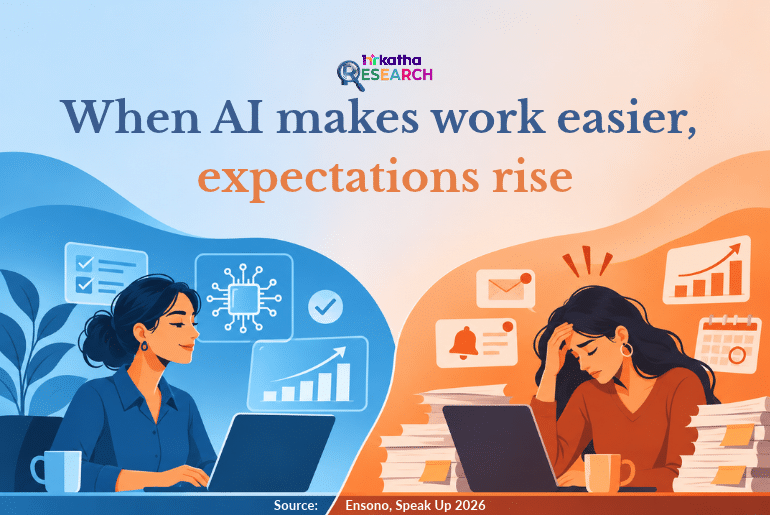
Sixty-two per cent of women in technology say AI has made their workload more manageable. Yet 42 per cent say they are now expected to produce more work in less time because of it. AI has made work easier to manage for many women. For a substantial minority, it has also raised what they are expected to deliver.
The findings come from Ensono’s Speak Up 2026, the company’s sixth annual survey of 1,500 full-time female-identifying technology professionals across the US, UK and India. Respondents could report more than one effect of AI on their workloads, and the published figures do not show how many reported both. The survey covers only women, so it cannot show whether their experience differs from men’s.
Skill is not the constraint
The women surveyed are far from reluctant adopters of AI. Seventy per cent rate their knowledge and skills as advanced or expert, while 97 per cent identify at least one career benefit from using the technology. Nearly half say AI helps them produce higher-quality work (49 per cent), learn new skills more quickly (45 per cent) or take on more strategic responsibilities (47 per cent).
The improvement in confidence has been considerable, although it has not followed a straight line. The proportion rating themselves as AI experts rose from 14 per cent in 2024 to 28 per cent in 2025 before easing to 25 per cent this year. Combining advanced and expert ratings, however, produces a sustained increase from 35 per cent in 2024 to 65 per cent in 2025 and 70 per cent in 2026.
These are self-assessments rather than independently tested skills, and the report does not establish whether the same individuals were surveyed each year.
Even so, AI is becoming a familiar part of professional work, not a technology awaiting adoption.
That familiarity brings another demand. Forty-three per cent identify the need to keep developing new skills to remain competitive as their biggest concern about AI. Learning to use the technology is no longer a one-time adjustment. For many, it has become an additional and continuing requirement of the job.
Efficiency becomes the baseline
The benefits of AI are evident in how respondents describe their workloads. Besides the 62 per cent who say their work has become more manageable, 47 per cent report that their responsibilities have become more strategic. Seventeen per cent say their workload has become more overwhelming, while 8 per cent report no significant effect.
But 42 per cent now face expectations to produce more work in less time. For them, the productivity gain has come with a higher target attached. The survey does not say who sets those expectations. It does raise the question every organisation adopting AI has to answer: what happens to the productivity gains?
Burnout and its stated causes
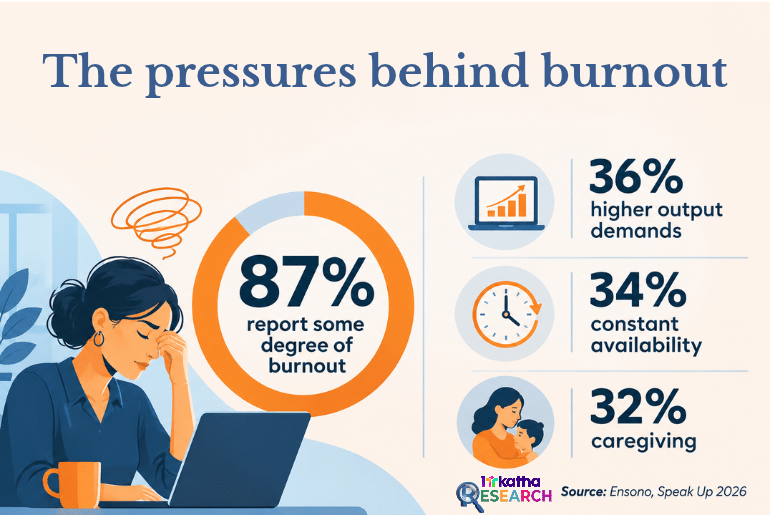
The pressure is visible in the survey’s burnout findings. Eighty-seven per cent report experiencing at least some degree of burnout, with 60 per cent describing themselves as moderately, very or extremely burned out.
The report does not provide a comparable historical burnout figure or a male comparison group. Nor does it establish that AI has caused burnout. It does, however, identify the pressures respondents associate with their experience.
Producing more work in less time is the most frequently cited contributor, at 36 per cent. Pressure to remain constantly available follows at 34 per cent, while 32 per cent identify the challenge of balancing caregiving responsibilities with work.
The leading contributor is the same expectation, producing more in less time, that 42 per cent attribute to AI. The questions differ, and the survey does not show whether the same people answered both. The other two leading causes, constant availability and caregiving, are demands on people rather than features of any tool.
The office adds a third demand
These pressures are arriving alongside a renewed emphasis on physical attendance. Fifty-three per cent say their organisations require more days in the office than a year ago. The proportion working primarily in person has risen from 28 per cent in 2025 to 36 per cent in 2026, while hybrid working has declined from 61 to 55 per cent.
The shift matters because employees also associate office visibility with career advancement. Ninety-two per cent agree that being seen in person is important for progression, including 52 per cent who strongly agree. Among primarily in-person workers, 63 per cent strongly agree, compared with 45 per cent of hybrid workers.
The practical difficulties have not disappeared. Balancing caregiving responsibilities with work is the most frequently reported challenge of in-person working, cited by 49 per cent. Another 38 per cent identify increased stress or anxiety, while commuting stress and responsibilities outside their formal roles are each cited by 35 per cent.
Hybrid workers are more likely than primarily in-person employees to report caregiving difficulties associated with office attendance, at 54 versus 42 per cent. The survey does not say why, but the difference complicates the assumption that a hybrid arrangement makes competing responsibilities easier to manage.
Three demands now sit on the same workforce: continuous AI learning, higher output expectations and physical visibility.
India leads on opportunity and strain
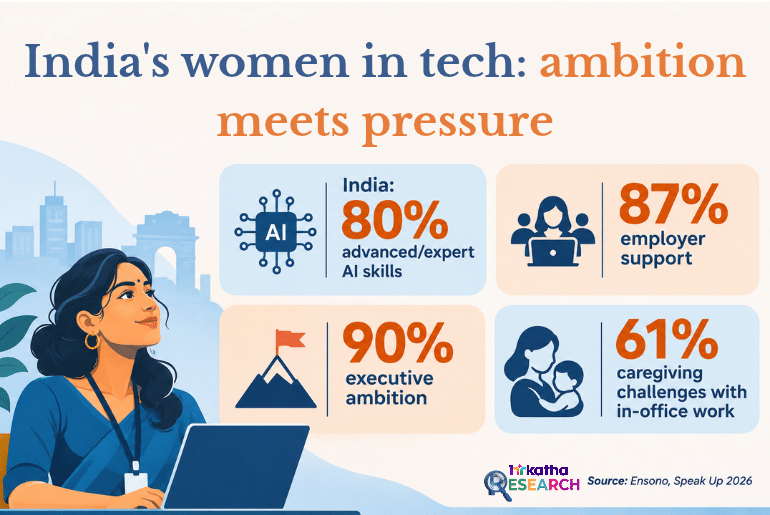
The India findings bring this tension into sharper focus. Indian respondents report the highest confidence in their AI capabilities among the three countries surveyed. Eighty per cent rate their AI knowledge and skills as advanced or expert, compared with 67 per cent in the US and 64 per cent in the UK.
They also report stronger organisational support. Eighty-seven per cent say their employer actively helps employees adapt to AI tools, against 76 per cent in the UK and 72 per cent in the US.
Yet the same country group reports the greatest pressure on several measures related to office attendance and caregiving.
Fifty-eight per cent of Indian respondents say their organisation requires more in-office days than a year ago, compared with 51 per cent in the US and 50 per cent in the UK. Sixty-two per cent strongly believe that in-person visibility matters for career advancement, against 48 per cent in the US and 45 per cent in the UK.
Caregiving presents an even sharper difference. Sixty-one per cent of Indian respondents identify balancing caregiving with work as a challenge of in-person attendance, compared with 46 per cent in the US and 39 per cent in the UK.
At the same time, Indian respondents report the strongest executive ambition. Ninety per cent aspire to an executive leadership role, compared with 83 per cent in the UK and 75 per cent in the US.
These comparisons describe the women surveyed, not the countries’ technology workforces. Indian respondents report the highest AI confidence, the strongest employer support and the greatest leadership ambition. They also report the greatest pressures from office attendance requirements and caregiving responsibilities.
The report provides no country-specific burnout figures, so it cannot establish whether these combined demands translate into higher burnout among Indian respondents.
Ambition holds
Despite the pressures, leadership ambition remains strong across the sample. Eighty-three per cent aspire to an executive role, virtually unchanged from the previous year.
But career success is being defined more broadly. Forty-nine per cent say building skills and expertise has become a bigger priority, while 48 per cent say the same of maintaining work-life balance. When asked what matters most at their current career stage, work-life balance ranks first at 40 per cent, followed by flexible working hours at 32 per cent.
Among respondents who do not aspire to executive leadership, 43 per cent say they are satisfied with their current responsibilities, while 42 per cent do not want the additional stress associated with leadership. Forty-one per cent prefer hands-on technical work. Far fewer cite a lack of confidence (11 per cent) or insufficient skills (6 per cent).
Stress is nearly as common a reason for opting out as contentment, and far more common than doubt.
AI has made workloads more manageable for 62 per cent of the women surveyed, while 42 per cent report higher output expectations. The survey cannot tell us how often these experiences coincide. But it raises a question that matters beyond technology: when work becomes easier to accomplish, who benefits from the time saved?
A productivity gain belongs to whoever keeps it.