


Close Menu
    Facebook X (Twitter) Instagram
    • Our Story
    • Partner with us
    • Reach Us
    • Career
    Subscribe Newsletter
    HR KathaHR Katha
    • Exclusive
      • Exclusive Features
      • Perspectives
      • Friday Features
      • herSTORY
      • Rising Stars
      • Case-In-Point
      • Point Of View
      • Research
      • HR Pops
      • Dialogue
      • Movement
      • Profile
      • Beyond Work
      • By Invitation
    • Brief News
      • Global HR News
      • Compensation & Benefits
      • Diversity
      • Events
      • Gen Y
      • Hiring & Firing
      • HR & Labour Laws
      • Learning & Development
      • Merger & Acquisition
      • Performance Management & Productivity
      • Talent Management
      • Tools & Technology
      • Work-Life Balance
    • Special
      • Editorial
      • HR Forecast 2026
      • Cover Story
      • HR Forecast 2024
      • HR Forecast 2023
      • HR Forecast 2022
      • HR Forecast 2021
      • HR Forecast 2020
      • HR Forecast 2019
      • New Age Learning
      • Coaching and Training
      • Learn-Engage-Transform
    • Studio
      • The CHRO Playbook
      • Quick HR Insights
      • The Corner Office
    • Reports
      • Whitepaper
        • HR Forecast 2024 e-mag
        • Future-proofing Manufacturing Through Digital Transformation
        • Employee Healthcare & Wellness Benefits: A Guide for Indian MSMEs
        • Build a Future Ready Organisation For The Road Ahead
        • Employee Experience Strategy
        • HRKatha 2019 Forecast
        • Decoding and Driving Employee Engagement
        • One Platform, Infinite Possibilities
      • Survey Reports
        • Happiness at Work
        • Upskilling for Jobs of the Future
        • The Labour Code 2020
    • Forums
      • HRKatha Inner Circle
      • HRKatha Futurecast
      • Leadership Summit 2025
      • Rising Star Leadership Awards
      • HRKatha Futurecast 2025
      • Automation.NXT
      • The Great HR Debate
    WhatsApp LinkedIn X (Twitter) Facebook Instagram
    HR KathaHR Katha
    Home»Exclusive Features»HR Pops»HITL: Why the human is still in the loop
    HR Pops

    HITL: Why the human is still in the loop

    As AI takes on more HR decisions, the real question is not whether a human is involved, but whether that human can meaningfully intervene
    mmBy Liji Narayan | HRKathaNovember 10, 20265 Mins Read30 Views
    Share LinkedIn Twitter Facebook WhatsApp
    HITL (Human-in-the-loop) HR Pops
    Share
    LinkedIn Twitter Facebook WhatsApp

    What does HITL mean?

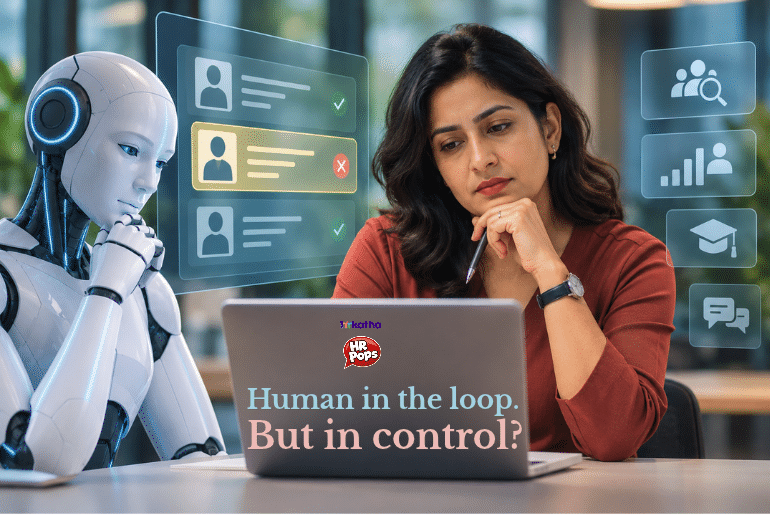
    An AI system screens hundreds of applications and recommends a shortlist. A recruiter reviews the names and approves them. The organisation can now say a human was involved in the decision.

    But did the recruiter actually exercise judgement?

    Human-in-the-loop, or HITL, describes an approach in which people participate in an automated system’s operation, training, validation or decision-making process. Human involvement may include reviewing outputs, correcting errors, supplying context or intervening before consequential decisions are made.

    In HR, the distinction matters because automated recommendations can influence who gets hired, promoted, developed or flagged for poor performance.

    The purpose of HITL is not simply to keep a person somewhere in the process. It is to ensure that human involvement adds something the system cannot reliably provide.

    That might be context, judgement, accountability or the ability to challenge an apparently convincing result.

    Where did the idea come from?

    Human involvement has been part of automated systems for decades, particularly where machines required supervision, feedback or correction.

    The development of machine learning gave the concept greater prominence. Human input became important in activities such as labelling training data, validating predictions and correcting system outputs.

    As AI systems began influencing more consequential decisions, the discussion expanded beyond technical performance to questions of oversight, responsibility and governance.

    HITL now appears in debates about how organisations should use AI without surrendering control over decisions that require human accountability.

    But human-in-the-loop is not the same as human control. That depends on how the system is designed and what authority the person actually possesses.

    Why is it relevant for HR?

    AI is increasingly capable of handling work that once required substantial human effort: screening applications, analysing performance information, recommending learning pathways and responding to employee queries.

    The efficiency gains can be considerable. So can the consequences of getting something wrong.

    Consider recruitment. A system trained on historical hiring data may reproduce patterns embedded in earlier decisions. A recruiter who simply accepts its shortlist may reinforce those patterns rather than challenge them.

    Performance management presents a different problem. An algorithm may identify declining output without understanding a change in responsibilities, an unusually difficult assignment or circumstances affecting an employee’s performance.

    In both situations, the system can identify a pattern. Whether that pattern justifies a particular decision requires further examination.

    HITL can provide that examination, provided the human reviewer has access to relevant information, understands the system’s limitations and can change the outcome.

    For HR, the question is therefore not how many processes include human approval.

    It is which decisions genuinely benefit from human judgement, and whether the process allows that judgement to be exercised.

    The uncomfortable truth

    Human oversight can become a convenient fiction.

    When an AI system produces a confident recommendation, a reviewer may be reluctant to challenge it, particularly under pressure to process large volumes of work. This is one manifestation of automation bias: the tendency to place excessive trust in automated outputs.

    The human remains in the workflow, but the decision has effectively already been made.

    That creates an accountability problem. An organisation can claim that a person reviewed an outcome even when the review was little more than a formality.

    Scale makes matters harder. A recruiter expected to examine hundreds of algorithmic recommendations cannot necessarily scrutinise each one meaningfully. Adding a human approval stage does not automatically create the time, information or authority needed for proper oversight.

    Nor are human reviewers free from bias themselves. Their involvement can introduce different assumptions and inconsistencies.

    The objective is not to replace supposedly biased machines with supposedly unbiased people. It is to create a process in which questionable decisions can be identified, examined and corrected.

    What HR should do

    The starting point is to distinguish routine automation from decisions with significant consequences for employees.

    A chatbot answering a standard leave-policy question does not require the same oversight as an AI-assisted recommendation affecting someone’s employment or career prospects.

    For consequential decisions, HR should establish who reviews the recommendation, what information they can examine, when they can intervene and who is accountable for the final outcome.

    Reviewers must also have sufficient time and authority to disagree with the system. Without those conditions, human oversight becomes procedural rather than meaningful.

    Employees should have appropriate ways to question decisions that affect them, particularly when AI has contributed to the outcome.

    The measure of effective HITL is not whether someone clicked an approval button.

    It is whether the organisation has preserved the capacity to exercise independent judgement.

    The takeaway

    HITL reflects an important tension in AI adoption. Organisations want automation to reduce the need for human intervention, yet some of the decisions they automate are precisely those where human judgement matters most.

    The answer is not to insist that every automated output receives human approval. It is to identify where intervention matters and design the process so that intervention is genuine.

    For HR, the distinction is fundamental.

    A human in the loop is not necessarily a human in control.

    AI Accountability AI adoption AI and Employment AI ethics AI governance AI in HR AI Regulation Algorithmic Bias artificial intelligence Automation Bias data-driven HR Decision Intelligence Digital HR Emerging HR Concepts employee development Employee Experience Employee Trust Ethical AI Explainable AI fair hiring Future of HR Future of work HITL HR analytics HR innovation HR leadership HR Pops HR Technology HR Transformation HRKatha pops HRPops Human in the Loop human judgement Human Oversight Human-Centred AI Intelligent Automation People analytics Performance Management pops recruitment bias Recruitment Technology responsible AI Responsible Leadership Talent Acquisition Talent Management Workforce Governance workforce technology Workplace Decision Making workplace technology
    Share. LinkedIn Twitter Facebook WhatsApp
    mm
    Liji Narayan | HRKatha

    HRKatha prides itself in being a good journalistic product and Liji deserves all the credit for it. Thanks to her, our readers get clean copies to read every morning while our writers are kept on their toes.

    Leave A Reply Cancel Reply

    Related Posts

    UK moves towards mandatory pay transparency in job ads

    November 10, 2026

    Boeing slows hiring, plans job cuts as recovery takes longer than expected

    November 10, 2026

    Syneos Health gets Tina L Sirmal as executive director-HR

    November 10, 2026

    Rising Star: Ineet Bagga on why the real advantage lies in how quickly an organisation can unlearn

    November 6, 2026
    zoha
    Editorial

    Hard work built India’s global reputation. Availability cannot define its future

    I must have been in school when I first heard the slogan. I was passing…

    The rift between the corner office and the floor below

    A general manager at a large Indian steel conglomerate recently described an exchange with his…

    EDITOR'S PICKS

    HITL: Why the human is still in the loop

    November 10, 2026

    The HR question that has no perfect answer

    November 6, 2026

    herSTORY: Nandini Matiyani, GCHRO, Strides

    November 5, 2026

    Case-in-Point: The internal whistleblower bypass

    November 5, 2026
    Latest Post

    HITL: Why the human is still in the loop

    HR Pops November 10, 2026

    What does HITL mean? An AI system screens hundreds of applications and recommends a shortlist.…

    UK moves towards mandatory pay transparency in job ads

    Global HR News November 10, 2026

    The UK government plans to introduce a new law that will require employers to clearly…

    Boeing slows hiring, plans job cuts as recovery takes longer than expected

    Brief News November 10, 2026

    Boeing’s commercial aircraft division plans to reduce about five per cent of its workforce as…

    “Compulsory retirement is a performance tool, not a punishment”: SC

    IR & Labour Laws November 10, 2026

    The Supreme Court has upheld the compulsory retirement of two employees from the Chhattisgarh Legal…

    Asia's No.1 HR Platform

    Facebook X (Twitter) Instagram LinkedIn WhatsApp Bluesky
    • Our Story
    • Partner with us
    • Career
    • Reach Us
    • Exclusive Features
    • Cover Story
    • Editorial
    • Dive into the Future of Work: Download HRForecast 2024 Now!
    © 2026 HRKatha.com
    • Disclaimer
    • Refunds & Cancellation Policy
    • Terms of Service

    Type above and press Enter to search. Press Esc to cancel.