



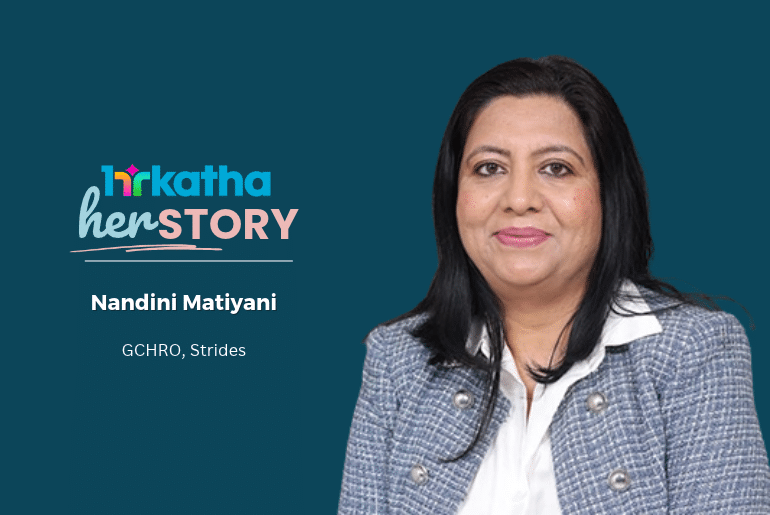
From sales to HR
For Nandini Matiyani, group chief human resources officer at Strides, a career in HR was not part of the original plan.
She began in sales and was progressing steadily when the birth of her first child prompted her to reconsider her career direction. She decided to move into a non-sales role, just as her organisation was embarking on a Six Sigma quality initiative.
Matiyani took the opportunity, earned her Six Sigma Black Belt certification and spent the next few years working on projects ranging from reducing days sales outstanding to improving engineer productivity.
That experience eventually brought her into contact with HR. She began leading transformation projects for the function, including an initiative that helped reduce attrition from 28 per cent to 14 per cent in nine months.
In 2005, she was offered a full-time HR role. She accepted, bringing with her an understanding of business operations and process improvement that would continue to shape her approach to people management.
The transition also shaped her belief that HR leaders need to understand commercial realities rather than approach organisational problems solely through the lens of people processes.
“I have a seat at the tables where careers are decided, so I see sponsorship as part of my job, not a side project.”
The boss who stood up for her
One of the most influential lessons of Matiyani’s career came from an experience of gender-based pay disparity.
Early in her professional life, she discovered that she was earning less than half of what her male counterparts received for the same role.
Her supervisor, Varsha Anand (née Patade), decided to challenge the disparity.
At appraisal time, Anand made a strong case for correcting the disparity. The company, however, offered Matiyani a 20 per cent increment, the standard increase for a high performer. Unwilling to accept the outcome, Anand declined her own increment and asked her boss and HR to use that budget to correct Matiyani’s salary instead.
Management eventually agreed to the correction, after which Anand accepted her own increment. For Matiyani, the incident became a defining example of what it means to advocate for another person when doing so carries a personal cost.
She has challenged gender bias on several occasions since, but considers none of those moments quite as powerful as what Anand did for her.
She remains grateful to her first female “superboss”, both for correcting an injustice and for demonstrating the kind of leadership she would later try to practise herself.
“The CHRO role is one of the most commercially consequential jobs in the C-suite, not just the ‘caring’ function.”
From being sponsored to sponsoring others
Today, Matiyani sees sponsorship as an essential part of her responsibility as a CHRO.
“As CHRO, I have a seat at the tables where careers are decided, so I see sponsorship as part of my job, not a side project,” she says.
During talent and succession reviews, she ensures women are considered for critical roles.
When someone is described as “not quite ready”, she asks what specifically is missing and who will help that person develop the required capabilities.
She also personally sponsors a small group of high-potential women each year.
That means more than offering advice. She recommends them for visible, high-stakes assignments and advocates for them with the executive team and the board.
But Matiyani believes individual sponsorship is not enough if the systems governing career progression remain unequal.
“I also use my position to fix the system rather than just help individuals,” she says.
That involves monitoring representation, promotion rates and pay equity across levels, and holding leaders accountable for progress.
She also tries to demonstrate through her own leadership that professional ambition and family responsibilities need not be incompatible. Having experienced what genuine sponsorship can achieve, Matiyani now uses her position to extend that opportunity to others.
The newspaper test
Another formative lesson came during Matiyani’s early years at Wipro.
When she joined the organisation, Azim Premji conducted a session on Wipro’s values and introduced a test for making difficult ethical decisions.
Imagine that something you are about to say or do appears on the front page of tomorrow’s newspaper, with your photograph beside it.
Would you feel proud or ashamed?
If the answer is shame, do not do it.
The simplicity of that test stayed with Matiyani.
She has relied on it throughout her career as a reminder that integrity should not depend on whether a decision is visible to others or whether taking the easier route might bring an immediate advantage.
For her, ethics and integrity remain non-negotiable, particularly when difficult decisions affect people’s careers and livelihoods.
Quick fire round
Your mantra for difficult days?
Calm and steady is a strategy. People take their cue from how the CHRO shows up in a crisis.
What’s the best career advice you’ve ever received?
Earn your seat at the table by understanding the business as well as the CEO, COO and CFO do, then bring the people perspective no one else can.
One thing you wish people understood about being a woman in HR leadership?
The CHRO role is one of the most commercially consequential jobs in the C-suite, not just the “caring” function, and it deserves to be treated as a credible pipeline to COO/CEO.
Morning ritual that sets you up for success?
An early walk without my phone, followed by 60 minutes of yoga and dhyan with my guru. It clears my mind for dealing with the challenges of the day.
If not HR, what career path would you have pursued?
Probably quality or consulting. I’ve always loved solving complex problems where people and strategy meet.
Building an AI-savvy workforce
At Strides, Matiyani is now helping prepare a traditionally manufacturing-oriented workforce for a more digital future.
One initiative is the Lighthouse Digital & AI Capability Programme, which provides selected factory teams with training in digitalisation, data analytics, artificial intelligence and machine learning.
The objective is to enable employees to apply these capabilities to operational challenges rather than treat technology as a subject reserved for specialists.
Some of the trained shopfloor teams are now developing predictive models to improve product quality.
“Seeing shopfloor teams use data to solve real problems has been one of the proudest moments of my career,” Matiyani says.
The programme received a Gold award at the Brandon Hall Group HCM Excellence Awards 2026 in the Future of Work category for Best Use of AI for Business Impact.
Other initiatives include Strides’ first company-wide culture diagnostic, which recorded 82 per cent participation, and multiskilling programmes for shopfloor supervisors.
For Matiyani, these efforts reflect HR’s larger responsibility: building the culture, capabilities and leadership the organisation will need as its business evolves.
Thinking like a business leader
Matiyani’s advice to young women entering HR is to develop commercial credibility from the beginning.
“Think like a business leader from day one,” she says.
That means learning to read a profit and loss statement, understanding the organisation’s strategy and connecting people recommendations to growth, risk and performance.
She also encourages professionals to build fluency in data and technology, particularly as AI and people analytics reshape the function.
Breadth of experience matters just as much. Her own transition from sales to quality and eventually HR taught her the value of understanding how different parts of a business operate.
She recommends seeking challenging assignments, including difficult restructurings and crisis situations, because these are often the experiences that develop judgement and establish credibility.
Mentors and sponsors have different roles in that journey. Mentors challenge thinking and offer guidance; sponsors advocate for people when important career decisions are being made.
Having experienced the difference personally, Matiyani considers both essential.
Her final advice is simple: “Back yourself. No one can champion you better than you can.”