



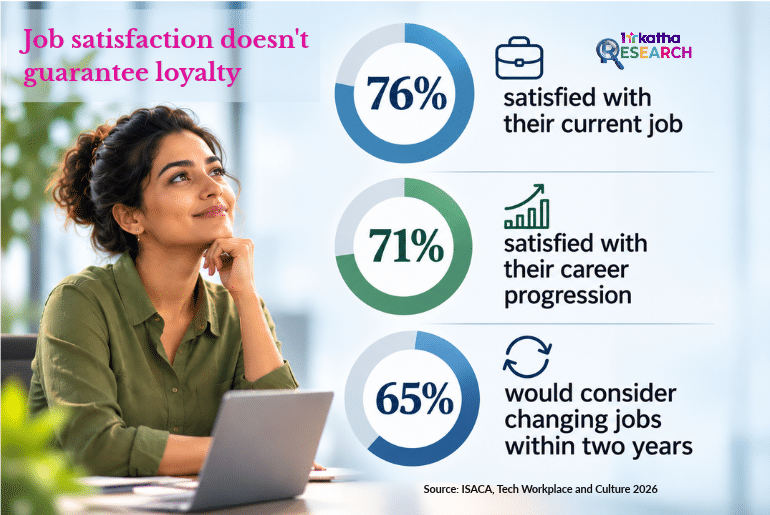
Seventy-six per cent of technology professionals are satisfied with their current jobs. Seventy-one per cent are satisfied with their career progression. Yet 65 per cent would consider changing jobs within the next two years.
The findings come from ISACA’s Tech Workplace and Culture 2026 report. Three-quarters of respondents also say retaining talent is a concern for their organisation. The survey measures willingness to consider a move, not actual resignations. Even so, high satisfaction and considerable openness to leaving sit side by side in the same workforce. A contented workforce is not necessarily a stable one.
What people leave for
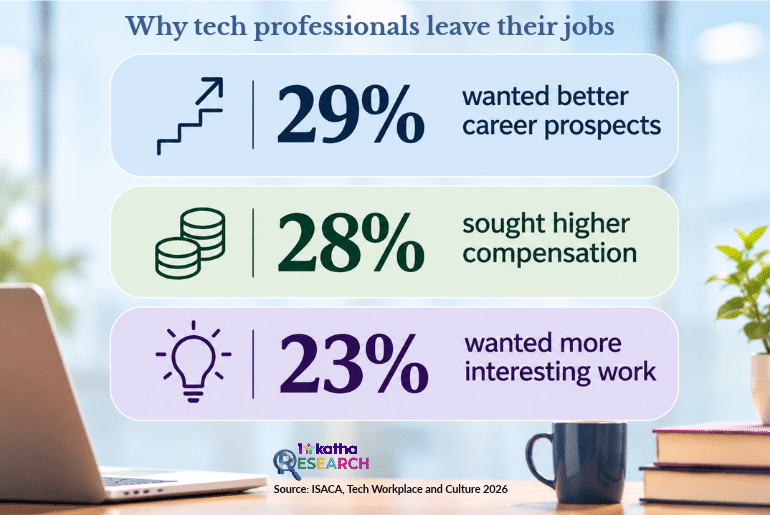
The reasons respondents gave for leaving their previous jobs are revealing. Twenty-nine per cent wanted better career prospects, 28 per cent sought higher compensation and 23 per cent wanted more interesting work.
These reasons do not necessarily describe an unhappy employee. A professional may enjoy the present job and still see a more rewarding future elsewhere. Satisfaction measures the quality of the existing arrangement, while career decisions also involve expectations about what comes next.
The obstacles respondents identify reinforce the importance of progression. The absence of a clear upward career path is the most frequently cited obstacle among both men and women, although the proportions differ: 33 per cent of men and 41 per cent of women. Limited access to career opportunities follows at 23 and 31 per cent respectively.
Employers have made progress on flexibility. Hybrid arrangements are the most common, reported by 41 per cent of respondents, compared with 35 per cent working on-site and 24 per cent remotely. Sixty-one per cent say their current arrangement increases job satisfaction. But flexibility does not feature among the three leading reasons respondents gave for leaving their previous employers. The factors that make a job agreeable are not necessarily the same as those that make another opportunity attractive.
Burnout beneath the satisfaction scores
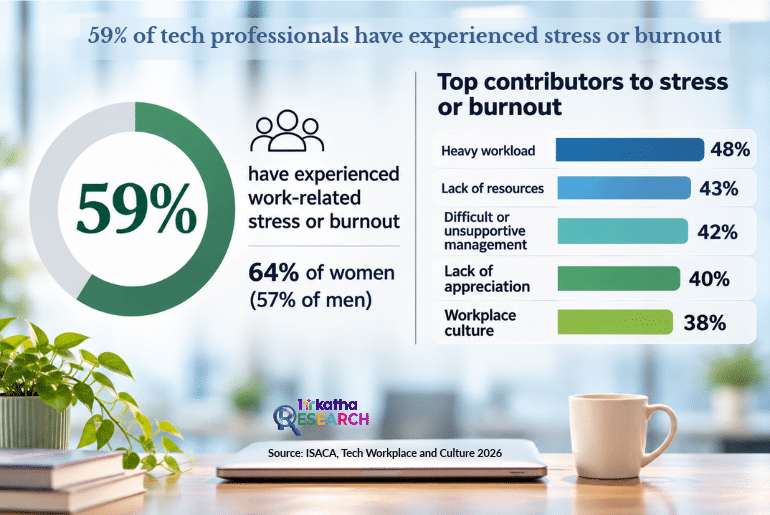
High satisfaction also coexists with substantial workplace strain. Fifty-nine per cent of technology professionals report having experienced work-related stress or burnout. The proportion reaches 64 per cent among women, compared with 57 per cent among men.
Heavy workload is the leading contributor, cited by 48 per cent. Lack of resources follows at 43 per cent, difficult or unsupportive management at 42 per cent, lack of appreciation at 40 per cent and workplace culture at 38 per cent.
Four of the five leading contributors concern the conditions around the work, rather than its volume. Satisfaction and strain need not be mutually exclusive. Indeed, assuming both figures use the same respondent base, the reported percentages imply that at least 35 per cent are satisfied with their jobs and have experienced work-related stress or burnout. This is a mathematical inference rather than a separately reported survey finding. A satisfaction score cannot, by itself, establish that the wider employee experience is healthy.
Career gains conceal an authority gap
The report’s gender findings introduce another complication. Seventy-three per cent of women and 71 per cent of men received a salary increase or promotion during the previous two years. On this combined measure, the difference is small.
But the picture changes when respondents are asked about career progression, workplace culture and authority.
Sixty-seven per cent of women are satisfied with their career progression, compared with 73 per cent of men. Satisfaction with workplace culture is 52 per cent among women against 65 per cent among men. For job security, the corresponding figures are 59 and 69 per cent.
The differences become more pronounced when the question shifts from career outcomes to decision-making authority.
Fifty-three per cent of women believe they have sufficient authority to contribute to company strategy, compared with 66 per cent of men. On personnel decisions, the figures are 48 and 59 per cent. On purchasing decisions, they are 32 and 52 per cent, a gap of 20 percentage points.
An organisation can report similar proportions of men and women receiving a salary increase or promotion while employees experience very different levels of influence over decisions.
The combined measure suggests broadly comparable career movement. The authority figures reveal a different picture.
The barriers start at entry
The differences are not confined to the workplace itself. Thirty per cent of women report encountering gender or diversity bias or stereotypes when entering the technology sector, compared with just 4 per cent of men. Half of women believe pay inequality exists between men and women in technology, against 25 per cent of men.
These figures describe respondents’ experiences and perceptions, not independently measured pay differences. Even so, the size of the gaps suggests that men and women navigate different professional environments, even when their formal career outcomes appear relatively similar.
The distinction matters because recruitment and promotion numbers can capture visible career movement without revealing how employees experience the workplace.
Representation is one measure of progress. Access to authority, confidence in career prospects and the ability to influence decisions are others.
Expectations are rising as hiring programmes decline
The longer-term picture is equally uncertain. Fifty-three per cent of respondents report that their employer has a programme encouraging more women to enter technology roles, down from 63 per cent in 2024. Yet 71 per cent expect women’s representation in the sector to increase over the next five years, even as 46 per cent believe women remain underrepresented.
The figures do not prove that recruitment initiatives are being abandoned, but they reveal a gap between expectations of progress and the reported prevalence of programmes intended to support it. Optimism about the future is not, by itself, evidence that organisations are building the structures needed to achieve it.
The reasons respondents gave for leaving their previous jobs centred on career prospects, compensation and the nature of the work. Satisfaction scores describe how employees feel about the present. They reveal considerably less about the opportunities employees see elsewhere, the obstacles they face or the influence they exercise within their organisations.
For employers, the question is no longer simply whether employees are satisfied. It is whether they can see a future worth staying for.