



In IT services, the need for new skills can emerge faster than organisations can develop the people to meet it. A technology becomes commercially important, clients start asking for expertise, and companies must choose between recruiting people who have it and building it within their existing workforce.
Kyndryl is trying to anticipate those requirements before they become urgent.
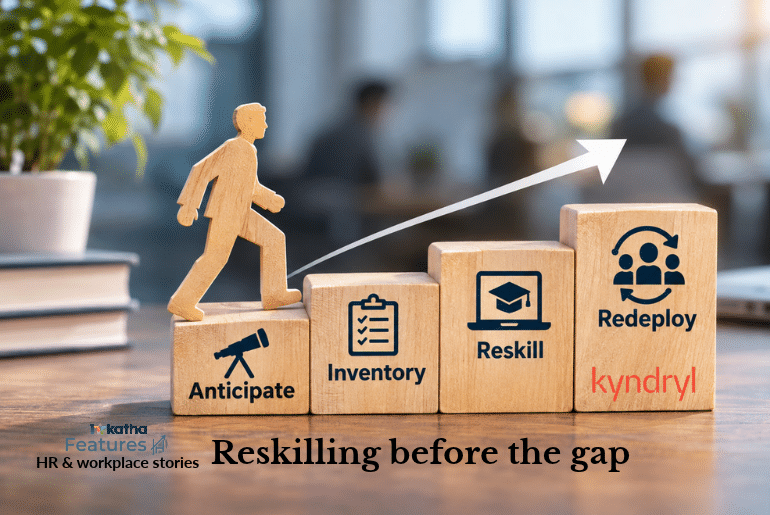
The company has developed a framework called AIR, which stands for anticipate, inventory, reskill and redeploy. The sequence begins by identifying future capability requirements, examining the skills already available within the organisation and preparing employees for roles expected to become more important.
“We won’t really end up reacting to the skills gap that’s emerging, but will be ahead of what we need to do,” says Rajita Singh, chief people officer for India and global delivery HR leader.
The difference is between responding to a vacancy and preparing for a capability requirement. But identifying future needs is only the beginning. Employees must acquire the necessary skills, managers must support their development and the organisation must create opportunities for them to apply what they have learnt.
Kyndryl has already redeployed more than 15,000 employees globally as part of its broader workforce transformation, according to Singh. In India, where it employs about 26,000 people, AIR has been running for eight to nine months. Singh did not share India-specific redeployment figures, saying the framework needs more time to produce measurable outcomes. The global number shows the scale of Kyndryl’s redeployment efforts; it is too early to assess AIR’s impact in India.
Anticipating the next role
Kyndryl has identified six to seven roles it considers particularly important to its business and client requirements. It is mapping the skills associated with those roles and developing learning journeys and career pathways for employees who could move into them.
“We won’t really end up reacting to the skills gap that’s emerging, but will be ahead of what we need to do.”
Rajita Singh, CPO-India & global delivery HR, Kyndryl

The approach starts with an inventory of existing capabilities, which lets the organisation compare the skills it has with those it expects to need.
Singh does not suggest that every capability can or should be developed internally. Where expertise is required immediately and cannot reasonably be built within two to three months,
Kyndryl continues to hire externally. That matters in a business where client requirements change quickly. Internal development offers continuity and career opportunities; external recruitment covers what cannot be built in time.
Confidence is part of the skills gap
Skills data can help identify what an employee knows and what additional capabilities a role requires. It cannot establish whether the employee wants to make that transition.
Singh acknowledges that moving into an unfamiliar technology or responsibility creates uncertainty. Employees want to understand what the change means for their careers, whether opportunities will be available and how the new skills will be used. Someone with years of expertise in one area has something to lose by starting again in another.
Kyndryl is therefore approaching reskilling through conversations, time to learn and examples of employees who have made similar transitions successfully.
Managers carry much of that work. They are expected to help employees identify development opportunities and consider career paths beyond their immediate assignments.
In an IT services business, that means balancing current delivery with preparing people for future work.
The two demands do not operate on the same timetable. A client assignment may need an employee’s expertise today, while developing that employee for a different role requires time away from familiar responsibilities.
Client environments make this harder. They shape where and how teams work, and how much time employees can spend away from delivery work to learn. That constraint bears on reskilling more directly than any hybrid-work policy, and it makes internal mobility a business decision as well as an HR intervention.
Measuring more than training hours
Kyndryl looks beyond participation in learning programmes to understand whether its workforce is becoming more prepared. Certifications, internal mobility, progression into new roles and career development all form part of that assessment, with skills data directing learning investment towards capabilities the business expects to need.
Completing a course does not mean an employee is ready for a different role. Readiness depends on whether the learning can be applied, whether relevant opportunities exist and whether employees can move into them.
Kyndryl’s performance process, Compass, evaluates two dimensions: business results and the Responsibility to Others Index, which considers collaboration and contributions to colleagues.
The company’s career philosophy, “Thrive in the Adventure”, also recognises lateral movement and new assignments as forms of progression.
Singh offers her own case: about eighteen months ago she took on the global delivery HR portfolio alongside her India role, earlier than a conventional path might have allowed.
HR goes through the change first
HR was among the first groups at Kyndryl to undergo AI training, giving its professionals direct experience of the tools and changes they would later help other employees navigate.
“Before asking the wider workforce to embrace a particular responsibility, HR must understand what it involves in practice,” Singh says.
From skills inventory to actual movement
AIR gives Kyndryl a sequence: anticipate the roles, inventory existing capabilities, reskill employees and redeploy them. The first two stages are largely about information and planning. The latter two depend more directly on employee choices, managerial support and the availability of work that uses the newly acquired capabilities.
An employee may complete a learning programme without moving into a different role. Another may have transferable skills but need more experience. A third may prefer to stay in an existing specialisation. These differences make workforce transformation less predictable than the framework’s orderly sequence might suggest.
AIR’s test is whether anticipating requirements makes redeployment systematic rather than reactive. That is the larger challenge for IT services companies. Identifying tomorrow’s skills is one part of the exercise. Persuading employees to prepare for them, and creating the opportunities to move, is another.
The real measure of reskilling is not how many people an organisation trains, but how many it can put to work doing something different.