



Company: NovaEnergy (fictitious), a mid-sized renewable energy firm with 2,100 employees, developing and operating solar, wind and hybrid energy projects across India for industrial, commercial and government clients.
Background
Arjun Mehta has been a sustainability analyst at NovaEnergy for three years. His work involves compiling project data for the company’s carbon offset disclosures, which underpin its ESG credentials and form part of its regulatory submissions.
Six weeks ago, he noticed a discrepancy.
The carbon offset figures submitted to the regulatory authority were materially higher than the underlying project data could support. This was not a rounding error or a formatting issue. The reported numbers were wrong.
NovaEnergy had a formal whistleblower mechanism, complete with a designated reporting channel, a written policy and a commitment to confidentiality.
Arjun did not use it.
Instead, he approached the regulatory authority directly.
The regulator investigated and confirmed the misreporting. NovaEnergy corrected its submissions and, partly because of the voluntary correction, avoided formal penalties.
The compliance failure was genuine. But the disclosure had consequences.
The investigation attracted unwanted scrutiny, strained relationships with key partners and generated media attention. Senior leaders were furious. Some described Arjun’s decision to bypass internal channels as disloyal and asked HR what action could be taken against him.
The CHRO now faced an uncomfortable question. Arjun had exposed a genuine problem, but he had also chosen not to use the organisation’s established reporting mechanism.
Why he made that choice remained unclear.
The dilemma
Should HR protect Arjun from disciplinary action, recognising that his disclosure exposed genuine regulatory misreporting and that penalising him could discourage others from reporting wrongdoing?
Or should HR examine his decision to bypass internal channels, recognising that organisations establish reporting procedures for legitimate reasons, including confidential investigation, timely correction and appropriate escalation?
And if neither response is sufficient, should HR separate the two issues: protect the integrity of Arjun’s disclosure while examining why he chose the external route, whether internal channels were credible and whether any guidance on reporting procedures is appropriate?
What’s really at stake
This is a question about whether organisations can encourage employees to report wrongdoing while expecting them to follow established procedures.
NovaEnergy had a whistleblower mechanism. Arjun knew it existed but chose not to use it. That decision deserves examination, although it does not necessarily establish that he distrusted the system. He may have doubted its independence, believed the matter required regulatory attention or simply considered external reporting the more appropriate course.
Internal reporting mechanisms serve a legitimate purpose. They allow organisations to investigate concerns confidentially, establish facts and correct failures before they escalate. Employees who bypass them may deprive the organisation of an opportunity to respond internally.
But that argument has limits.
The misreporting was real. Arjun did not manufacture an allegation or expose an innocent organisation to baseless scrutiny. His disclosure revealed inaccurate regulatory submissions that NovaEnergy’s existing controls had failed to prevent.
The company’s frustration over reputational damage therefore cannot be separated from its responsibility for the underlying compliance failure.
There is also a legal distinction. Whether an external disclosure attracts statutory protection depends on the applicable law, the reporting framework and the circumstances. HR cannot assume either that every disclosure is automatically protected or that bypassing an internal mechanism justifies disciplinary action. Any proposed response would require careful legal examination.
The larger organisational question concerns trust. If employees believe internal reporting channels are ineffective or unsafe, the existence of a whistleblower policy offers little reassurance. Equally, a single decision to approach a regulator does not establish that the internal mechanism has failed.
HR must therefore understand Arjun’s reasoning without turning that examination into retaliation.
There is another issue NovaEnergy cannot overlook. How did materially inaccurate carbon offset figures pass through its internal review processes? Correcting the submissions addresses the immediate problem, but it does not explain how the error occurred or why existing controls failed to detect it.
The challenge is to reinforce responsible reporting without making employees fear the consequences of exposing genuine wrongdoing.
The deeper question is whether an organisation can defend its reporting process without appearing to punish the person who revealed that its compliance controls had failed.
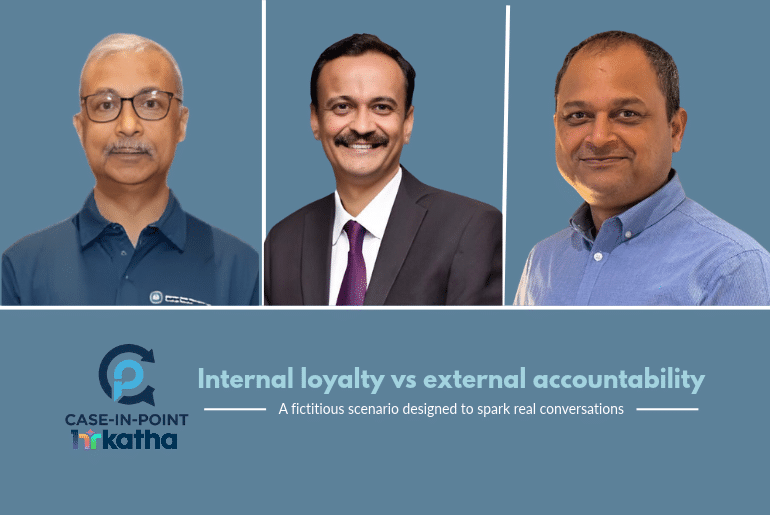
We asked three HR leaders how they would approach this dilemma.
What HR leaders said
Himanshu Sinha, CHRO, Nippon Koei
“Organisations should be careful about how they approach situations like these. The first question should not be whether the employee followed the correct hierarchy, but whether the organisation has created an environment where people feel comfortable raising concerns internally.

We should never create a culture where employees are afraid to speak up internally, nor one where they feel compelled to go outside because internal channels do not work. If an employee feels that approaching the designated reporting mechanism will not lead to an appropriate response, it raises questions about the organisation’s internal culture and the credibility of its processes.
HR’s responsibility is to build trust in these mechanisms. Employees must know that their concerns will be heard, investigated objectively and treated with confidentiality. Equally important is ensuring there is no fear of retaliation for raising uncomfortable questions. Having a whistleblower policy on paper is not enough. Employees must have confidence that it works in practice.
Organisations must build a culture where speaking up is encouraged, not penalised. Transparency, accountability and trust should be stronger than hierarchy, and doing the right thing should always be supported.”
Salil Chinchore, group CHRO, Rustomjee Group
“The key issue in this case is not whether the employee was right to flag a concern about sustainability reporting. It is whether HR should address his decision to approach an external regulator without first using the organisation’s established internal channels.

My recommendation would be a two-track approach: address the employee’s decision to bypass internal channels while independently ensuring that the underlying concern is investigated and corrected.
First, HR should speak to the individual to understand why the external route was chosen. Was he aware of the internal reporting mechanisms? Did he have confidence in them? Was there a perceived conflict of interest, or did he believe the issue required immediate regulatory attention? Understanding the circumstances is essential before drawing any conclusions.
Second, the concern itself should be investigated independently. HR should work with Compliance, Sustainability and Legal to establish the nature and materiality of the inconsistencies, identify any control failures and verify whether the corrective action is adequate. The fact that the organisation has updated its reporting should not automatically close the matter. It is equally important to understand how the gaps occurred and why they were not identified earlier.
Third, if internal channels were accessible and credible, and the employee had no legitimate reason to bypass them, HR may counsel him on the expected escalation process. However, if he had reasonable grounds to doubt the effectiveness of those channels, the choice of channel should not be treated as misconduct. Any action must be consistent with applicable whistleblower protections and legal obligations.
Fourth, the organisation should review whether employees understand how to raise concerns, whether complaints are investigated promptly and whether employees believe their identities will be protected.
HR must separate the employee’s choice of reporting channel from the validity of the concern. While internal processes matter, they should never come at the cost of transparency or the organisation’s responsibility to address genuine issues.”
Rajeev Singh, CHRO, Yokohama ATG
“I see this case as an opportunity for the organisation to reflect on two important questions. The first is whether its internal reporting mechanisms have been communicated effectively. The second is whether employees genuinely trust them.

Organisations may have whistleblower policies and confidential reporting channels in place, but the real question is whether employees know about them and believe they work. Such mechanisms need to be regularly communicated and reinforced, not mentioned once in an onboarding document.
The second question is understanding why the employee chose to approach an external authority. Was it a conscious decision because he did not trust the internal system, or was he simply unaware of the channels available? Sometimes employees may believe their concerns will not be taken seriously or that nothing will change if they report internally. In such situations, they may seek an external route because it feels like the only way to ensure the issue receives attention.
There is also a need to examine the internal checks that existed before the sustainability data was reported. Such information would typically pass through multiple levels of review. If inconsistencies went unnoticed at those stages, the organisation needs to understand where the gaps occurred.
Going forward, the focus should be on reinforcing existing reporting mechanisms. Every accountable manager should regularly communicate the availability of these channels and demonstrate through action that concerns are heard and addressed. The communication must also be positive and non-threatening. Employees should see raising a concern as a responsible action, not one that puts them under scrutiny.
Having a reporting mechanism is only half the job. Building credibility around it is what matters.”
If you were the CHRO at NovaEnergy
Arjun exposed genuine regulatory misreporting. The company corrected its submissions and avoided penalties, but leadership is demanding action over his decision to bypass internal channels.
What would you do?
- Protect Arjun from disciplinary action, recognising the legitimacy of his disclosure and the risk of discouraging future whistleblowers?
- Counsel him on internal reporting expectations, if appropriate and legally permissible, while investigating why he chose the regulator?
- Focus first on an independent review of the reporting mechanism and compliance controls, reserving judgement on Arjun’s conduct until the circumstances are understood?
Or is the bigger question this:
When an employee exposes a genuine compliance failure, should the organisation be more concerned about how the truth came out or why its own systems failed to detect it?
Share your perspective in the comments or on LinkedIn using #HRKathaCaseInPoint.