



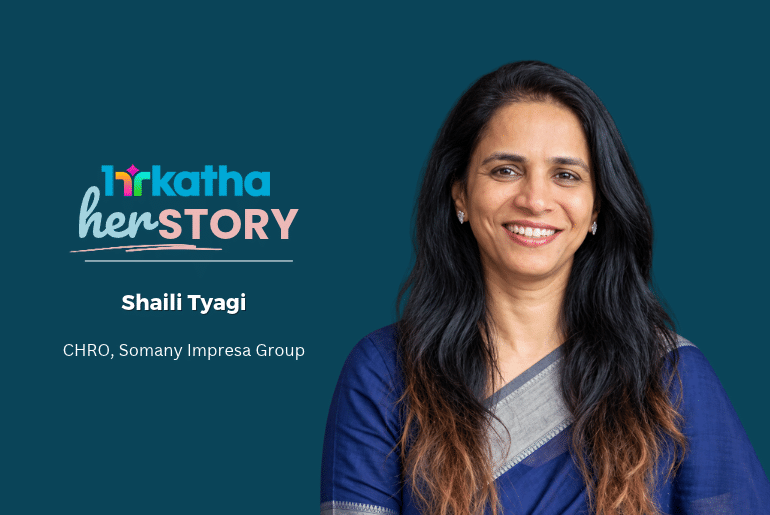
An unexpected career, built deliberately
For Shaili Tyagi, chief human resources officer at Somany Impresa Group, a career in HR began almost by accident. Building a career in it, however, was an entirely deliberate choice.
After studying Botany at Delhi University, she completed a master’s degree and intended to pursue a PhD. Her plans changed when the CEO of Emmpower offered her an opportunity to become a corporate facilitator.
She accepted, despite having no conventional grounding in HR, and began learning the profession while practising it.
Over the years, she strengthened her expertise through HR certifications, psychometrics, leadership coaching, and also education at XLRI. Learning and working were never separate phases of her career.
Her professional journey subsequently took her across industries and organisations, including nearly fifteen years with multinationals, an APAC role and assignments in family-run businesses.
Each transition required her to understand a different business environment and establish credibility afresh.
Looking back, Tyagi believes these moves, often made by stepping away from an established position into unfamiliar territory, were among the most important decisions of her career.
They taught her not to assume that an approach successful in one organisation would necessarily work in another.
“Experience helps you ask better questions; it does not remove the need to learn,” she says.
Her advice to younger professionals follows naturally from that journey: “Don’t feel you need your entire career mapped out before taking the next step.”
“HR should be part of decisions before deployment, not brought in afterwards to arrange training.”
Unruffled by bias
For much of her career, Tyagi has often been the only woman in the boardroom.
She acknowledges that gender bias exists, but has chosen not to let it determine how she approaches her responsibilities.
“I simply haven’t allowed it to define my experience,” she says.
Rather than dwelling on difficult encounters, she has preferred to concentrate on what she can influence through her work, decisions and relationships.
“I would rather put my energy into what I can influence than dwell on a negative encounter,” she explains.
That approach reflects the perseverance and resilience with which she has navigated unfamiliar professional environments.
Her experience has also shaped her understanding of what meaningful support for women should involve.
Advice and encouragement matter, but Tyagi believes they must be accompanied by access to challenging assignments, business exposure and genuine consideration for leadership opportunities.
In manufacturing, this also means addressing practical barriers, including transport, shifts and workplace facilities.
“Encouragement matters; the conditions to act on it matter just as much,” she says.
For Tyagi, inclusion is, therefore, not simply about helping women prepare for leadership. It is also about ensuring they have opportunities to demonstrate their capabilities.
Clear reasoning, fair treatment
Some of the hardest decisions Tyagi has faced have involved organisational change, when business requirements carry real consequences for employees.
Her approach begins with examining the alternatives.
Can employees be redeployed or reskilled? Can the work be organised differently? Is there another way to achieve the business objective?
If a difficult decision remains necessary, she believes it must be supported by clear reasoning, fair treatment and honest communication.
“Being people-focused cannot mean avoiding business realities, nor can a sound business case be an excuse for poor treatment,” she says.
For Tyagi, the way a decision is implemented matters as much as the decision itself. It affects not only those directly involved, but also the employees who remain with the organisation.
Her emphasis is on ensuring that business decisions are made responsibly, with an understanding of their human consequences.
“Experience helps you ask better questions; it does not remove the need to learn.”
Connecting technology with people
Somany Impresa Group already has a foundation in plant digitisation and process automation. Tyagi’s priority is to connect these investments with the people expected to use the technology.
As AI becomes part of industrial workflows, she believes organisations must look beyond the technology itself.
“As AI enters these workflows, we need to ask which tasks change, where human judgement remains essential and how employees learn the redesigned role,” she explains.
That requires HR to participate in decisions about technology adoption from the beginning, rather than becoming involved only when employees need training.
“HR should be part of those decisions before deployment, not brought in afterwards to arrange training,” she points out.
For Tyagi, the measure of success is not simply whether automation reduces manpower requirements. It is whether the organisation achieves improvements in quality, safety, productivity and customer experience while preparing employees for changing roles.
Different businesses, different needs
Working across diverse organisations has made Tyagi wary of standard HR solutions.
She believes one mindset that deserves to be questioned is the assumption that every business within a conglomerate must operate with identical people practices.
Standards of integrity, fairness and accountability should remain consistent. But organisation design, incentives and talent priorities need to reflect the realities of each business.
A packaging plant and a consumer-appliances business, for instance, may operate with very different demands, capabilities and rhythms. For Tyagi, the important question is not whether every business follows the same HR process, but whether its people systems support its strategy.
That conviction has been strengthened by her career transitions. Moving between industries taught her to understand the context before offering an HR solution.
It also explains why she continues to value research and inquiry, interests that date back to her academic years.
She wants to understand the problem before deciding what needs to change.
Quick fire round
Where do you feel most energised: on the shop floor or in strategy meetings?
The shop floor. Strategy makes far more sense once you have seen how the work is actually done.
If HR were one of your company’s product lines, would it be sturdy like building materials, sleek like appliances or versatile like packaging?
Packaging: adaptable, protective, quietly essential.
What’s your must-have pick-me-up during a long day: coffee, chai or a quick walk?
Quick walk. Helps to re-energise and complete 10,000 steps.
If your leadership style were a consumer appliance, would it be a power blender, a smart fridge or a reliable washing machine?
A reliable washing machine: no drama, dependable, quietly handles whatever you throw at it.
If you could trade roles with any employee for a day, which part of the conglomerate would you choose: building products, appliances or packaging, and why?
A day on the building-products shop floor, to watch a brand promise being made, literally, by hand.
The courage to begin again
Tyagi’s career has involved repeatedly leaving familiar environments for new ones.
She acknowledges that these transitions required courage. Moving from an established position into a different industry or business culture meant rebuilding credibility, understanding new expectations and learning how decisions were made.
Yet, those experiences also broadened her perspective on leadership and organisational behaviour.
She has learnt that professional experience is valuable not because it provides ready-made answers, but because it helps leaders recognise what they still need to understand.
That is also why she encourages younger professionals to take opportunities that stretch them, even when the next step is not entirely clear.
Her own career, after all, began with a plan to pursue academic research and took a direction she had never anticipated.
What mattered was not knowing where every move would lead, but being prepared to learn once she got there!