


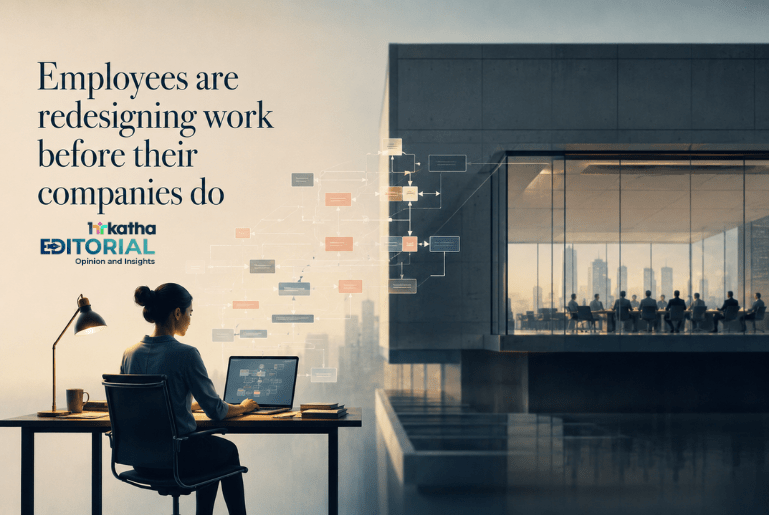
Nobody announced that work would change this way.
There was no strategy document, pilot programme or change-management communication. An employee found that drafting an email took a fraction of the time it used to. An analyst discovered that interrogating a dataset that once took a day could be done in an hour. A recruiter stopped writing job descriptions from scratch. A manager who dreaded putting together presentations found the task considerably less painful. A programmer began reviewing code differently, and then writing it differently.
Each of these decisions was individual. None was coordinated. Most were not reported to anyone. And yet, accumulated across thousands of employees, they are changing what work actually looks like inside organisations that have not yet changed how they formally describe it.
The AI strategy is being written in boardrooms. The actual transformation is already happening at desks.
From simple to complex, without permission
The progression followed a logic nobody designed.
Simple tasks came first. An email draft. A meeting summary. A document structure. Nobody thought of these as experiments in AI adoption. They were just ways of getting something done faster. Then, quietly, the tasks became more substantial. Research synthesis. Scenario modelling. Analysis that used to take two people most of a week.
The employee who started by using AI to draft emails is now using it to prepare strategic recommendations. The analyst who began with data interrogation is now modelling outcomes that once required specialist support. The work has changed. The job title has not.
The role profile has not. The capability framework has not. The organisational structure, which was designed around work as it existed before any of this happened, has not.
There is a gap opening between what employees actually do and what their organisations formally believe they do. Most organisations have not measured it. Many may not even know how.
“The AI strategy is being written in boardrooms. The actual transformation is already happening at desks.”
When does changing the task change the job
There is an important distinction here. Using AI to perform a task differently does not automatically mean the job has been redesigned.
An employee who saves two hours a week may simply produce more in the remaining time. The purpose of the role, the capabilities required to perform it and its place in the organisation may remain substantially unchanged.
The organisational question begins when enough tasks change that the economics or purpose of the role changes with them.
If AI absorbs a third of the work once performed by a junior analyst, what fills that third? More analysis? More judgement? More client interaction? Fewer analysts? A different route towards becoming a senior analyst?
The last question is particularly important. Some apparently routine work is also apprenticeship. Junior lawyers learn by researching cases. Analysts learn by building models. Young consultants learn by gathering and synthesising information. If AI increasingly performs the work through which expertise was historically developed, organisations have not merely gained productivity. They may have disrupted the mechanism through which tomorrow’s experts are created.
That is the point at which productivity becomes an organisation design problem.
“Some apparently routine work is also apprenticeship. If AI increasingly performs the work through which expertise was historically developed, organisations have not merely gained productivity. They may have disrupted the mechanism through which tomorrow’s experts are created.”
The organisation is writing the strategy for a world that has already moved
AI transformation, as most organisations conceive it, is a top-down exercise.
Leadership articulates a vision. IT builds a deployment plan. HR designs a change-management programme. Communications prepares the narrative. The process is deliberate
and relatively slow because large organisations tend to move that way.
Meanwhile, informal adoption operates on a different timeline.
Employees experiment with tools that are publicly available, often inexpensive and demonstrably useful. They share what works with colleagues. Practices spread laterally, through teams and functions, through informal conversation and observation, without passing through a governance committee.
By the time the formal strategy arrives, the organisation it was designed for has already partially changed. The strategy addresses a starting point that no longer quite exists.
This is not a failure of leadership intent. It is a structural mismatch between the speed at which individuals can change how they perform work and the speed at which organisations can formally redesign work around them. The gap between the two is where the real management challenge lives.
“Automating an inefficient workflow preserves the workflow. Redesign begins by asking whether the work should still exist in its current form.”
It does not look the same everywhere
The pattern is widespread. What it looks like depends on where you work.
In technology companies, AI can enter the productive core of the job itself. Developers use it to write, test and review code. The implications are therefore more fundamental than in businesses where the value is still created primarily through physical work or direct human interaction.
In professional services, the problem is structural. Consulting, legal and accounting firms built their economics and their talent models around pyramids in which junior employees perform large volumes of research, analysis, document review and modelling. AI can compress some of that work considerably. The immediate productivity gain is real. But the longer-term question is what happens to a talent model that relied on junior work not merely to produce output but to develop expertise. The pyramid is being reshaped from the base. Most firms are watching carefully and moving cautiously.
In banking, healthcare and pharmaceuticals, formal adoption is more controlled. The regulation is real and the caution is justified. But the administrative work that surrounds the core, the documentation, the reporting, the correspondence, is changing quietly regardless.
Manufacturing, hospitality and construction will encounter yet another version. Physical work does not disappear because generative AI becomes more capable, but planning, scheduling, supervision and managerial work may still be altered in ways that take time to become visible.
The sector shapes both the pace and the consequences. What remains consistent across all of them is the possibility that employees change individual components of work faster than organisations change the formal roles around them.
“Employees are already running an experiment in how work could be done differently. The results are sitting in thousands of individual workflows, largely unread.”
There is no template worth copying yet
There are useful examples of deliberate redesign, but not yet an obvious blueprint.
IBM’s approach to redesigning parts of HR is instructive because it did not begin by asking what could be automated. It started by eliminating unnecessary work first, simplifying what remained and automating after that. Its AskHR system subsequently absorbed a substantial range of routine HR activities while the operating model around employee support changed with it.
The principle matters more than the technology. Automating an inefficient workflow preserves the workflow. Redesign begins by asking whether the work should still exist in its current form.
Other organisations are experimenting with AI-native teams, redesigned customer-service operations and different ways of building software. Some experiments will work. Others will discover that they redesigned around capabilities AI did not yet reliably possess.
That makes the search for a single model somewhat misguided. A bank, a software company, a hospital and a manufacturing plant are redesigning fundamentally different kinds of work. The useful lesson may lie less in copying somebody else’s organisation chart than in copying the method: understand what work has actually changed before deciding what the organisation around it should become.
“For most of modern corporate history, organisations redesigned work and employees adapted to it. AI may be disturbing that sequence. Employees are changing tasks first. Jobs are beginning to change around them. The formal organisation is following behind.”
The irony HR has not fully confronted
HR may not own the work. But it owns many of the systems that describe it.
Role profiles, capability frameworks, career architectures, workforce plans and much of the formal organisation-design machinery sit within or alongside HR. That creates a peculiar problem when employees begin changing the content of their jobs faster than the systems designed to describe those jobs can keep up.
The informal redesign AI is producing therefore lands directly in HR’s territory. It can alter what roles require, which capabilities matter and even how people acquire the experience needed for their next role, without passing through any formal job-design process.
There is a quiet irony in this. The function responsible for maintaining much of the architecture around work may increasingly find that the architecture describes yesterday’s version of the work.
This is not a criticism of HR’s intent. Informal adoption is fast, distributed and often invisible to any central function. But treating it purely as a compliance problem misses what it is also revealing: employees are already running an experiment in how work could be done differently. The results are sitting in thousands of individual workflows, largely unread.
Organisations need guardrails around data, security and acceptable use. That much is not in dispute. What would also help is someone reading the experiment.
The gap that is widening
The organisations most capable of benefiting from AI may not be the ones that deployed it earliest. They may be the ones that took seriously the question of what work should look like once AI became a permanent part of how it gets done.
Individual employees are already answering pieces of that question informally. Every decision about which task to delegate to AI, which output to distrust, where human judgement remains essential and where technology genuinely saves time reveals something about the emerging division of labour between people and machines.
At some point, the gap becomes visible in ways that are hard to ignore. Roles that no longer reflect what people actually do. Career paths that assume people will learn through work AI now performs. Structures organised around a distribution of tasks that has quietly shifted.
The formal organisation starts to feel like a description of something that used to exist.
The organisations that notice this gap early will have an advantage. Not because they have better technology. Because they have a clearer picture of what their people are actually doing and what their organisation needs to become.
For most of modern corporate history, organisations redesigned work and employees adapted to it. AI may be disturbing that sequence. Employees are changing tasks first. Jobs are beginning to change around them. The formal organisation is following behind.
The redesign of work may already have begun. The question is whether the organisation has noticed.