


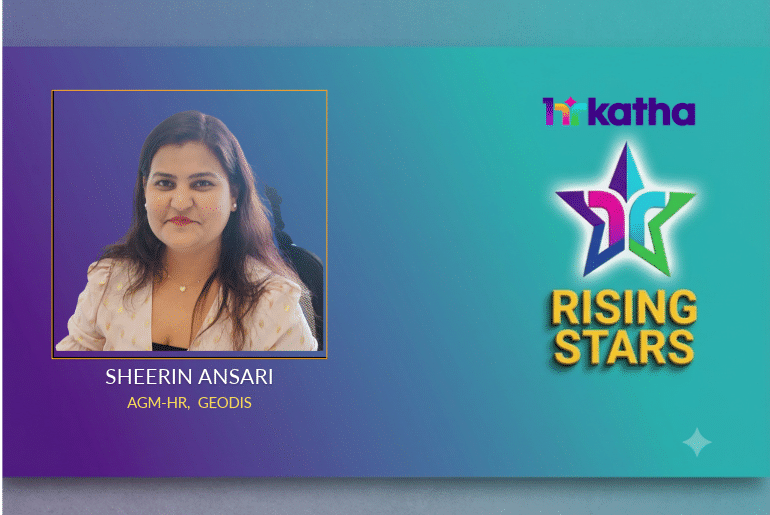
In her second week at GEODIS, Sheerin Ansari, assistant general manager, human resource, GEODIS, was approached by a member of the support staff who had noticed something unusual about her.
“Ma’am, it feels so nice that you ask how I’m doing.”
It was a small remark, but one that stayed with her. Ansari had simply been checking in, something she considered an ordinary part of interacting with colleagues. Yet, the response suggested that such attention was not necessarily as commonplace as she had assumed.
For Ansari, the experience reinforced a belief that has shaped her career in HR: meaningful communication often begins with something much simpler than a formal engagement initiative or an elaborate feedback mechanism.
It begins with making people feel that someone is genuinely interested in what they have to say.
Now assistant general manager, human resource at GEODIS, Ansari sees that everyday attentiveness as an important foundation for the trust HR needs to build across an organisation.
A voice doesn’t need a title
Ansari believes that speaking up should not depend on where someone sits in the organisational hierarchy.
Courage and conviction matter, she argues, but so does the willingness of others to listen.
Throughout her career, she has encouraged more transparent and regular communication between employees and leadership. Her reasoning is straightforward: when people believe their concerns can be raised and discussed openly, trust becomes easier to establish and maintain.
The challenge, however, is not merely encouraging employees to express themselves.
An organisation can invite feedback repeatedly and still struggle to create openness if employees believe that questioning a decision will carry consequences. Communication becomes meaningful only when people have reason to trust how their views will be received.
For Ansari, that makes openness a responsibility shared by employees, managers and HR, rather than something that can be achieved through a communication policy alone.
Ambition and responsibility
One of Ansari’s more personal challenges has been balancing professional ambition with responsibilities outside work.
Like many women building careers while managing family commitments, she has experienced periods when both demanded attention at the same time.
Her response was to become more deliberate about boundaries and more willing to communicate her priorities to managers and colleagues.
But she also learnt that individual effort has limits.
Supportive leaders, genuine flexibility and a dependable network at home and at work made an important difference. The experience taught her to distinguish between organisations that speak favourably about flexibility and those prepared to make it work in practice.
Ansari now draws on those lessons when mentoring others facing similar pressures. She encourages them to articulate what they need rather than assume their circumstances will be understood automatically. Equally, she believes professionals should pay attention to whether their working environment genuinely allows those conversations to happen.
The experience has made her more conscious of how much career progression depends not only on individual ambition but also on the conditions surrounding it.
Listening beyond the words
Ansari places relationship-building at the centre of effective HR.
For her, that means being able to connect with employees across levels, understand their concerns and establish enough trust for conversations to move beyond formalities.
Emotional intelligence is closely connected to that capability.
Employees do not always articulate what is troubling them directly. Sometimes the hesitation, tone or context surrounding a conversation can reveal as much as the words themselves. Ansari believes HR professionals need the patience to recognise those signals without jumping too quickly to conclusions.
Adaptability completes the picture.
As organisations change, employees face unfamiliar expectations, new ways of working and uncertainty about their roles. HR cannot rely entirely on established responses when the circumstances themselves are shifting.
For Ansari, the three capabilities reinforce one another. Relationships make conversations possible, emotional intelligence helps HR understand them, and adaptability determines whether that understanding can translate into a useful response.
Explaining the decision, not just making it
Ansari’s emphasis on communication becomes particularly important when HR has to implement an unpopular decision.
Her approach begins with examining the decision itself. Before communicating it, she wants to understand whether the reasoning is sound, whether it is consistent with the organisation’s values and whether it serves a defensible longer-term purpose rather than merely resolving an immediate difficulty.
Only then comes the conversation with employees.
Ansari believes people deserve a clear explanation of why a decision has been made, particularly when it affects them directly. That also means acknowledging concerns rather than treating disagreement as something to be managed away.
Transparency does not guarantee agreement. Employees may still consider the outcome unfair or undesirable. But explaining the reasoning and allowing people to express their concerns can make a difficult process more credible than simply announcing what has been decided.
For Ansari, the quality of HR communication is tested most seriously when the message is one people do not want to hear.
The choices behind a career
Ansari also draws perspective from an interview with former PepsiCo leader Indra Nooyi, whose reflections on career and personal responsibilities resonated with her own experience.
The idea that stayed with her was that professional and personal fulfilment rarely arrive without trade-offs. Different stages of life demand different choices, and the people who support those choices can influence how a career develops.
It is a perspective Ansari now brings into conversations with professionals navigating competing expectations. She does not believe there is a single formula for balancing ambition and responsibility. What matters is recognising the choices involved, communicating them openly and building the support needed to sustain them.
That view connects naturally with her broader approach to HR. Whether the conversation concerns career growth, personal pressures or an unpopular organisational decision, Ansari believes people respond better when they are treated as individuals whose circumstances deserve to be understood.
Quick Takes
Three words that describe her: Adaptable, collaborative, dedicated.
An unpopular HR opinion: Not every employee needs constant feedback. Some perform better when given the independence to work and demonstrate their capabilities without frequent intervention.
A question she wishes more people asked HR: “What can I do to develop my career within the company?” It opens a conversation about development and internal mobility.
How HR can better support rising leaders: Tailored mentorship and meaningful opportunities to practise leadership, rather than relying on titles alone.
Engagement driver: Recognition.
Why she is a Rising Star
Ansari’s approach to HR is grounded in attentiveness rather than elaborate frameworks. A simple conversation with a support staff member reinforced her belief that trust begins when people feel genuinely heard. Her own experience balancing career ambitions with personal responsibilities has also shaped how she mentors others. What distinguishes her is the consistency between these experiences and her approach to difficult decisions: listen carefully, understand the circumstances, and communicate openly even when the outcome is uncomfortable.
Rising Stars is HRKatha’s editorial series profiling the next generation of HR leaders shaping the future of the profession. The series features winners and finalists of the HRKatha Rising Star Leadership Awards alongside emerging professionals whose work, ideas and leadership potential deserve wider recognition.
