



Experience and self-discovery
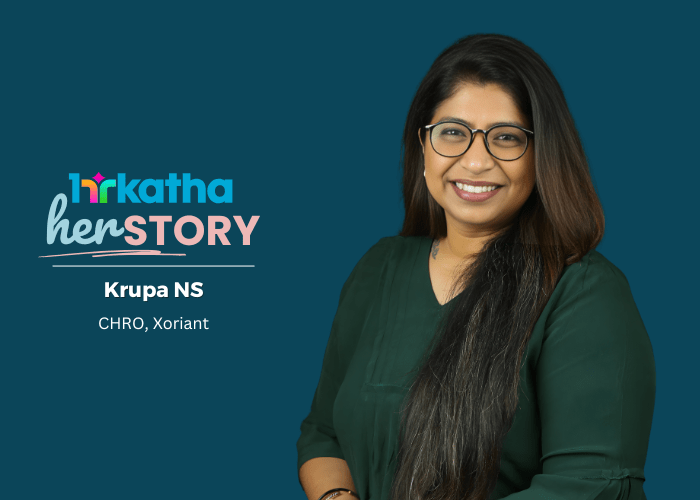
Krupa NS’ entry into HR was less a predefined decision and more an evolution shaped by experience and self-discovery. She began her professional journey in 1999, at a time when the function was still referred to as personnel management and industrial relations. Her first role at Aptech involved student relations, where engaging with people, understanding concerns, and enabling solutions came quite naturally to her.
Observing that her personality and strengths aligned strongly with people-centric roles, a mentor encouraged her to pursue formal education in HR. She subsequently completed her postgraduate studies in Personnel Management and Industrial Relations, going on to pursue advanced programmes that deepened her understanding of the function.

Over time, what began as an opportunity gradually became a conscious and deeply fulfilling career choice.
Today, as CHRO at Xoriant, Krupa leads with a philosophy forged through experience: trust is not accidental; it is a leadership responsibility.
To her younger self, Krupa’s advice would be to “be more vocal about your aspirations”. Early in her career, she believed that consistent hard work alone would speak for itself. However, she came to realise something critical.
“While performance is important, articulating ambition and sharing one’s perspective with leaders plays an equally critical role in shaping career growth.”
Navigating with competence and integrity
Krupa considers herself fortunate for not having experienced direct gender bias in her professional journey. Across organisations and roles, she has largely worked in environments where contribution and capability were valued above all else.
While workplace dynamics naturally present challenges and differing perceptions, Krupa’s experience suggests that fairness tends to follow when performance, credibility, and consistency remain the focus. She strongly believes that competence and integrity create their own space, and that mindset has helped her navigate her journey with confidence.
“Fairness tends to follow when performance, credibility, and consistency remain the focus.”
Trust all the way
Trust and transparency remain absolute non-negotiables for Krupa.
In her opinion, organisations don’t struggle because of change—they struggle because of uncertainty and silence. In any high-growth or technology-driven environment, evolution is constant. New capabilities, new structures, new expectations—all of that is inevitable. What determines whether an organisation stays stable through that change is trust.
And trust is not accidental; it is a leadership responsibility.
Transparency, in her view, is not just about sharing good news. It is about ensuring people understand not only what decisions are being made, but why they are being made. Even when outcomes are challenging, openness builds long-term credibility. When employees feel respected with information, they remain aligned—even if they may not agree with every decision.
At Xoriant, Krupa has had the opportunity to translate this belief into practice. “Our Career X framework brings clarity to growth pathways and expectations, reducing ambiguity around progression. Our performance systems are designed to encourage dialogue rather than one-sided evaluation. Leadership interactions across forums and All Hands ensure that communication remains continuous, not episodic,” shares Krupa.
Change can feel unsettling, but when people understand the intent behind it and see consistency in how decisions are applied, organisational stability strengthens.
For Krupa, culture is not built on comfort. It is built on confidence. And confidence comes from trust that is earned, consistently, over time.
‘No’ to rigidity
The mindset that needs to retire, according to Krupa, is rigidity—the assumption that established ways of working must remain unchanged simply because they have historically worked.
Today’s workforce operates with different expectations, motivations, and ways of contributing. HR must, therefore, move away from fixed frameworks and embrace adaptability.
What deserves greater attention is openness—particularly the willingness to listen to ideas irrespective of hierarchy. Innovation in people practices often emerges from unexpected places, and organisations benefit when HR actively creates space for diverse perspectives to influence decision-making.
Quick fire round
One book that changed your perspective on leadership?
The One Minute Manager—its emphasis on timely feedback and immediate recognition continues to influence my leadership approach.
Your mantra for difficult days?
“All is well.”
What’s the best career advice you’ve ever received?
Keep going—persistence matters more than momentary setbacks.
One thing you wish people understood about being a woman in HR leadership?
Women in leadership reach there through commitment, capability, and sustained effort—not circumstance or concession.
Morning ritual that sets you up for success?
Meditation, followed by cycling whenever possible, provides quiet reflection and mental clarity before the day begins.
Long-term capability versus short-term challenges
“Strategic HR is about building long-term capability—not just solving short-term challenges,” asserts Krupa.
It means thinking beyond policy implementation and asking a deeper question: Are we designing systems that strengthen both organisational performance and employee confidence? If the answer is ‘no’, then it is not strategic—it is reactive.
Strategic HR requires balancing business priorities with employee realities. It sometimes means constructively challenging established ways of working; investing in leadership depth before gaps appear; building skills before market disruption demands them.
At Xoriant, she has been fortunate to practice what she believes in. “Our push towards AI readiness is not just about technical certification. We have achieved 100 per cent AI literacy across the workforce, alongside a 64 per cent increase in hyperscale capability building. We have also institutionalised experimentation through Ideathons and AI challenges so that learning translates into applied capability,” shares Krupa with pride.
Various programmes and partnerships support high-potential women leaders, and ensure leadership capability evolves alongside business complexity.
Strategic HR, in practice, is about alignment—when learning, leadership, wellbeing, and performance systems reinforce one another. When employees feel secure in their growth and supported in their evolution, the organisation becomes not just future-ready, but future-confident.
Gratitude for candid guidance
Krupa’s growth has been shaped by several mentors and leaders across different phases of her career rather than a single individual. Experienced leaders guided her through important professional transitions and broadened her perspective on leadership.
What she values most about these relationships is the candid guidance and the willingness to share real-world experiences, both successes and setbacks. Those conversations helped her understand that leadership development rarely happens in isolation.
“It evolves through continuous learning, trusted relationships, and the collective wisdom of people who challenge and support you along the way,” believes Krupa.