



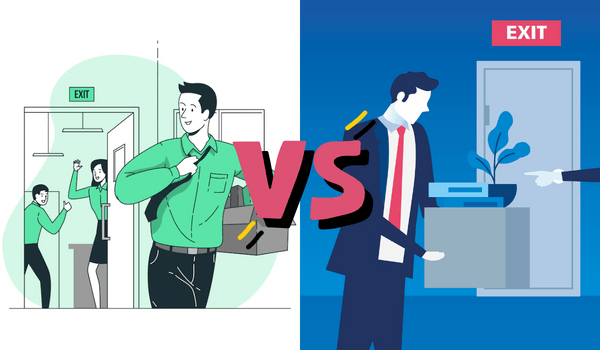
Although different terms, ‘attrition’ and ‘resignation’ are similar concepts. Both have a common outcome — loss of talent for the company. Hence, the two terms are often used interchangeably.
As Ajay Tiwari, senior VP-HR, Lupin rightly puts it, the two terms are flip sides of a coin. ‘Attrition’ is a more general term that encompasses all types of employee turnover, while ‘resignation’ specifically refers to employees choosing to leave their job.

“At the end of the day, whether it is ‘attrition’ or ‘resignation’, the company is losing people,” observes Manish Majumdar, head – HR, EMS, Centum Electronics. Both terms suggest a loss of human capital for an organisation, and impact the organisation equally.
“The Great Resignation was a trend characterised by employees leaving their jobs in search of better opportunities or to take advantage of the increased flexibility that resulted from the pandemic, as the economy seemed quite bright.”
Lalit Kar, senior VP & head – HR, Reliance Digital

The Great Resignation referred to the trend of employees leaving their jobs in large numbers due to the economic impact of the COVID-19 pandemic. The year after everything came back to normal post two years of lockdown, the economy seemed really bright and growing. “Companies were expanding, startups were mushrooming, and a lot of talent was available in the market”, says Lalit Kar, senior VP & head – HR, Reliance Digital. This trend was characterised by employees leaving their jobs in search of better opportunities or to take advantage of the increased flexibility that resulted from the pandemic.
Companies were welcoming talent across sectors and people also had many opportunities to try, but still there was attrition. “It is possible that after the Great Resignation, companies may have faced the Great Attrition as well,” he adds.
“In industries such as pharma and IT, both ‘resignation’ and ‘attrition’ are equally considered. In these sectors, we require certain niche/specific skills, which creates a lot of pressure to retain talent within the organisation.”
(Personal views and opinions)
Ajay Tiwari, senior VP-HR, Lupin

Talking about the current rough global scenario, Kar says that even though the global economy is facing many uncertainities due to various reasons — such as the rising inflation in the US and the UK, the Ukraine War, the upcoming recession, and the growing resistance to Chinese goods in European countries — attrition remains a reality. He further adds, “Attrition is more like a natural phenomenon that has always existed, along with resignation”.
However, even though the two concepts are similar, there are some key differences as follows:
External vs internal factors
The Great Resignation was more an outcome of external factors. “People had many options and they were eager to try new and better opportunities available. The Great Attrition, on the other hand, refers to a more general trend of employees leaving an organisation due to a variety of internal reasons,” points out Majumdar. This can include factors such as improper work functioning, low pay, lack of opportunities for advancement, and dissatisfaction with company culture.
Sector specific
Attrition is a trend that happens in certain sectors or specific divisions of a company. Tiwari opines, “In industries such as pharma and IT, both ‘resignation’ and ‘attrition’ are equally considered. In these sectors, we require certain niche/specific skills, which creates a lot of pressure to retain talent within the organisation.” These sectors keep expanding and hiring new talent even while maintaining the old employees to avoid any unnecessary talent gap. Also, this saves a lost in terms of hiring and training costs.
“Unlike The Great Resignation, The Great Attrition is not limited to a specific time period or event. It can happen over a longer period of time. It also damages the internal functioning of the company and breaks the morale of existing employees.”
Manish Majumdar, head – HR, EMS, Centum Electronics

Opportunities
People generally resign when they have a better opportunity, but in attrition, they do so even when they don’t have jobs in hand. As per a report by Mckinsey, 36 per cent of employees quit their jobs even without having a new job in hand. This is yet another way the Great Attrition differs fundamentally from previous downturn-and-recovery cycles.
Image of the organisation
Resignations do not really reflect badly on an organisation as the employees aren’t leaving because of the company. They are only doing so of their own accord, for their future growth prospects. They may have got the same opportunity with the current company after some time, but decided to seize the new opportunity with a senior role that came by. “If not for a new opportunity or offer, they would’ve stayed,” opines Majumdar. On the contrary, high attrition reflects badly on a company. These unhappy/dissatisfied employees moving on from the organisation may damage the employer branding and future networking opportunities of the company.
Time period
Unlike The Great Resignation, The Great Attrition is not limited to a specific time period or event. It can happen over a longer period of time. It also damages the internal functioning of the company and breaks the morale of existing employees. “It creates a domino effect,” says Majumdar. When productive employees leave, the morale of the existing employees is affected as they start questioning their own future at the workplace.
While Majumdar believes attrition is more fatal for an organisation, Kar thinks it is not something to be much concerned about.
Control
When many employees are leaving from a specific division, it may considered a trend, otherwise, attrition is not something significant. He further explains, “The Great Resignation was beyond our control, as the phenomenon was more on an economic level. India is still in a green position as we are still importing (good relations with Russia), and our economy isn’t as badly hit as the others (the US, China and the UK). Hence, The Great Attrition is not that major a concern, and it’s still in the hands of the company.”
Causes
Tiwari observes that a company can consider and work around the causes of attrition. Improved attrition will not only save costs in terms of training new employees, but also save the company from any business disruptions, and reduce the talent gap. He suggests that organisations conduct surveys to understand the root cause and then act accordingly. “There will definitely be some organisations that need no change, but some may require real attention,” he says.
While the Great Resignation is driven by external factors and can be difficult to fully control, companies can take steps to mitigate its effects. The Great Attrition is more internal and companies can have more control over it by implementing policies and strategies to reduce employee turnover and keep their current workforce engaged.