

Close Menu
    Facebook X (Twitter) Instagram
    • Our Story
    • Partner with us
    • Reach Us
    • Career
    Subscribe Newsletter
    HR KathaHR Katha
    • Exclusive
      • Exclusive Features
      • Perspectives
      • Friday Features
      • herSTORY
      • Case-In-Point
      • Point Of View
      • Research
      • HR Pops
      • Dialogue
      • Movement
      • Profile
      • Beyond Work
      • Rising Star
      • By Invitation
    • News
      • Global HR News
      • Compensation & Benefits
      • Diversity
      • Events
      • Gen Y
      • Hiring & Firing
      • HR & Labour Laws
      • Learning & Development
      • Merger & Acquisition
      • Performance Management & Productivity
      • Talent Management
      • Tools & Technology
      • Work-Life Balance
    • Special
      • HR Forecast 2026
      • Cover Story
      • Editorial
      • HR Forecast 2024
      • HR Forecast 2023
      • HR Forecast 2022
      • HR Forecast 2021
      • HR Forecast 2020
      • HR Forecast 2019
      • New Age Learning
      • Coaching and Training
      • Learn-Engage-Transform
    • Magazine
    • Reports
      • Whitepaper
        • HR Forecast 2024 e-mag
        • Future-proofing Manufacturing Through Digital Transformation
        • Employee Healthcare & Wellness Benefits: A Guide for Indian MSMEs
        • Build a Future Ready Organisation For The Road Ahead
        • Employee Experience Strategy
        • HRKatha 2019 Forecast
        • Decoding and Driving Employee Engagement
        • One Platform, Infinite Possibilities
      • Survey Reports
        • Happiness at Work
        • Upskilling for Jobs of the Future
        • The Labour Code 2020
    • Conferences
      • Leadership Summit 2025
      • Rising Star Leadership Awards
      • HRKatha Futurecast
      • Automation.NXT
      • The Great HR Debate
    • HR Jobs
    WhatsApp LinkedIn X (Twitter) Facebook Instagram
    HR KathaHR Katha
    zoha
    Home»Exclusive Features»Research»Spending on benefits programmes: A futile effort?
    Research

    Spending on benefits programmes: A futile effort?

    mmBy Dr. Prajjal Saha | HRKathaJune 16, 20154 Mins Read2913 Views
    Share LinkedIn Twitter Facebook WhatsApp
    Share
    LinkedIn Twitter Facebook WhatsApp

    A report by Towers Watson indicates that Indian companies are seeing a major gap between the amount they spend on employee benefits and the value they get in return.

    A highly competitive job market often sees companies rolling out reward programmes and schemes to keep their employees happy. Meant as a retention strategy, these schemes, if designed properly, can help an organisation achieve short-term and long- term goals.

    zoha

    However, a study by leading global professional services company, Towers Watson,— 2015 Asia Pacific Benefit Trends — indicates that only 18 per cent of the respondent companies from India believed that benefits are highly valued by employees. What is even worse is that around 17 per cent of Indian companies, which participated in the survey, failed to evaluate the actual spend on benefits. This is despite the fact that around 30 per cent of Indian companies spend over 20 per cent of their payroll on benefits.

    Anuradha Sriram, director of benefits, Towers Watson India, finds this to be an alarming trend because if employers themselves are unaware of their spend, how will it percolate to the employees. This implies that there will be low employee awareness and appreciation of benefits provided.

    “A successful and effective benefits programme must be aligned to employee needs, communicated clearly and delivered seamlessly for it to be truly appreciated and valued by employees,” she says.

    Employee benefits are a key differentiator in the EVP basket, and how successful such programmes are for Indian companies is evident from the fact that a majority of Indian employers are facing challenges in attracting and retaining top-performing and high-potential employees, as revealed by another Towers Watson study — TW Global Talent Management & Rewards Survey

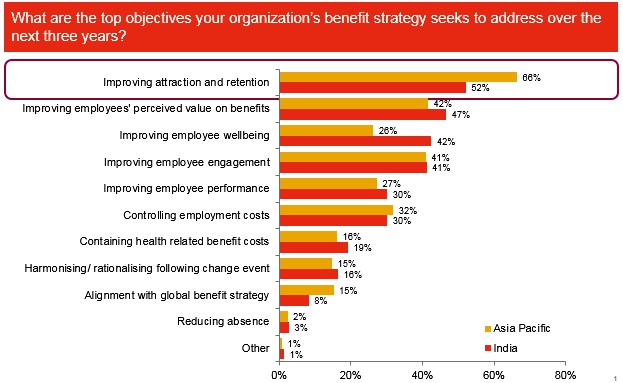
    It is not that the Indian companies are ignorant of the importance of employee benefits and rewards programmes. The survey reveals that 52 per cent of the companies surveyed in India opined that improving attraction and retention of talent is the major focus of their benefit strategies. However, it is still low as compared to other companies in the Asia Pacific region, where the average is 66 per cent.

    In comparison to the Asia Pacific region, Indian employers spend a larger proportion of their total benefits budget on providing health-related assistance. 55 per cent Indian employers spend more than a quarter of their benefits budget on health-related benefits compared to 38 per cent in the region. However, this is not the top category. Annual leave and medical inpatient remain the most prevalent benefits in the country, and employees now expect medical screening to be offered to them in the foreseeable future.

    zoha

    The importance of communicating the advantages of benefits programmes to the employees is evident from the fact that companies which did so rated its effectiveness in a higher percentage than the ones which did not.

    Around 20 per cent of Indian employers who communicated the advantages said their benefits were highly valued while for companies which did not, the figure was only five per cent.

    A similar effect was seen among companies that take employee insights into account while determining which benefits to offer. The number of Indian organisations that said benefits were highly valued is more for companies that take employee insights into account (18 per cent) compared to those that do not (6 per cent).

    While a vast majority of Indian employers gather employee insights on benefit programmes in some form, the country ranks lowest when it comes to organisations involving employees in determining which benefits to offer.

    Sriram believes that this gap is the major reason behind the considerable difference between the amount of money companies spend on employee benefits and the value they get from it. “This contradiction is a major contributor to the gap between benefit spend and perceived value. At a time when organisations are aiming to leverage benefits as an attraction and retention tool, employee opinion must play a far more important role in determining the benefits being offered,” she said.

    The 2015 Asia Pacific Benefits Survey tracks trends in Asia Pacific-based employers’ benefits plans and strategies, with a particular focus on cost and value perception.

    A total of 1,145 organisations across 20 countries in the Asia Pacific, including approximately 100 from India, participated in the survey, making it the most comprehensive benefits trends survey conducted in the region.

    Anuradha Sriram director of benefits Employee Benefits Towers Watson Towers Watson India
    Share. LinkedIn Twitter Facebook WhatsApp
    mm
    Dr. Prajjal Saha | HRKatha

    Dr. Prajjal Saha is a business journalist and the editor-publisher of HRKatha. He writes on the realities of work and organisations, offering a clear-eyed view of how companies translate intent into action—often revealing the gap between the two. With over 25 years of experience, he focuses on interpreting workplace trends and leadership decisions in a way that is both insightful and accessible. He founded HRKatha in 2015 to create a platform for credible, insight-driven analysis of the evolving workplace.

    Leave A Reply Cancel Reply

    Related Posts

    Case-in-Point: When managers game the system to protect their teams

    July 2, 2026

    Tamil Nadu enhances health insurance cover for employees & pensioners

    July 1, 2026

    Orissa HC upholds retiral benefits for employees, pulls up Odisha govt for delay

    July 1, 2026

    Nissan probes employee data breach after Oracle cyberattack

    July 1, 2026
    Editorial

    Every IPO tells two stories

    Someone I know spent eight and a half years building the research function at a…

    The two cultures inside the same multinational

    Someone I know works with one of the world’s largest technology and consulting firms. Based…

    EDITOR'S PICKS

    Case-in-Point: When managers game the system to protect their teams

    July 2, 2026

    herSTORY: Niyathi Madasu, CHRO, Premier Energies

    July 2, 2026

    Cybersecurity doesn’t have a hiring problem. It has a capability problem!

    July 1, 2026

    HR Perspectives by Preeti Kannan: “ AI is no longer optional, it is the way forward”

    July 1, 2026
    Latest Post

    Prashant Srivastava appointed CPO, Imperial Auto Industries

    Movement July 2, 2026

    Imperial Auto Industries, the Indian integrated manufacturer and assembler of fluid transmission products, has roped…

    Kanwaljeet Singh Bakshi is now CHRO, IndiGo

    Movement July 2, 2026

    IndiGo has announced the appointment of Kanwaljeet Singh Bakshi as its new chief human resources…

    Delhi Wipro employee shares shock of sudden layoff after 6 years

    Employee Behaviour July 2, 2026

    A Delhi-based employee of Wipro has spoken about losing her job after working with the…

    Nandini Bhalla to lead HR for L’Oréal Dermatological Beauty, India

    Movement July 2, 2026

    L’Oréal has elevated Nandini Bhalla to head-HR for the L’Oréal Dermatological Beauty division in India.…

    Asia's No.1 HR Platform

    Facebook X (Twitter) Instagram LinkedIn WhatsApp Bluesky
    • Our Story
    • Partner with us
    • Career
    • Reach Us
    • Exclusive Features
    • Cover Story
    • Editorial
    • Dive into the Future of Work: Download HRForecast 2024 Now!
    © 2026 HRKatha.com
    • Disclaimer
    • Refunds & Cancellation Policy
    • Terms of Service

    Type above and press Enter to search. Press Esc to cancel.