

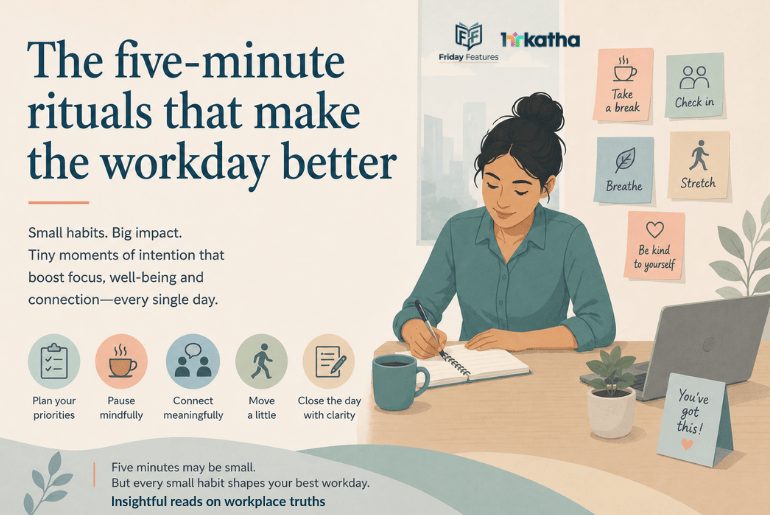
Most workdays are not transformed by sweeping leadership initiatives or ambitious culture programmes. They are shaped by things far smaller and far less visible: the cup of coffee shared before the day begins, the three priorities written down before opening email, the short walk between meetings that nobody schedules but almost everyone needs.
These habits rarely appear in employee handbooks. They do not feature in engagement surveys or culture presentations. Yet they quietly influence how people begin, navigate and end their day, and over time their effect on focus, wellbeing and connection is often far greater than their size suggests.
Three HR professionals reflect on the small habits they have seen shape workplaces and why organisations would do well to make room for them.
The habits nobody prescribes
Bhawna Kirpal Mital, CHRO, Hero Future Energies
Bhawna Kirpal Mital has watched a quiet variety of habits emerge across her organisation, and what strikes her most is how personal they are.
Some employees begin the day by writing down their top three priorities before opening a single application. Others move deliberately between collaborative spaces and quieter rooms depending on the work ahead. Some keep lunch free from phones. Others clear their desks before logging off and leave themselves a note about where to begin the next morning.
What connects these routines is intention. Each creates a brief moment where people decide how they want to work instead of allowing the day to dictate the pace. Small choices, repeated consistently, often have a greater influence on productivity than elaborate systems designed to improve it.
She has noticed something similar in the habits that strengthen relationships. Joining a virtual meeting a few minutes early for informal conversation. Checking in with a colleague without needing a reason. Sending a quick message acknowledging someone’s contribution. None of these takes more than a few minutes, yet together they build the trust and familiarity that no team-building workshop can manufacture.
Her conclusion is refreshingly practical. Encourage these habits, but resist the temptation to prescribe them. What restores one person may exhaust another. The organisation’s responsibility is to create the space, not write the routine.
When the workplace becomes part of the habit
Shireesha Sunderraju, Director HR and People Success Partner, Aziro
Shireesha Sunderraju believes many of the moments that improve a workday happen before anyone has opened a laptop.

At her organisation, the journey through the office has become part of the experience. A greeting at reception. A glance at the day’s highlights in the lounge. A quick stop at the vending machine that unexpectedly turns into a conversation. Even a game of carrom before the first meeting often gathers colleagues who otherwise might not have met until much later.
None of these interactions is organised. That is precisely why they work. They create the informal connections that formal engagement programmes often struggle to replicate, making people feel that they belong somewhere rather than simply work there.
The afternoon brings its own informal rhythm. A short walk, a stretch before the next meeting, a conversation that starts at the coffee machine and ends with a problem solved that no one had scheduled time to discuss.
Her observation is simple. Five minutes, used intentionally and consistently, can accumulate into something that looks remarkably like culture.
The habits people bring with them
Neena Chakraborty, VP HR, Rainbow Hospitals
Neena Chakraborty approaches the subject from a different angle. Before asking which habits organisations should encourage, she asks where those habits come from in the first place.
Her answer is that they are rarely created at work. Values, upbringing, family routines and cultural influences shape how people behave long before they join an organisation. The employee who waters the plant on their desk every morning is not following a productivity technique. They are bringing a part of themselves into the workplace.
Understanding that, she argues, gives leaders a better understanding of people. Habits often reveal values more clearly than personality assessments ever could, and leaders who recognise those patterns are usually better equipped to coach, communicate and build trust.
She has also seen how organisations can create conditions in which positive habits emerge naturally. A recognition board that employees pass on their way into work. A short mood check before the day begins. Events built around employees’ genuine interests rather than generic engagement exercises. None of these is particularly dramatic. Together, however, they send a clear signal that the organisation notices people before it measures performance.
Her broader point extends well beyond daily routines. Behaviours that are recognised become habits. Habits repeated across enough people become culture. And culture, more consistently than any process or technology, is what sustains performance over time.
Why small habits outlast big initiatives
Organisations invest considerable time and money in programmes designed to improve engagement, wellbeing and connection. Many deliver results for a while before quietly fading.
The habits described here work differently. They sustain themselves because they belong to the people practising them rather than to the programme that introduced them. Nobody needs a reminder to check in with a colleague or take a thoughtful pause before ending the day. Once those behaviours become personally meaningful, they have a habit of staying.
Perhaps that is the most useful lesson for organisations. The goal is not to design every habit employees should adopt, but to create workplaces where positive habits emerge naturally. Spaces that encourage conversation. Leaders who model the behaviours they hope to see. Cultures where a short pause is recognised as good judgement rather than reduced commitment.
The five-minute habit is not another wellbeing initiative. It is simply what happens when people are given enough trust to work like human beings.