




Adoption of digital learning platforms had always been a challenge for companies, till the pandemic came along and brought about significant changes.
Many employees were forced to work from home and many HR processes went virtual and digital, much earlier than expected. Similarly, companies made employees meet their learning goals using digital and virtual-learning platforms. Even a study on the future of learning during COVID-19, published by Deloitte, says that the impact of COVID-19 increased the adoption of existing learning platforms in employees. More than 60 per cent of companies in India saw an increase in adoption of existing learning platforms by 20 per cent.

Reena Wahi, head – HR, Tata Realty & Infrastructures, shares that in their company, the adoption rate of their learning management software (LMS) was below 20 per cent. The reason for such a low adoption by the employees was the repository model, wherein a stock of content was available for employees, and they could choose what they wanted to learn. This content on the earlier LMS system was not even updated. “The content was quite static in nature, which never really attracted the employees and we had to adopt a push factor to make employees complete their courses,” points out Wahi.

Measures of improvement
New LMS: Now, however, with the implementation of the new LMS framework, the learning content available is quite vast. Wahi explains that now the content comes from various channels and sources, in the form of articles, videos, presentations and books. Moreover, the Company has also tied up with other learning vendors— that provide certification courses in project management — whose content is also available to the employees.
Multiple sources of content: Relevant news feeds from social-media platforms are also a source of content for employees. For instance, if employees prefer to consume learning content from YouTube, that content is also available to them on the learning system. “Now, there is not just ‘one’ single source of content for employees, but many,” mentions Wahi.
“Now that we have managed to increase the adoption rate, our next aim will be to sustain this achievement”
Reena Wahi, head – HR, Tata Realty & Infrastructures

Notification of updates: Additionally, if there is some updated content available for the employees on a particular subject they prefer, they are notified about the same. For instance, if they wish to learn about digital transformation, they get notified about any updated content available on the same. Earlier, if one completed five modules in a course, then that was pretty much the end. That is because, no further content updates were available for the employee.
Clearly, updations and notifications helped Tata Realty increase the adoption rate.
Co-owning processes: Another important factor was the changing of people’s mindset. “One way of digitising a process is to just bring in the technology and expect the employees to adapt to it. The other way is to make them co-own it,” Wahi explains.
Tata Realty chose the second path. It made employees co-own this change in the learning framework, which majorly helped them increase participation. The Company made a cross-functional team comprising people from sales and customer service, as well as project managers, designers and civil engineers from different geographies.
Cross-functional team: The cross-functional team was created with the objective of handling operations, developing content, as well as testing and implementing technology. The members of this team have now become the points of contact for employees, who may have queries regarding the learning platform.
“This has made our employees co-own this project and implement it in an effective way,” shares Wahi proudly. This cross-functional team helped understand the challenges in the low adoption rate and implemented the new technology in a more effective way.
 The team also had subject matter experts (SMEs) who helped curate content for the new learning framework. Tata Realty’s own employees are also developing content for their peers. For instance, if some employees from the designing team come across new and relevant information, they just create a presentation, so that the knowledge can be available to their peers on the LMS platform.
Knowledge sharing culture: Tata Realty is trying to create a learning culture where knowledge sharing is encouraged. The employees who take up a course suggest and recommend the same to their colleagues if they find the content relevant.
“At Tata Realty, we have a learning theme, wherein managers create a learning opportunity for their team members every day, and people are encouraged to start taking steps to acquire a new skill every day,” asserts Wahi.
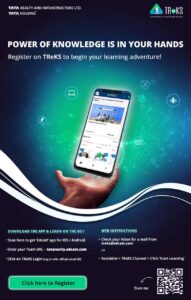 With these determined efforts, within a month, the adoption rate of digital learning content at Tata Realty rose to 70 per cent, which is a commendable achievement for any company.
Sustainability
“Now that we have managed to increase the adoption rate, our next aim will be to sustain this achievement,” says Wahi.
The real-estate sector has been majorly disrupted by the new ways of delivering solutions to their clients and customers. People want smart technologies and infrastructures at home, and on the commercial side, workplaces are now being designed to support a hybrid model of working.
Companies do not require big spaces any more, as their full employee strength is not really showing up physically at the workplace. Even during the development of infrastructure, digital monitoring tools such as drones are being used to monitor and provide updates to customers on construction.
The sales team is working on a digital sales model and using 3D technologies to attract customers and provide an immersive experience.
As part of its future learning strategy, Tata Realty is really looking at building skills such as digital, techno-commercial and risk-management skills, which have become essential during the pandemic.