


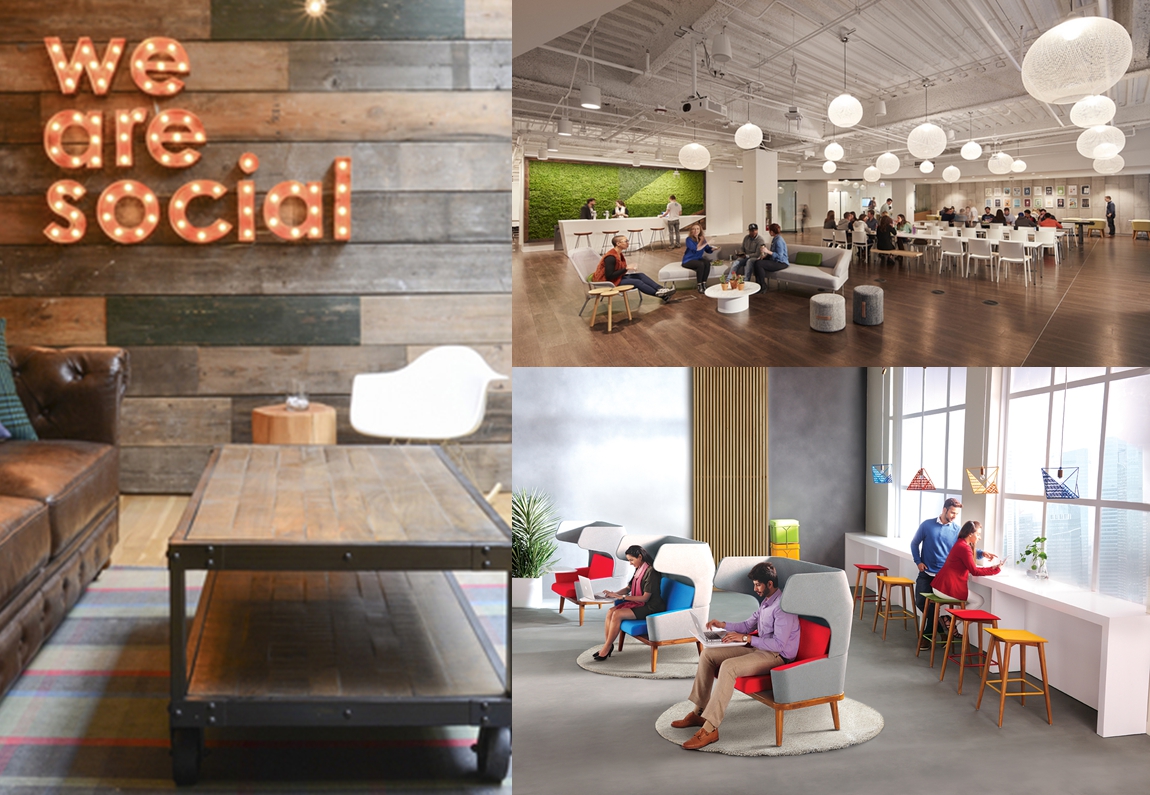
A social office allows different people to interact and collaborate bringing them out of their silos and work boxes, thus enhancing team productivity.
From the traditional office layout to open office spaces, organisations are now looking at this new concept of ‘social office’, which allows different people to collaborate and converse. This kind of interaction brings them out of their silos and work boxes, thus enhancing their productivity as a team. It gives people an opportunity to work closely and mentor one another, while promoting an environment of collaboration between different departments and services.
Office designs are now becoming more colourful, vibrant and most importantly, devoid of the monotony of traditional office designs. More than the aesthetics, it is about the ease of function, interaction and collaboration that these new office layouts offer as compared to the past when people were happier working in their own silos.
Cushman & Wakefield’s office is designed on the concept of a social office. The Company believes that workplace design is extremely important in determining the creativity of its people. “The AMO theory states that performance of an employee is dependent on three broad factors—ability, motivation and opportunity. Therefore, the workplace needs to create an environment that encourages ideas and helps boost performance. This extends to the workplace design, which should be able to provide a robust platform that allows employees to bring their varied approach and mindset on board,” says Deepali Bhardwaj, executive director-HR, Cushman & Wakefield.
Office designs are now becoming more colourful, vibrant and most importantly, devoid of the monotony of traditional office designs.
Bhardwaj feels that a workplace needs to facilitate collaboration and creativity, dispelling traditional workplace concepts and rethinking to make a workplace more flexible, agile, engaging, inspiring, receptive, sustainable, and capable of elevating workforce productivity.
Despite the fact that technology has eased out work pressures by taking away most of the physical, mechanical or administrative load, many people today end up spending more time in office as compared to their counterparts a decade back. People now spend a very large amount of time in the office spaces, amounting to almost 10–12 hours in a day. In that, most people spend a large part of their day sitting.

More than the aesthetics, it is about the ease of function, interaction and collaboration that these new office layouts offer as compared to the past when people were happier working in their own silos.
Moreover, the intensely competitive nature of today’s workspaces has made tight deadlines an innate part of the modern office and having to deliver on these deadlines means working consistently without breaks and distractions. This is also the reason behind the sedentary lifestyle- related disorders in most people who work in the corporates.
A research conducted by Godrej Interio Ergonomics Team studied the effects of static postures amongst office goers in India. It revealed that a large number of office workers suffer from multiple pain problems, with 76 per cent complaining of musculoskeletal pain/discomfort in the last six months.
There were other worrisome stats the research revealed— 64 per cent of the employees studied, spendover nine hours of their time sitting – either at their own desks, in meetings or in conferences. While, 68 per cent work continuously at their workstations, 75 per cent attend long conferences every day.
Today’s office designs need movement, interaction, sitting postures that help break monotony, and spaces to relax during short breaks while at work.
These statistics, the longer work hours, static postures for long stretches of time and the common workplace design that doesn’t require people to walk around much, are all a threat to employee wellness. All this further indicates the need for unique office designs that allow movement, interaction, sitting postures that help break monotony, and spaces to relax during short breaks while at work. The answer to all this lies in the concept of a ‘social office’.
Looking beyond the concept of an ‘open office’, a social office allows a perfect balance of collaboration and privacy, beyond the limitations of traditional office setups.

Anil Sain Mathur, COO , Godrej Interio, says, “A social office allows organisations to build spaces that enable personal focussed work (Immerse), encourage face to face interaction (Interact) and allow relaxation at the workplace (Unwind).”
He further explains that a social office breaks away from the typical concept of an open office. It consists of elements, such as poufs, stools, enclosed seating, sofas, quirky lamps, armchairs and other such elements that create a home-like feel in the office, allowing a sense of comfort and belonging within the workplace, while maintaining its functionality such that work continues to happen seamlessly. A social office allows workers the choice and freedom of choosing where to work from and how to work.
“Social office creates the sort of informal and pleasing environment that makes people want to be at work and to meet and interact. This not only results in more ideas, but better ideas and a strong sense of belonging. This also creates a sense of control, and therefore, satisfaction with one’s work situation,” says Mathur.
That said, Bhardwaj also shares that they identified the need to allow employees to work closely with each other, and hence design their office accordingly. “The physical space of an office has great impact on the performance of the staff. Therefore, the physical attributes, such as colours, lighting, exposure to daylight, break out areas, collaboration spaces and locations for relaxation are critical in creating a more enabling environment. The physical space and an enabling environment help to create more responsive employees,” she opines.
A social office allows organisations to build spaces that enable personal focussed work (Immerse), encourage face to face interaction (Interact) and allow relaxation at the workplace (Unwind).
Today’s office workers rate workspaces full of cabins and cubicles as boring. Most people now prefer functioning out of cafeterias, work lounges, break-out spaces and so on, rather than spend all of their time at a single workstation. This means that office is no longer formal. Employees prefer a more social space that facilitates easy collaboration and interaction. Most organisations looking at redesigning or revamping their office spaces are cognizant of the trend.
For instance, even Piramal recently inaugurated its new office, which has a biophilic design along with a more social and open setup. As organisations increasingly look at adopting new and unique layouts for their offices, workplaces seem to be getting closer to the idea of a ‘second home’ conceptually, if not literally!