


The architecture of workplace wellness is built largely around problems organisations know how to see. Physical health produces insurance claims, hospitalisation data and medical costs. Mental health increasingly appears through counselling utilisation, absenteeism and employee surveys. Engagement has its scores. Attrition has its dashboards.
Financial stress is more elusive.
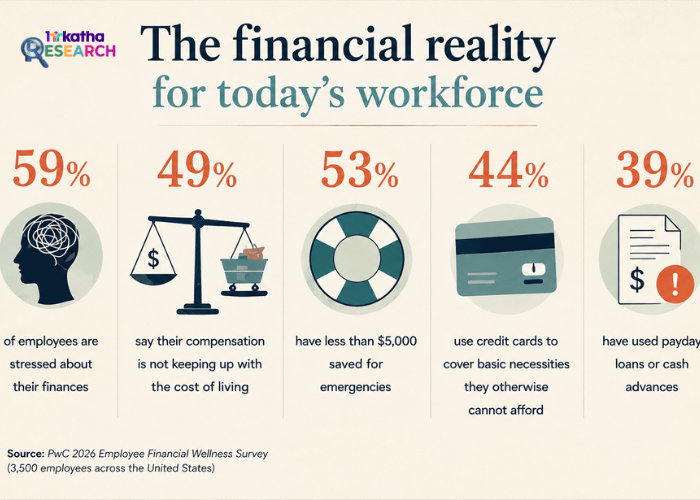
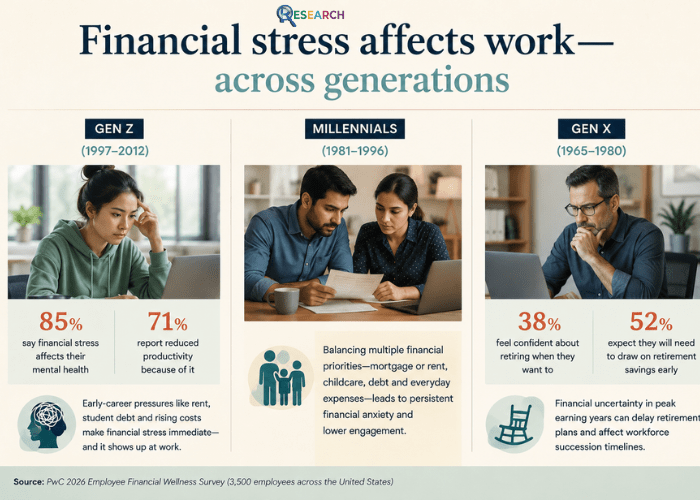
A 2026 Employee Financial Wellness Survey by PwC, covering nearly 3,500 employees across the US, suggests that this may be a significant blind spot. Fifty-nine per cent of respondents say they are currently stressed about their finances. Among Gen Z employees, 85 per cent say financial stress affects their mental health and 71 per cent say it reduces their productivity.
The numbers underneath that anxiety are more revealing. Nearly half ( 49 per cent) say their compensation is not keeping pace with costs. More than half have less than $5,000 saved for emergencies, while 30 per cent have less than $1,000. Forty-four per cent use credit cards to pay for necessities they otherwise cannot afford, while 39 per cent have used payday loans or advances.
These are not principally the problems of employees worrying about whether their retirement portfolios are sufficiently diversified. They describe something more immediate: a workforce with remarkably little room for financial error.
For employers, that should change the way the problem is understood.
The stress that arrives at work
Money may be a private matter. Its consequences are not.
An employee worrying about rent, debt or an unexpected expense does not stop worrying when the working day begins. Financial decisions compete with professional ones for attention. The survey makes that relationship particularly visible among younger employees, with 71 per cent of Gen Z respondents reporting reduced productivity because of financial stress.
The mechanism is not difficult to imagine. Financial anxiety affects mental health, sleep and self-esteem. Each can influence how an employee experiences and performs at work.
Yet organisations may encounter the consequences without identifying the underlying condition. The distracted employee becomes a productivity issue. The anxious employee becomes a wellbeing issue. The person seeking a better-paying job becomes an attrition statistic.
The financial pressure underneath them may never become a workplace metric at all.
That is what makes financial stress different from many of the problems HR routinely measures. It can appear elsewhere in the data while remaining invisible in its own right.
The emergency-savings problem
The most revealing statistic in the survey may therefore not be the 59 per cent reporting financial stress.
It may be the absence of a financial cushion.
More than half of employees have less than $5,000 available for emergencies. Three in ten have less than $1,000. Even among higher earners, one in three worries about meeting household expenses each month.
That last finding is particularly important. Financial stress is easy to interpret as a low-income problem. The data suggests it does not disappear neatly as salaries rise.
Income and financial resilience are related, but they are not the same thing. Household commitments rise, debt accumulates and lifestyle costs adjust. A higher salary can therefore coexist with surprisingly little capacity to absorb a financial shock.
This creates an interesting mismatch between how organisations and employees experience compensation. Employers tend to think about pay periodically: annual increments, compensation reviews, bonuses and market benchmarking. Employees experience their finances continuously, one rent payment, loan instalment, grocery bill and unexpected expense at a time.
The salary may be annual. Financial security is monthly.
The American numbers raise an Indian question
The survey is American and its percentages should not be transplanted onto the Indian workforce. Income levels, household structures, social protection, debt markets and employee benefits differ too substantially for that.
But the underlying question travels rather well.
India’s Economic Survey, drawing on PLFS data, put average monthly earnings for regular salaried workers at Rs 20,702 nationally in 2023-24 and Rs 23,974 in urban India. Those numbers cannot tell us how financially stressed Indian employees are. Nor can they be compared directly with the American survey.
They do, however, make financial resilience an equally legitimate workplace question in India.
An employee’s vulnerability depends not simply on income but on what remains after housing, transport, dependants, debt, healthcare and other household expenses have been met. At very different absolute income levels, American and Indian workers may experience very different forms of financial pressure.
What Indian employers know far less about is how much of that pressure enters the workplace with them.
When a money problem becomes a productivity problem
This is where the distinction between financial wellness and financial literacy becomes useful, though not in the way it is usually framed.
Forty-one per cent of respondents say their education or background did not adequately prepare them to manage their finances, while 52 per cent do not feel capable of planning for longer-term financial goals.
Knowledge clearly matters.
But knowledge cannot explain everything in a survey where 49 per cent say their compensation is not keeping up with costs and 44 per cent are using credit cards for necessities.
Someone struggling to understand compound interest may have a financial-literacy problem. Someone who understands it perfectly but does not have enough money left at the end of the month has a different problem.
For employers, conflating the two is convenient because education is easier to provide than financial headroom. But the distinction matters when interpreting workforce behaviour. Not every financial problem can be solved by teaching employees to manage money better.
Sometimes there simply isn’t enough margin to manage.
Today’s financial stress can become tomorrow’s succession problem
The effects also stretch much further into an employee’s career.
Fifty-two per cent of respondents believe they are likely to need to draw on their retirement funds. Among Gen X employees, who are approaching the period when retirement preparation should be most advanced, only 38 per cent are confident they will be able to retire when they want to.
At first glance, that appears to be an individual financial problem.
Eventually, it can become an organisational one.
Workforce planning rests on assumptions about movement. Senior employees retire, successors move upwards and younger employees progress into the vacancies created beneath them. If substantial numbers of employees remain in work longer than expected because they cannot afford to leave, some of those assumptions begin to shift.
Delayed retirement is not necessarily bad for an organisation. Experienced employees staying longer can preserve valuable institutional knowledge. But unplanned delayed retirement is different. It can affect succession timing, workforce demographics and the movement of talent through an organisation.
A private financial vulnerability accumulated over decades can therefore surface eventually as a workforce-planning constraint.
That is an unusually long journey for something HR may never have measured at its source.
The measurement blind spot
HR has become extraordinarily good at measuring what employees do.
It knows who leaves, who stays, who is absent, who is engaged and, increasingly, who is at risk of leaving. Organisations benchmark compensation, track wellbeing and measure sentiment with a sophistication that would have been unimaginable two decades ago.
What they cannot always see is why several apparently separate indicators may be moving together.
Financial stress is a useful example precisely because it cuts across conventional HR categories. It can affect mental wellbeing without originating as a mental-health problem. It can reduce productivity without being a capability problem. It can influence an employee to leave without being a career-development problem. And much later, it can affect retirement without beginning as a succession problem.
The employee remains one person. The HR dashboard turns that person’s experience into several different metrics.
What the numbers are really saying
The survey describes financial wellness in surprisingly modest terms: less stress, fewer surprises and the freedom to make financial choices with confidence.
For much of the workforce surveyed, even that appears difficult to achieve.
The employer cannot solve every employee’s financial circumstances, nor is that the argument the data supports. Financial decisions remain personal, household circumstances vary enormously and organisations cannot reasonably become responsible for everything affecting an employee outside work.
But the boundary becomes less clear when the effects cross into work.
If financial anxiety reduces concentration, affects mental health, changes decisions about leaving and eventually alters retirement timing, then it is difficult to continue treating financial health as entirely separate from workforce health.
That is the larger blind spot exposed by the research.
HR measures engagement. It measures productivity. It measures attrition. It plans succession.
What it may not know is how often the money problem came first.