



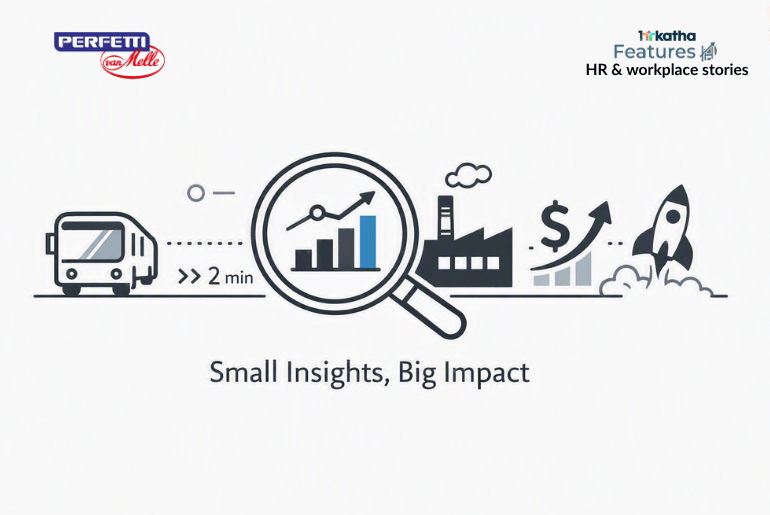
At 1:50 pm, a worker steps off a bus outside a manufacturing plant. The shift begins at 2 pm. Between the bus stop and the production line sits a sequence of small actions: checking in, changing, washing and handing over, which can at times lead to loss of critical time to start the line.
Perfetti Van Melle India began examining exactly this part of the workday. The exercise shaved two minutes off the process. According to Avishek Roy, director of human resources, as per a recent study conducted, those two minutes translated into an estimated 300 to 400 tonnes of additional production output per month across the plant.
It is an unusual destination for HR analytics.
Rather than remaining inside attrition dashboards and engagement scores, something as ordinary as a bus arrival time had entered a supply-chain conversation.
“The endeavour is how do you make that data come together? How do we leverage technology to bring it together, connect it to each other, and then use that data access to insight holistically to make decisions?” Roy says.
That is increasingly the proposition behind HR at Perfetti. The objective is not to accumulate more people data. It is to connect that data to what the business is trying to accomplish.
Technology across a divided workforce
Most conversations about AI and workplace technology quietly assume employees sit behind laptops.
Perfetti’s workforce does not.
It spans manufacturing plants, frontline sales teams and corporate offices. Technology consequently enters each part of the organisation differently.
Salespeople no longer take orders on paper. Handheld devices can help to navigate the salesperson to the next outlet on a route and surface information about previous purchases, likely order values and stock-out risks. The salesperson arrives with more information and less guesswork.
At the plants, the economics are different.
Perfetti is exploring Industry 4.0, but many of its products sell for around one rupee. Automation cannot therefore be justified merely because something can be automated.
“The endeavour is how do you make the workforce data come together? How do we leverage technology to bring it together, connect it to each other, and then use that data access to insight holistically to make decisions?”
Avishek Roy, Director-HR, Perfetti Van Melle

Roy calls the approach “affordable automation”. Line-efficiency data and maintenance parameters are increasingly automated. Other production processes remain manual because the economics of replacing labour with machines simply do not make sense.
That qualification is important in India, where automation debates can become detached from labour economics. The technologically advanced answer is not necessarily the commercially intelligent one.
“A lot of the repetitive task is going to go away, which will also mean enrichment of jobs,” Roy says.
The aim, then, is not to make every job digital. It is to decide which parts of a job technology should take away and what people should be able to do instead.
The leader who knows where the machine is
Perfetti expects its senior leaders to remain unusually close to operations.
The management team and other senior executives are aware of the machines on the plant floor, why they are positioned there and their production parameters.
But technical depth is no longer enough.
The company is trying to build what it describes as enterprise thinking: the ability to understand how a decision inside one function affects the wider business. Resilience, listening and empathy sit alongside that expectation, particularly as different generations work together.
Technology has also reversed some traditional assumptions about where expertise resides. Senior employees may know considerably more about the business while younger employees know considerably more about the digital tools entering it. Reverse mentoring is one way Perfetti is attempting to make those two forms of knowledge travel in both directions.
The same desire for immediacy sits behind Infeedo, a real-time employee-listening platform introduced recently. Within three to four months, nearly half the workforce had begun responding. Perfetti reported a mood score above 4.5/5 and engagement above 85 per cent.
The more interesting point is not the score.
It is the timing.
Annual surveys often tell organisations what employees thought several months ago. Real-time listening gives managers an opportunity to respond while the experience is still unfolding and, potentially, before dissatisfaction turns into resignation.
Learning without the catalogue
Perfetti has also resisted the idea that learning should begin with a standard catalogue of courses.
Training is built around what employees and managers identify as current requirements and what the organisation expects to need next.
LearnUpon provides self-directed learning paths, including journeys for new joiners and first-time managers. Much of the content runs for 15 to 30 minutes and can be completed at the employee’s own pace.
But digital learning is only one layer.
The Operational Learning Academy and Marketing Learning Academy bring external experts into the organisation. Employees also spend time outside Perfetti. One group recently visited PepsiCo to examine practices that might be adapted internally. Others travel to Perfetti operations in the Netherlands and elsewhere, returning with ideas that can be tested in India.
The principle is more interesting than the programmes themselves.
Organisations with long-tenured employees can become very good at teaching people how they do things. The danger is that learning gradually becomes institutional reinforcement.
Deliberately exposing employees to how other organisations operate introduces an outside in perspective.
That matters particularly at Perfetti because its employees tend to stay.
Retention measured in years
Average employee tenure at Perfetti is 11 to 12 years. Attrition is around 15 per cent.
Roy does not attribute that primarily to compensation. He points instead to the nature of the work, opportunities to grow, organisational purpose, the physical working environment and the expectation of a safe, harassment-free workplace.
Wellbeing is also embedded in the everyday working environment, with interventions that support healthier choices and routines. We provide fruit throughout the day, while lunch includes a live salad counter, alongside a broader focus on food, health and physical activity. These may seem like simple measures, but they reflect a purposeful approach to make wellbeing part of everyday working life.
Recognition operates closer to where the work happens. Plants hold monthly town halls where shop-floor employees can be acknowledged for production and maintenance contributions. Long-service awards are presented quarterly. Sales-high performers are awarded once a year for the Director’s Club. Family days at plants allow employees to receive recognition in front of their families.
In an organisation where people build careers spanning a decade or longer, recognition becomes a shared part of the employee experience—visible across locations, levels and functions, and celebrating contributions wherever they happen.
When workforce data enters the business plan
The more consequential change is happening inside Perfetti’s data architecture.
The company already possessed large amounts of information across recruitment, hiring, attrition and other workforce processes. Over the past year, the emphasis has shifted towards connecting those separate pools of information.
Business planning increasingly provides the starting point.
If the annual budget or three-year plan indicates that the company will need more people, different skills or another layer of managers, HR can work backwards. Succession, attrition, learning requirements and managerial capability become parts of the same planning exercise rather than separate HR processes.
Metrics including succession, engagement, attrition predictability and compensation planning now appear in business reviews. Perfetti says its engagement NPS is above 50 per cent, compared with an industry benchmark of around 37 per cent.
The need for better workforce planning is becoming more urgent because the business itself is growing fast.
Perfetti Van Melle India has witnessed significant growth since 2018 and remains committed to sustaining this strong growth trajectory in the years ahead.
Growth creates a peculiar talent problem. Strong employees can move into global roles, which is good for careers but creates vacancies at home. Those gaps have to be anticipated rather than discovered after someone moves.
Its management-trainee programme currently supplies roughly half the annual requirement for area sales managers. As managers accumulate field experience and progress, new trainees replenish the layer behind them.
The objective is less sophisticated than the technology surrounding it: know where the business is going early enough to have people ready when it gets there.
The sales job is changing shape
The bigger people question for FMCG companies is not whether technology will eliminate frontline sales roles.
It is how these roles will evolve once technology gets integrated into the routine work aspect.
Roy expects rising per-capita income, urbanisation, e-commerce and omnichannel retail to change how products reach consumers. Traditional general trade may decline as a proportion of the market. Route planning, routine reordering and basic stock management are increasingly suitable for automation.
What remains is more human.
A salesperson still has to decide how to sell, what to emphasise and how to engage a retailer navigating an increasingly complicated market. Better data could allow salespeople to cover more outlets and identify opportunities that previously went unnoticed.
The same principle applies inside HR.
A payroll professional who no longer spends hours working on spreadsheets has not necessarily become less valuable. The question is what happens to the time that has been released. It could be spent speaking to employees, understanding problems and resolving them before they become reasons to leave.
Automation becomes interesting only when the work that replaces the automated task is more valuable than the work that disappeared.
HR that has to justify itself
Roy is sceptical of HR initiatives undertaken because they feature prominently in industry reports or produce attractive photographs for corporate social media.
At Perfetti, the expectation is that leadership development, workforce planning, engagement and learning eventually connect to something the business and teams cares about.
That does not mean every HR intervention needs an immediate financial return. It does mean HR should be able to explain the impact it is trying to create.
Sometimes that impact is a stronger succession pipeline. Sometimes it is anticipating attrition. Sometimes it is preparing employees for technologies that have not yet reached their jobs.
And sometimes it is two minutes.
The bus example is the clearest illustration because the insight did not emerge from an engagement survey or sophisticated talent dashboard. It came from HR and plant teams standing near the bus stop, watching what happened during the ten minutes before a shift began and asking whether the process could work differently.
The technology made the numbers visible. Human observation found the question worth asking.
That may be the more useful definition of people analytics. Not more dashboards, but a better understanding of where to look.