


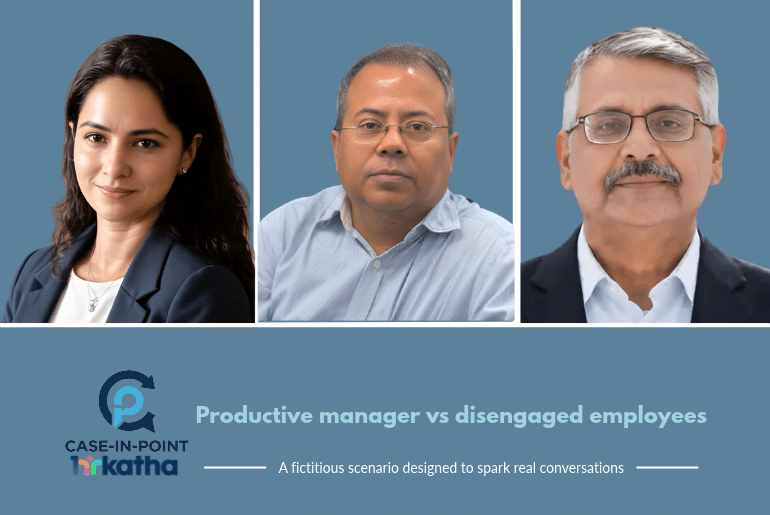
HRKatha’s Case-in-Point presents real-world HR dilemmas and invites leaders to weigh competing business and ethical choices.
Company: Forge & Allied Manufacturing (fictitious), a mid-sized engineering and manufacturing company with 3,800 employees, producing precision components and assemblies for the automotive, heavy machinery and industrial equipment sectors.
Background
The results of Forge & Allied Manufacturing’s annual engagement survey arrived three weeks ago. Across most of the organisation, scores were stable. One unit stood out.
Plant 4, which handles the company’s most complex machining operations, recorded the lowest engagement scores in the organisation. In the confidential comments, employees described their plant manager, Rakesh Tomar, as controlling, dismissive and difficult to work with. Several used the word ‘fear’. One wrote: “I do my job and go home. I stopped expecting anything more.”
HR flagged the results to the CHRO.
Then came Rakesh’s performance data.
Plant 4 had delivered the company’s best productivity numbers for three consecutive years. Missed targets were rare, output quality consistently exceeded benchmarks, and two of the company’s largest clients specifically requested components from the plant.
Rakesh had never faced a formal complaint.
When HR approached him about the survey results, his response was direct.
“People are unhappy because I hold them to a standard. That is my job. If they wanted an easy life, they should have found a different plant.”
HR now faced a manager whose operational performance was difficult to question but whose team appeared deeply dissatisfied.
The dilemma
Should HR intervene formally, making Rakesh accountable for his team’s experience and requiring measurable improvement in people management, even if that risks disrupting a highly productive operation?
Or should it recognise that demanding management is not necessarily misconduct, and that low engagement scores alone may not justify formal action against a manager with an exceptional performance record?
And if neither approach is satisfactory, should HR first conduct a structured assessment of the team’s experience, acknowledge Rakesh’s achievements and introduce people-management expectations with a defined timeline for improvement?
What’s really at stake
This is a question about what organisations consider performance, and how much weight they give to the way results are achieved.
Rakesh’s achievements are substantial. Plant 4 has maintained exceptional productivity and quality for three years, in an operation where missed targets can affect customers and the wider manufacturing chain. HR cannot dismiss those results simply because employees dislike their manager’s style.
High standards, close supervision and demanding targets are not inherently unreasonable, particularly in complex manufacturing environments.
But the engagement data cannot be dismissed either. When several employees describe their workplace using the word ‘fear’, HR has reason to examine what lies behind that sentiment.
It may reflect an excessively controlling manager, unrealistic pressure or a breakdown in communication. The survey alone cannot establish which.
There is also a question about what the organisation rewards. If operational output is the only measure that meaningfully influences a manager’s standing, people management may remain a secondary consideration, regardless of what the company says about its culture.
Yet changing that equation is not without risk. Rakesh has built a successful operation, and an intervention that undermines his authority without establishing the facts could damage both morale and performance. Equally, ignoring the feedback could allow problems to deepen, potentially affecting retention, collaboration and the plant’s long-term effectiveness.
The challenge for HR is to distinguish demanding leadership from damaging behaviour without treating either productivity or employee experience as expendable.
The deeper question is whether a manager can be considered an exceptional performer if the organisation measures only what the team delivers, and not what it experiences while delivering it.
We asked three HR leaders how they would approach this dilemma.
What HR leaders said
Megha Latawa, CHRO, KLAY
“Results and relationships at work are not opposing forces that need to be traded off. A manager who delivers exceptional productivity while eroding discretionary effort is not running a sustainable team. He is extracting short-term output at the cost of medium-term capacity. The organisation that accepts this bargain is choosing to deplete its human capital in exchange for quarterly numbers. That is not pragmatism or high performance. It is deferred-cost accounting.

The real question is never ‘results or people?’ It is ‘how do we engage teams to deliver the results we need, and within what timelines?’ Forge & Allied’s dilemma is not a choice between intervening and looking the other way. It is about acknowledging the performance alongside the gaps and making a timely investment to build the right behaviours in the manager.
I would begin by recognising the results while widening accountability through formal systems. The manager’s three-year productivity record should be acknowledged. At the same time, engagement scores, attrition, succession indicators and team feedback should become part of his formal objectives. Performance cannot be assessed only through output metrics.
The next step would be a focused diagnostic using an external or neutral internal facilitator to surface specific behaviours and patterns. This would help establish clear expectations around the workplace environment while also making coaching more action-oriented.
Finally, there needs to be a firm timeline. Moving the manager should be the last resort. But if the behavioural shift does not happen within a timeline appropriate to the context, the organisation must act, whether that means moving the manager to another role or eventually moving him out.”
Ravi Mishra, head, HR, BITS Pilani
“This is a very normal and genuine situation, particularly in manufacturing and engineering environments. I have seen many cases where managers are described as controlling, dismissive or arrogant. But if this situation has reached the stage where an entire team is unhappy, I would see it first as an HR responsibility. It is the role of HR to understand what is working, what is not and what kind of environment is being created.

At the same time, I would not immediately conclude that the manager is wrong. If a manager is meeting his targets and delivering, that is an important part of his job. Performance standards matter, particularly in manufacturing, where the value chain is long and one weak link can affect the entire business.
However, performance cannot come at the cost of safety, compliance or basic human values. In manufacturing, performance is not simply about EBITDA or profitability. It is linked to people’s lives and the organisation’s licence to operate. If a manager is pushing productivity while ignoring compliance, that becomes a fundamentally different concern.
The second issue is the manager’s style. Controlling behaviour may sometimes be a communication problem, but HR needs to establish whether there is also bias, for example, if the manager is supportive of people he has worked with previously while being dismissive of others.
My approach would be to speak to both sides, take independent feedback and understand the circumstances before reaching a conclusion. A 360-degree feedback process can be useful here. HR should guide the manager on how to get work done without creating unnecessary stress or fear. But HR must also recognise that employees have different sensitivities and circumstances, and understand that context before drawing conclusions.”
Mukul Chopra, CHRO, DEPL
“For me, there is no question that business performance cannot come at the cost of people. Tomorrow, when we talk about culture, what kind of behaviour are we setting up for others to emulate? If we allow one high-performing manager to behave badly because he delivers numbers, that behaviour can spread. The ends do not justify the means.

I would make people management a measurable part of his performance. If attrition in his team is running at 40 per cent when it should be 20 per cent, a significant portion of his bonus should depend on bringing that number down. How he achieves it is up to him, but the accountability has to be real.
At the same time, I would not simply say, ‘I don’t like this manager, change him.’ If HR wants to take action, it should have sufficient evidence that the manager has been given the opportunity, support and feedback to improve but has still failed to do so. The assessment has to be objective and cannot become personality-driven.
There is also a very clear line between encouraging someone to deliver and humiliating or degrading that person in front of the team. Once that line is crossed, the organisation’s values and culture become meaningless if leadership chooses to look the other way.
My approach would be to make the consequences clear without making the conversation confrontational. Tell the manager that his attrition is high, his team experience is poor and his next appraisal will reflect that. When people know that their people-management outcomes have a direct bearing on their rewards, accountability becomes much more tangible. The price of allowing this behaviour is ultimately much higher than the cost of correcting it.”
If you were the CHRO at Forge & Allied Manufacturing
Rakesh has delivered exceptional productivity for three years. His team has recorded the lowest engagement scores in the organisation, with several employees describing a culture of fear. No formal complaint has been filed.
What would you do?
- Intervene formally, making people management part of Rakesh’s performance objectives and setting a timeline for improvement?
- Begin with coaching and an independent assessment of the team’s experience, without immediately making it a formal performance issue?
- Continue monitoring the situation, accepting that low engagement does not necessarily indicate misconduct and that operational performance remains strong?
Or is the bigger question this:
If an organisation measures what it values, what does it tell managers when people management carries less weight than productivity?
Share your perspective in the comments or on LinkedIn using #HRKathaCaseInPoint.