


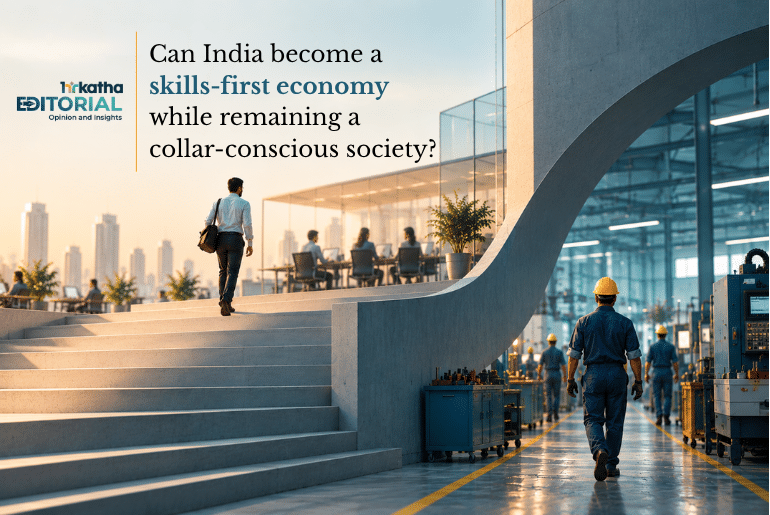
Consider two employees beginning their careers.
One joins a technology company as a junior analyst. The employee has an academic qualification, some theoretical knowledge and perhaps a few months of training, but little experience of solving real business problems. The work is largely procedural, closely supervised and designed to develop competence over time. Yet from the first day, the employee belongs to the white-collar workforce.
The other joins a manufacturing facility as a technician. Over the next two decades, the technician learns to operate sophisticated equipment, diagnose complex failures, interpret technical data and make decisions that can determine whether an entire production line continues to function. Experience develops into expertise, and expertise into a form of judgement that cannot easily be acquired in a classroom.
Twenty years later, the technician is still blue collar.
The distinction is not necessarily inaccurate as an occupational description. One works in an office-based role, the other in an industrial environment. But society rarely treats the labels as merely descriptive. White collar has come to suggest professional standing, career aspiration and social respectability. Blue collar, despite the skill it may represent, often carries a lower position in the hierarchy of occupations.
And therein lies a contradiction that India has yet to confront.
When the collar became a social distinction
The terminology emerged in the United States during the early twentieth century, when clothing provided a visible distinction between industrial and office workers. Factory employees typically wore darker, durable clothes suited to physical labour. Clerical and administrative employees wore white shirts, signalling work performed away from machinery and the factory floor.
The distinction reflected the organisation of employment in an industrial economy.
Production and maintenance were separated from administration and management. Manual and non-manual work were treated as different occupational categories, often with different working conditions, pay structures and career paths. Over time, however, these occupational descriptions acquired social meanings. Office work became associated with education, professional advancement and middle-class aspiration. Factory and trade occupations, even when technically demanding, were more readily associated with physical labour and a lower social position.
India absorbed these distinctions into a society that already had its own hierarchies of work.
The social stigma attached to manual work in India did not begin with industrialisation. It carries an older hierarchy that the credential system inherited and reinforced. Colonial administration had reinforced the prestige of English-language education and clerical employment. Academic qualifications offered access to positions of authority and social mobility, while manual occupations continued to carry the weight of older divisions of class and caste. Independence expanded educational opportunities, but it did not remove the preference for degree-based careers over vocational pathways.
That preference remains visible in how families assess career choices. Entry into an engineering college is generally regarded as an achievement. Entry into an industrial training institute is often treated as a less desirable alternative, even though the two institutions prepare students for different kinds of work.
The problem is not the existence of different educational pathways. A modern economy needs engineers, technicians, craftspeople, managers and administrators. The problem begins when those pathways become a hierarchy of human potential.
Skill develops. The label does not
An office employee does not have to demonstrate advanced professional expertise to enter the white-collar category. The designation follows from the nature of the occupation. A newly recruited analyst, a junior administrator or an entry-level software tester may have limited practical experience, yet all are readily described as white-collar employees.
A technician’s position is different. The worker may begin with basic vocational training and gradually acquire the ability to handle increasingly complex equipment, solve problems independently and exercise judgement developed through years of experience. Some technicians become specialists whose knowledge is difficult to replace and whose decisions carry substantial operational consequences.
Yet the collar remains blue.
This does not mean every blue-collar worker is highly skilled or that white-collar work requires less expertise. The point is that the collar does not measure skill in the first place. It identifies a broad category of work. But when that category is interpreted as an indication of professional worth, the worker’s actual competence becomes secondary to the environment in which the work is performed.
A highly experienced technician may possess greater practical expertise in a particular system than a recently recruited engineer. That is neither surprising nor an argument against engineering education. It is how expertise develops in most professions. Yet the technician’s expertise does not necessarily translate into the same language of professional recognition that organisations routinely extend to office-based specialists.
We have become accustomed to recognising expertise when it comes with a desk, a designation and a degree. We are less consistent when it comes with tools, machinery and a shop floor.
The contradiction in India’s skilling ambition
India’s policy direction increasingly emphasises employable skills. Skill India, the National Skills Qualifications Framework and efforts to strengthen vocational education reflect a recognition that academic qualifications alone cannot meet the needs of a changing economy.
But promoting skills and respecting skilled workers are not the same thing.
A government can expand training capacity, establish qualifications and encourage industry participation. What it cannot achieve through policy alone is a change in how families, employers and society value those competencies.
A young person considering vocational training is not evaluating only the curriculum or the likelihood of employment. The decision also involves questions of status, income, career progression and social acceptance. Will the qualification lead to a respected occupation? Can the worker advance without acquiring a conventional degree? Will increasing expertise bring greater authority and recognition? Or will the individual remain permanently identified with a category considered less prestigious?
If the country wants more young people to acquire technical skills, it must make the careers built on those skills genuinely attractive. That requires more than training centres and certificates. It requires employers to recognise technical mastery through compensation, progression, responsibility and professional standing. Otherwise, India risks creating a peculiar contradiction: encouraging young people to become skilled while leaving intact the hierarchy that makes many of them reluctant to pursue skill-based careers.
An industrial-era mindset in a changing workplace
The distinction between manual and intellectual work has never been absolute. Skilled trades have always required judgement, calculation and problem-solving, while many office occupations have involved repetitive and standardised tasks. Technology is making the boundary even less useful as a shorthand for complexity.
A technician on a modern shop floor may work with computer-controlled machinery, interpret diagnostic data, monitor automated systems and use software to identify the source of a failure. The work can involve substantial technical reasoning alongside physical intervention. An employee in an office may spend much of the day following standard operating procedures, entering information or checking outputs. Such work is not inherently less valuable, but neither is it automatically more intellectually demanding because it happens in an air-conditioned workplace.
Artificial intelligence and industrial automation are exposing this weakness further. Routine office tasks are becoming easier to automate, while advanced manufacturing increasingly requires workers who can combine practical experience with digital and analytical skills. The future of work is unlikely to respect the old assumption that knowledge belongs primarily in offices and execution belongs primarily on factory floors.
Yet organisational structures can still reflect that division. Technical workers may have limited progression opportunities unless they move into supervision or management, even when their expertise is indispensable to operations. The question is whether systems for recognising professional expertise have evolved as quickly as the work itself.
What Germany, Japan and China demonstrate
Other industrial economies offer useful lessons, not because they have eliminated occupational hierarchies, but because they have developed different ways of recognising technical expertise.
Germany’s dual vocational education system combines classroom learning with practical training in companies. Apprenticeships lead to recognised qualifications, while advanced vocational routes allow experienced workers to acquire credentials such as Meister, or master craftsperson, and other higher technical qualifications. These pathways provide opportunities for professional advancement, supervisory responsibility and entrepreneurship without requiring every skilled worker to follow a conventional university route.
Japan offers another example. Its technical colleges, including the KOSEN system, combine theoretical education with practical engineering training. The country’s monozukuri tradition also reflects a cultural appreciation of the knowledge, discipline and craftsmanship involved in making things.
China has made deliberate efforts to raise the standing of vocational skills. Through skills competitions, public recognition of outstanding technicians and policies promoting vocational education, it has sought to give technical expertise greater visibility. Yet the preference for university education remains influential. China’s experience suggests that institutional recognition can help challenge occupational hierarchies, even if changing social attitudes takes considerably longer.
None of these countries treats every vocational occupation as equal in status or reward. What matters is that they demonstrate different approaches to building recognition around technical expertise.
India has vocational institutions, training frameworks and workers whose practical knowledge is essential to sophisticated industries. What remains less developed is a consistently respected route through which technical mastery can translate into professional standing, economic security and long-term advancement.
Respect cannot be created by changing the terminology
Renaming workers will achieve little if the underlying practices remain unchanged. A factory technician does not gain professional standing merely because an organisation adopts a more flattering designation.
Nor should the solution be to turn every experienced technician into a manager. Technical mastery and people management are different capabilities. A worker should be able to build a rewarding career through increasing specialist expertise without having to abandon the work in which that expertise was developed.
This is where HR and organisational leadership have a significant role. If companies claim to value skills, their employment systems should reflect that claim. Career structures must recognise advanced technical competence. Pay and progression should account for the difficulty, scarcity and contribution of skills rather than relying excessively on educational pedigree or occupational category. Development opportunities should extend beyond employees traditionally identified as professional or managerial talent.
The objective is not to pretend that every occupation is identical. It is to ensure that different kinds of expertise can command recognition on their own terms.
There is also a larger social challenge. For many Indian families, a career in an office still represents upward mobility in a way that a career on a factory floor may not. That perception will not change because policymakers celebrate vocational education or employers announce a commitment to skills. It will change when technically skilled careers offer visible examples of prosperity, progression, professional respect and influence.
India’s ambition to become a skills-first economy is not merely a question of producing more skilled workers. It is a question of what the country is prepared to recognise as professional achievement.
If skills are to become the foundation of employability, they must also become the foundation of professional respect. Until then, India may succeed in training more skilled workers without fully overcoming the old hierarchy that determines how those workers are valued.