


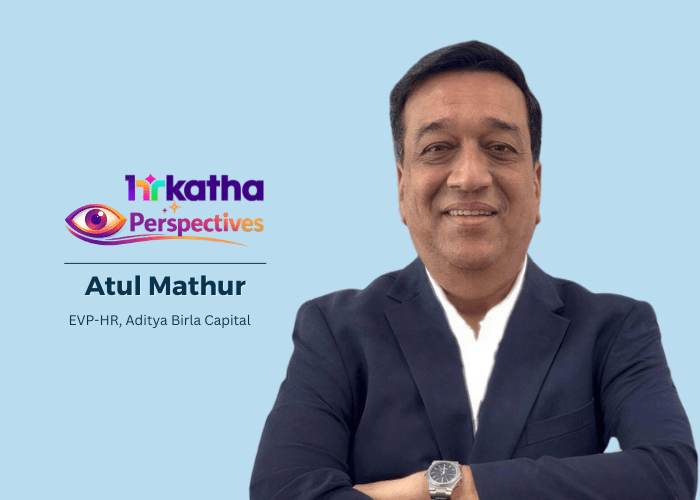
Aditya Birla Capital operates across a wide range of financial services businesses, which makes its people challenge anything but uniform. Different businesses serve different customers, require different capabilities and operate with different performance expectations. HR has to accommodate those differences without losing the organisational identity that holds them together.
For Atul Mathur, that makes a broad understanding of the business fundamental to HR’s role. In conversation with HRKatha, he explains why HR’s strategic relevance begins at the reasoning stage rather than the execution stage, why a manager who achieves a target through only two of six team members is not necessarily managing well, and why organisations need to be as deliberate about developing the broader workforce as they are about cultivating their high-potential pools.
Strategy first, then HR
What separates HR functions that genuinely influence business strategy from those that are simply invited to execute it?
When we say HR has a seat at the table, it starts at the reasoning stage. HR needs to understand what the organisation wants to achieve and how that translates into strategy. Being part of that formulation, not just its execution, is where genuine strategic relevance begins.
Functionally, HR has traditionally been responsible for hiring, developing and retaining people. But the role today goes further. It is about enabling the organisation to become more productive and effective, whether through policies, processes, incentive structures or other mechanisms that help the business perform.
Values are an important part of this. We are a responsible corporate, which means whatever we achieve has to be achieved in the right way. HR has a role in ensuring that everyone who joins understands those values and that organisational decisions reflect them.
The broader shift HR professionals need to make is from operating within a single functional area to developing a holistic perspective of the business. Talent is everybody’s responsibility, not just HR’s. Everyone in the organisation has a responsibility towards the people they work with.
Digital tools are helping HR professionals manage more diverse responsibilities, but the mindset shift has to come first. Understand the organisation’s strategy, contribute to its planning and then help execute it. HR’s role is no longer simply to bring people in, develop them and keep them. It is to understand how all those decisions contribute to what the business is trying to achieve.
“The organisational culture that enables people to fail forward is not soft. It has to be rigorous about learning from failure.”
The manager is the moment of truth
A manager can hit the team target while several people in that team underperform. What does that tell you about how managerial performance should really be judged?
For an employee, the manager is the moment of truth. If a manager is competent, that competence translates into the performance of the team. That is where organisations need to invest, making managers more capable through different exposures, learning and development, coaching and mentoring.
Consider a frontline sales manager with six people reporting to them. Traditionally, that manager might be measured on target versus achievement: did the team deliver the required revenue? But that target could have been achieved through the efforts of only two people.
Performance spread requires the manager to look at every individual in the team and enable each person to perform. When that happens, productivity can multiply significantly.
Managers also need to remember that when we say human resource, human comes first and resource comes later. The people working with you are not simply resources. They are human beings. The connection between a leader and a team member has to be established, and that is part of the organisation’s cultural DNA.
Potential is typically assessed by the manager in consultation with HR and validated through mechanisms such as assessment centres. But softer indicators matter too. Employee satisfaction scores associated with a manager, for instance, can tell you a great deal.
As someone moves up the hierarchy, how the outcome is achieved becomes as important as the outcome itself. Progressive organisations assess both performance and the leadership behaviours that determine how effectively someone can lead others.
“Start with the problem. Let the solution follow.”
Beyond the high-potential pool
High-potential programmes concentrate investment on a relatively small group. What capabilities might organisations miss when they look beyond that pool too late?
There is a shift towards recognising that talent development cannot be restricted to a small group. The classical talent-management system of clearly defined pools and identified individuals who demonstrate higher potential continues to exist and serves a purpose. But progressive organisations are also investing significantly in capability-building across the wider employee base.
Generative AI is a good example. It is a relatively new technology, and many employees remain uncertain about what it means for their roles. The first step is to make everyone familiar with the technology and help them understand how it applies to their work.
That starts with learning but needs to move quickly into practical application, giving employees projects through which they can explore how the technology can make their everyday work more effective.
These broader initiatives also help organisations identify capabilities across the workforce that formal talent pools may never surface. In large organisations, opportunities constantly emerge through growth, expansion and new roles. People can then be identified for those opportunities based on consistency, performance, attitude and the capabilities they demonstrate over time.
In a conglomerate such as Aditya Birla, there is another dimension: lateral movement across group companies. Exposure to a different company or industry can make a significant difference to an individual’s development. That is a structural advantage conglomerates can use more deliberately than most organisations do.
Not everyone may be part of the formal talent pool, but the broader employee base is what runs the organisation. They too need to be developed and given opportunities to grow.
“L&D is no longer about what the function wants to do. It is about what the business is trying to achieve.”
Start with the business problem
L&D functions have become very good at measuring participation. How do you determine whether learning has actually changed capability or business performance?
The starting point should not be what L&D can do. It should be the business opportunity or problem that needs to be addressed. Everything else follows from that.
Whether you are creating programmes, introducing digital tools or designing on-the-job interventions, they should originate from a clear understanding of the business challenge.
That is a significant shift from how L&D has historically operated, when the focus was often on mandates: how many programmes someone attended or whether attendance was complete. Those are passive measures, and organisations cannot afford to evaluate L&D through those metrics today.
In a multi-location organisation, digital interventions enable learning in the flow of work. If someone needs a new skill, self-paced tools should be available. If someone needs information, the organisation’s systems should provide it at the point of need rather than through a scheduled programme.
That is the shift. L&D is no longer about what the function wants to do. It is about what the business is trying to achieve and how learning can contribute to that objective.
Start with the problem. Let the solution follow.
“Performance spread requires the manager to look at every individual in the team and enable each person to perform.”
Failing forward
Well-being and performance are often treated as competing priorities. Do you see a genuine trade-off between the two?
The trade-off I return to most often is between well-being and performance, but my view is that the two are less in tension than organisations often assume.
When we talk about well-being, it is not simply about yoga sessions, gym access or sporting activities. Those have their place. But employees spend a significant proportion of their waking hours at work. The real moment of truth is the manager and the people they work with.
If a manager approaches the team with the right attitude and a genuine commitment to developing people, many aspects of well-being and performance begin to take care of themselves. If the workplace is stressful or people are constantly fearful, both performance and well-being suffer.
The objective should be to create a culture where people look forward to coming to work, are willing to take on challenges and feel comfortable experimenting. That brings me to a question I find more important than the well-being versus performance debate: are we encouraging people to fail forward?
Things cannot be perfect every time. When people try something new and do not succeed, they should be able to learn from the experience, make improvements and do better the next time.
It is similar to a rocket launch. A rocket does not always launch successfully on the first attempt. Scientists identify what went wrong, work on those areas and try again until the rocket takes off.
The organisational culture that enables this is not soft. It has to be rigorous about learning from failure and clear about what the next attempt should look like.
Employees are more likely to put in discretionary effort when they feel wanted, included and motivated. What happens at work also affects their personal lives. Organisations therefore need to think about enablement in the broadest sense: managerial effectiveness, the tools and technology employees work with, and the environment in which they work. These are different means to the same end.
“Being part of strategy formulation, not just its execution, is where genuine strategic relevance begins.”