


Not a sudden calling
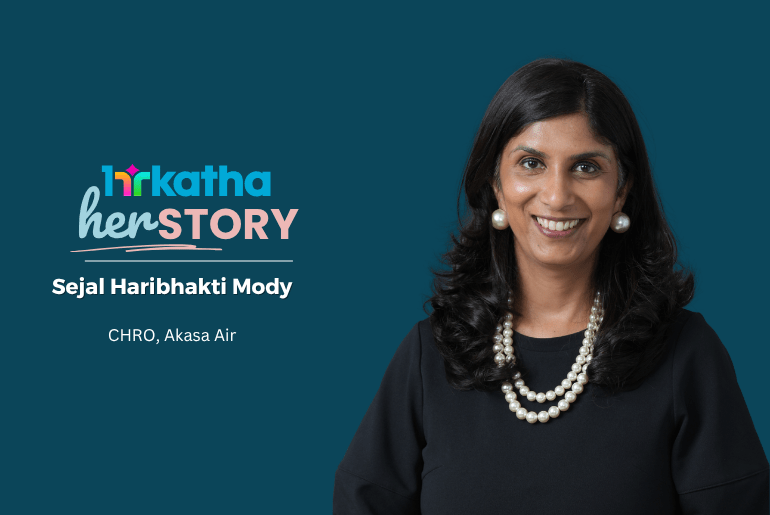
Human resources was never a sudden calling for Sejal Haribhakti Mody. It was more instinctive than planned.
Her early choices were shaped by numbers, analysis and business problem-solving. She studied MIS and mathematics during her BBA, followed by finance during her MBA.
After graduating from the Indian School of Business, she joined Accenture as part of its early Finance and Enterprise Performance consulting team. Then, quite by chance, while between active projects, she connected with a partner leading the Talent and Organisation practice.
Her first assignment in that space was with a bank’s KPO, helping build its competency framework.
That project changed how she thought about organisations. She began to see that strategy, investment and ambition alone were not enough. Organisations moved forward only when structures were right, people were in the right roles and there was clarity about the capabilities needed for the future.
After more than a decade in consulting, she wanted to experience the other side of change: not simply advising organisations, but living through the complexity of making change happen.
That took her to Star, where she headed centres of excellence within HR and became part of the core team driving the Disney-Star integration.
What looked from the outside like a series of career shifts was, for Mody, simply curiosity leading her into the next unfamiliar room.
From FMCG to aviation
The fundamentals of HR leadership, Mody believes, do not change dramatically across industries.
Building teams, shaping culture, driving change and aligning people strategy with business needs remain constant. What changes is the context, the rhythm of the industry and the talent pools that matter most.
Her move into aviation was therefore more than an industry switch. It also meant moving from large, established organisations into a young, fast-growing company.
“Aviation has taught me resilience, agility and the ability to work across highly diverse, dispersed and mission-critical talent groups,” she says.
Her experiences at both HUL and Akasa have reinforced one particular lesson: roles closest to the customer or operation often carry disproportionate importance.
Whether it is factory roles in FMCG or ground and cabin crew in aviation, these employees form much of the foundation on which organisational success rests.
The move also changed her relationship with culture.
At HUL, she was working within an institution shaped over decades. At Akasa, she has had the opportunity to help build culture more deliberately from the ground up.
That, she says, requires leaders to recognise that culture is created through everyday choices, not merely defined through values on paper.
People agenda versus business agenda
For Mody, one of the harder disciplines of HR leadership is keeping the human lens alive while remaining deeply grounded in business reality.
“You have to keep the human lens alive while also ensuring that every investment in people has a clear and meaningful business case,” she says.
Across her career, she has learnt that HR often works through influence rather than authority.
That influence comes from understanding what drives business leaders, what pressures they operate under and what outcomes matter most to them, and then connecting the people agenda to those priorities.
It is one of the most important lessons she has carried across industries.
The toughest calls, however, are often personal.
There have been times when she has had to ask people to leave because they were no longer the right fit for the role or the organisation.
“The ability to separate the person from the decision, while keeping humanity intact in the conversation,” is what guides her.
Mody believes very few people are intrinsically incapable. Often, the issue is fit, timing, context or role alignment.
For HR leaders, the responsibility is therefore not merely to make the decision, but to make it with clarity, fairness and compassion.
When bias is not about gender
Mody considers herself fortunate to have received largely merit-based opportunities and to have worked with leaders, both men and women, who supported her growth.
But bias, she discovered, does not always arrive in predictable forms.
There were moments when she felt out of place or not fully accepted simply because she was newer to an organisation, had not built enough tenure, or did not naturally fit the prevailing culture.
Experiencing that later in her career was difficult, but also instructive.
It taught her the importance of navigation: reading people, building credibility and adapting to new environments without losing her core.
“Bias does not always show up as gender. Sometimes it shows up as not fitting the culture, or not having enough tenure in the room.”
She has also worked intentionally on gender parity, while remaining conscious that equity can sometimes be perceived differently by different groups.
“I believe women do face real challenges in progressing beyond mid-management, often because of personal constraints, life stages and support systems,” she says.
That is why she spends time mentoring women and encouraging them to build networks of support that extend beyond family.
“Bias does not always show up as gender. Sometimes it shows up as not fitting the culture, or not having enough tenure in the room.”
Curiosity over risk
Mody’s career has involved a series of moves that may have looked risky from the outside.
She moved from Finance and Enterprise Performance into Talent and Organisation, from consulting into industry, from large multinationals into younger companies, and eventually into aviation.
The common thread was curiosity.
She rarely evaluated those moves primarily in terms of risk. Instead, she saw them as opportunities to learn, stretch herself and enter environments where
she would have to become a student again.
Even when the path ahead was unclear, she trusted that the experience would teach her something useful.
Perhaps the biggest lesson was that careers do not need to follow a perfect sequence.
She may have entered HR unexpectedly, but the choices that followed were deliberate.
No perfect career
If Mody could give her younger self one piece of advice, it would be to worry less about mapping out a perfect career.
“Early in our careers, we often feel pressure to have all the answers and follow a clear plan,” she says.
Looking back, many of her most meaningful opportunities came from paths she had not anticipated.
She would also tell herself to trust her instincts more.
Many of the decisions that shaped her career did not necessarily make perfect sense on paper. But each expanded her perspective and gave her something the previous role could not.
“Adapting to different environments does not require compromising who you are,” she says. “Learn to read the room, understand people and evolve your approach, but stay anchored to your values. Careers are marathons, not sprints, and authenticity compounds over time.”
That, perhaps, is the principle that best connects the different chapters of her career.
“Be curious, not fearful. You don’t need to have the entire path figured out. You just need the courage to take the next step, stay true to your values, and trust that the learning will follow.”
“Careers are marathons, not sprints, and authenticity compounds over time.”
People strategy is business strategy
One HR mindset Mody would like to see disappear is the belief that HR is primarily a support function.
The organisations that unlock the greatest value from HR, she believes, are those where people strategy is treated as business strategy rather than something adjacent to it.
That requires change on both sides.
Business leaders need to see HR as a genuine strategic partner. HR leaders, in turn, need to move beyond policies and processes and understand the business deeply enough to contribute to outcomes.
In aviation, that strategic contribution becomes particularly visible through culture.
The industry is built on processes, SOPs and compliance, and rightly so. But Mody believes the strongest organisations are not those where people follow procedure simply because they are told to.
They are the ones where employees do the right thing because they feel ownership, responsibility and pride in the outcome.
At Akasa, she sees culture as something deliberately built through leadership behaviour.
How leaders respond in difficult moments, whether employees feel safe to speak up, how managers balance accountability with empathy, and whether desired behaviours are reinforced consistently all shape the culture people actually experience.
In an industry where safety and consistency matter deeply, culture-led ownership is not separate from operational excellence. It is part of it.
Where the gender gap remains
Mody believes the first step towards change is acknowledging that a gap exists.
There has been meaningful progress in representation, but women remain underrepresented in executive leadership roles.
That is where, in her view, organisations need to push harder.
More women at the top can help shape the policies, practices and support systems that make it easier for others to sustain careers while navigating personal and professional milestones.
But the next frontier, Mody believes, is not policy alone.
“We need stronger networks of mentorship, sponsorship and informal support,” she says.
Organisations have a role to play, but women also need the confidence to ask for help, seek opportunities and build support systems both inside and outside work.
For young women beginning their HR careers, her advice is to stay curious and keep options open.
Explore before specialising. Learn the business, not simply the HR function. Ask for opportunities. Step forward when challenges arise. Focus less on the list of tasks assigned to you and more on the impact you can create.
And do not wait until you feel completely ready.
Growth, Mody has learnt repeatedly, often begins before certainty does.
Quick fire round
If HR had a boarding pass, what would be its “final destination”?
Purpose with performance.
Airline HR is global. What’s the biggest cultural difference you’ve had to navigate?
Moving from preserving culture to intentionally creating it, led from the top, lived every day.
If HR could innovate like aviation tech, what’s the one futuristic HR tool you’d want onboard?
A GPS for human potential.
What’s the one HR policy you’d never let crash and burn?
Anything that helps people succeed at work without sacrificing life.
Best investment you’ve made in yourself?
Instilling the lifelong learner mindset. I know it will compound multi-fold over time.