


Holacracy is not just a change in organisational structure, it’s also about change in mindset.
The online shoe and clothing retailer Zappos.com adopted a new organisational structure five years back, called holacracy. In this system, employees are expected to act more like entrepreneurs, and self-direct their work instead of reporting to a manager who tells them what to do.
So, does this mean there is no hierarchical designations in this system? No and Yes. There is hierarchy, but it is defined by roles and not the normal bureaucracy that’s followed in organisations.
The core objective of holacracy is to define collective roles of individuals and assign them to accomplish the work. This is very similar to teams or functions in traditional organisations.
For the uninitiated, the term ‘holacracy’ is derived from the terms ‘holon’ and ‘holarchy’, coined by Arthur Koestler in his 1967 book The Ghost in the Machine. A holon is a whole that is a part of a larger whole—like a cell of the body is both a self-contained whole and at the same time part of an organ. Similarly, an organ is a self-contained whole and at the same time part of an organism. That series—cell to organ to organism—is an example of a holarchy. It is the kind of hierarchy that nature uses.
Holacracy is similar to what we know as Industrial Democracy. We can also call it a corporate democracy. As a structure, it becomes important because agile workforces are more widely adopted and practised. In the agile environment, self-organising teams are formed for a project and also dismantled immediately after the project is over.
Many people relate holacracy to a more casual and rather informal system, which leads to an unstructured environment. Just because there is no boss to head the team, it doesn’t mean there is no structure. The fact is that holacracy is more structured than both conventional and most non-conventional management systems. The ‘rules of the game’ are clearly defined in the holacracy constitution, and these rules are designed to ensure alignment with the direction of the company.
Sounds perfect as that’s an ideal situation where every employee is motivated, knows her task and responsibilities and performs as expected.
But how far is this situation from reality?
David Allen, CEO of Getting Things Done reorganised his company using holacracy.
In his blog, Allen says, “Over several months, it became clear that some natural value streams within the company were getting clogged up because of how they were structured. Work was not flowing. It was ping-ponging off the different departments. We restructured our organisation into three value streams with a clear customer at the end of each. We now use Holocracy to help push work through the value streams to get to the customer with fewer handoffs and touch points. Earlier, we had questions on who has authority on the profit and loss; now it is crystal clear.”
Many people relate holacracy to a more casual and rather informal system, which leads to an unstructured environment. Just because there is no boss to head the team, it doesn’t mean there is no structure.
The fact is that holacracy is more structured than both conventional and most non-conventional management systems. The ‘rules of the game’ are clearly defined in the holacracy constitution, and these rules are designed to ensure alignment with the direction of the company.
In this system, partners or team members fill roles in the organisation with clear accountabilities. These team members have the authority to take any action they deem fit to meet their expectations.
Mike Arauz, a partner at the strategy firm, Undercurrent, which adopted holacracy, says, “The real difference is that the teams of people who own the work are given explicit permission to do their work in whatever way they see fit without asking for approval from the people above them.”
In case there is come conflict between two roles, as is often the case, holacracy has built-in mechanisms to establish those limits.
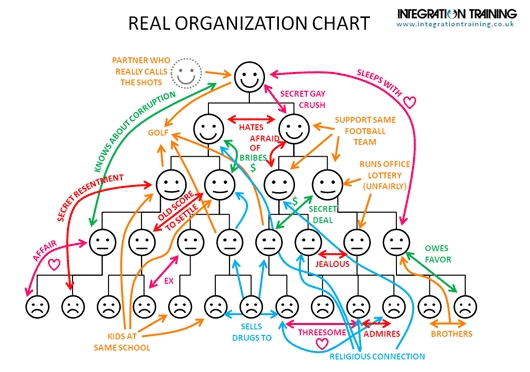
Many people assume that the absence of a boss in the system or transparency of the model makes no space for office politics. The fact is that holacracy doesn’t ‘eliminate’ office politics, but addresses work issues in ways that make politics less useful. It funnels whatever political tensions that arise into specific meeting processes—which actually leverages those tensions into useful organisational learning
However, not everyone is an admirer of this system.
Critics of this system point out that holacracy would have a different interpretation for slackers. First, their expectations are glaringly obvious to everyone along with their shortcomings. Second, the fact that no one expects them to do anything makes everyone stop and wonder why do they even have the job!
Another major shortcoming of a holacratic system that critics point out is that, the absence of a boss implies that there is no one person or a manager to give a neutral feedback to employees.
Many companies have overcome this hiccup by adopting a system where instead of a manager giving feedback, the group gives feedback to every team member. This, of course raised tensions in weekly meetings.
Many people assume that the absence of a boss in the system or transparency of the model makes no space for office politics. The fact is that holacracy doesn’t ‘eliminate’ office politics, but addresses work issues in ways that make politics less useful. It funnels whatever political tensions that arise into specific meeting processes—which actually leverages those tensions into useful organisational learning.
In holacracy, meetings are of utmost importance and they have to designed to carefully separate different modes of working. For instance, the meeting agendas have to be clear— updating each other on the status of the work; making decisions; devising strategies, and entering into open-ended collaborations.
A major shortcoming of a holacratic system that critics point out is that, the absence of a boss implies that there is no one person or a manager to give a neutral feedback to employees. Many companies have overcome this hiccup by adopting a system where instead of a manager giving feedback, the group gives feedback to every team member. This, of course raised tensions in weekly meetings.
Many people assume that the absence of a boss in the system or transparency of the model makes no space for office politics. The fact is that holacracy doesn’t ‘eliminate’ office politics, but addresses work issues in ways that make politics less useful. It funnels whatever political tensions that arise into specific meeting processes—which actually leverages those tensions into useful organisational learning.
In holacracy, meetings are of utmost importance and they have to designed to carefully separate different modes of working. For instance, the meeting agendas have to be clear— updating each other on the status of the work; making decisions; devising strategies, and entering into open-ended collaborations.
In addition, there is an important role of an elected facilitator, whose job is to shut down anything outside the meeting rules.
Another drawback for holacracy is compensation, hiring and firing. It becomes harder to calculate compensations when there are many people performing many roles at the same time and switching constantly.
Holacracy is supposed to be a great leveller, tearing down red tape and formal bureaucracy, and promoting creativity. It’s underlying principles can be transformative. But, adopters say the hardest part is to make the mental shift.
1 Comment
Crisp to the point and easy to understand video.
Thanks