


Close Menu
    Facebook X (Twitter) Instagram
    • Our Story
    • Partner with us
    • Reach Us
    • Career
    Subscribe Newsletter
    HR KathaHR Katha
    • Exclusive
      • Exclusive Features
      • Perspectives
      • Friday Features
      • herSTORY
      • Case-In-Point
      • Point Of View
      • Research
      • HR Pops
      • Dialogue
      • Movement
      • Profile
      • Beyond Work
      • Rising Star
      • By Invitation
    • News
      • Global HR News
      • Compensation & Benefits
      • Diversity
      • Events
      • Gen Y
      • Hiring & Firing
      • HR & Labour Laws
      • Learning & Development
      • Merger & Acquisition
      • Performance Management & Productivity
      • Talent Management
      • Tools & Technology
      • Work-Life Balance
    • Special
      • HR Forecast 2026
      • Cover Story
      • Editorial
      • HR Forecast 2024
      • HR Forecast 2023
      • HR Forecast 2022
      • HR Forecast 2021
      • HR Forecast 2020
      • HR Forecast 2019
      • New Age Learning
      • Coaching and Training
      • Learn-Engage-Transform
    • Magazine
    • Reports
      • Whitepaper
        • HR Forecast 2024 e-mag
        • Future-proofing Manufacturing Through Digital Transformation
        • Employee Healthcare & Wellness Benefits: A Guide for Indian MSMEs
        • Build a Future Ready Organisation For The Road Ahead
        • Employee Experience Strategy
        • HRKatha 2019 Forecast
        • Decoding and Driving Employee Engagement
        • One Platform, Infinite Possibilities
      • Survey Reports
        • Happiness at Work
        • Upskilling for Jobs of the Future
        • The Labour Code 2020
    • Conferences
      • Leadership Summit 2025
      • Rising Star Leadership Awards
      • HRKatha Futurecast
      • Automation.NXT
      • The Great HR Debate
    • HR Jobs
    WhatsApp LinkedIn X (Twitter) Facebook Instagram
    HR KathaHR Katha
    zoha
    Home»Culture»Why ‘Nunchi’ is important for managerial success
    Culture

    Why ‘Nunchi’ is important for managerial success

    mmBy Dr. Prajjal Saha | HRKathaAugust 21, 2020Updated:August 21, 20204 Mins Read27681 Views
    Share LinkedIn Twitter Facebook WhatsApp
    Share
    LinkedIn Twitter Facebook WhatsApp

    In the mid-90s, when South Korean companies started capturing global markets from Uzbekistan to England to Vietnam, they often encountered a unique cultural issue.

    The expatriate Korean managers in the foreign land were often misunderstood by the local subordinates due to their rigid attitude. On the face of it, they appeared to distrust non-Koreans, apart from being hard taskmasters. It was also perceived that they barely listened to their local subordinates. As a consequence, Korean companies in offshore lands often faced talent-retention problems.

    zoha

    Not to blame the Korean managers, the problem was linked to the hierarchical society back home, where people valued seniority. They were used to taking orders from their superiors blindly, and would rarely challenge their leaders. It was owed to gruelling military training that virtually all South Korean men undergo.

    The expatriate Korean managers tried to implement the same in the offshore lands. However, not all subordinates were the same – there were educated white-collared workforces in Germany and Netherlands, while there were low-wage workers in South East Asia. For instance, Dutch employees in a Korean subsidiary in Netherlands stated that their Korean superiors failed to understand the nuances of Dutch culture, while the Korean managers failed to understand why Dutch employees would call in sick because they had a cold whereas Korean employees would come to work until they were truly unable to do so. In South East Asia, Korean managers were even embroiled in beatings and brawls with low-wage workers.

    In Korean culture, if a boss asks ‘Are you hungry?’, he/she actually means ‘I am hungry, can we eat now?’ So, a ‘No’ in response would hurt his/her kibun, which means sentiment, morale, affection or mood. Now, such nuances were hard to understand for a subordinate from a different culture.

    The problems kept escalating and then the Korean companies realised that they needed to work on the cultural skills of the expatriate managers. That is when many Korean companies introduced the concept of ‘nunchi’ for Korean managers working offshore. The idea was to teach the Korean managers to ‘listen’ more.

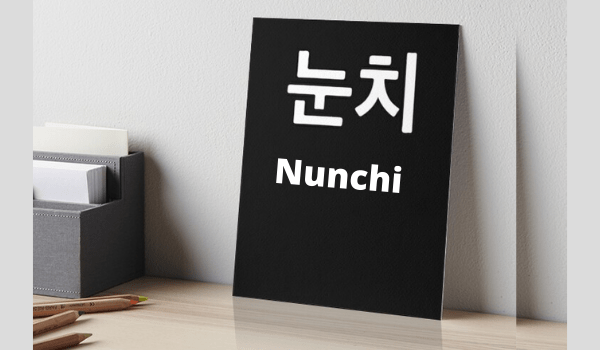
    Nunchi is a 17th century concept, which is the subtle art of listening and the ability to gauge others’ moods. The Japanese believe that a good listener hears one and understands 10. Nunchi is all about developing skills to become a better listener, as it provides the ability to assess a situation, read between the lines, and hear between the sounds. Nunchi is the ability to determine another person’s kibun by using the eye. It is like a sixth sense, which reads non-verbal and body languages, as well as the tones to get the real meaning of what they say.

    In other words, Nunchi is the tact to grasp social situations and read a given interaction, besides also learn how to respond to it. In short, it’s the act of grasping what other people are thinking and learning how to anticipate their needs.

    zoha

    Korean companies believe that nunchi enables Korean managers to uphold control in faraway lands. Korean managers are expected to look after employees’ needs, with the expectation that in return, the employees will show a high interest in their workplace. The companies have, therefore, laid down informal nunchi-grounded checks and balances.

    It is also a manager’s role to motivate and inspire others, to foster positive attitudes at work and generate a sense of contribution and importance with and among employees. All this can be achieved by practising nunchi. In Korean culture, a socially clumsy person is described as nunchi eoptta which means ‘absence of nunchi.’

    In today’s context, nunchi is comparable to a heightened form of emotional intelligence (EI), and to be an effective manager, one needs to possess emotional intelligence.

    Emotional intelligence is closely related to the broader concept of paralanguage. However, nunchi also relies on the understanding of one’s status relative to the person with whom one is interacting. It can be perceived as the embodiment of skills necessary to communicate effectively in high-context culture.

    hearing kibun Korea Korean offshore managers listening managerial success nunchi
    Share. LinkedIn Twitter Facebook WhatsApp
    mm
    Dr. Prajjal Saha | HRKatha

    Dr. Prajjal Saha is a business journalist and the editor-publisher of HRKatha. He writes on the realities of work and organisations, offering a clear-eyed view of how companies translate intent into action—often revealing the gap between the two. With over 25 years of experience, he focuses on interpreting workplace trends and leadership decisions in a way that is both insightful and accessible. He founded HRKatha in 2015 to create a platform for credible, insight-driven analysis of the evolving workplace.

    1 Comment

    1. Akari Minami on May 8, 2025 3:44 pm

      Such an interesting concept! I hadn’t heard of ‘nunchi’ before, but it makes so much sense—being aware of others and reading the room is such a key skill, especially for managers. Definitely something worth practicing more in any workplace.

      Reply
    Leave A Reply Cancel Reply

    Related Posts

    HR Perspectives by Preeti Kannan: “ AI is no longer optional, it is the way forward”

    July 1, 2026

    HRForecast 2026: Deployability will replace employability – Rajorshi Ganguli, President & Global HR Head, Alkem Laboratories

    June 30, 2026

    Humanocracy: If bureaucracy is broken, why does every organisation keep building more of it?

    June 30, 2026

    POV: Are return-to-office mandates about productivity or control?

    June 29, 2026
    Editorial

    Every IPO tells two stories

    Someone I know spent eight and a half years building the research function at a…

    The two cultures inside the same multinational

    Someone I know works with one of the world’s largest technology and consulting firms. Based…

    EDITOR'S PICKS

    HR Perspectives by Preeti Kannan: “ AI is no longer optional, it is the way forward”

    July 1, 2026

    HRForecast 2026: Deployability will replace employability – Rajorshi Ganguli, President & Global HR Head, Alkem Laboratories

    June 30, 2026

    Humanocracy: If bureaucracy is broken, why does every organisation keep building more of it?

    June 30, 2026

    POV: Are return-to-office mandates about productivity or control?

    June 29, 2026
    Latest Post

    HR Perspectives by Preeti Kannan: “ AI is no longer optional, it is the way forward”

    Perspectives July 1, 2026

    IIFL Finance is a branch-led lending business operating at scale across India, with a workforce…

    NCW orders annual POSH Audits to Strengthen Workplace Safety

    Employee Benefits & Welfare July 1, 2026

    The National Commission for Women (NCW) has issued an advisory to all states and Union…

    Will Microsoft let go up to 2.5% of its workforce next week?

    Layoff July 1, 2026

    In the latest round of job cuts at Microsoft, reportedly scheduled to be announced next…

    Microsoft’s Xbox restructuring reportedly triggers layoffs at PR partner assembly

    News June 30, 2026

    Microsoft’s reported restructuring of its Xbox business is beginning to impact its external partner network,…

    Asia's No.1 HR Platform

    Facebook X (Twitter) Instagram LinkedIn WhatsApp Bluesky
    • Our Story
    • Partner with us
    • Career
    • Reach Us
    • Exclusive Features
    • Cover Story
    • Editorial
    • Dive into the Future of Work: Download HRForecast 2024 Now!
    © 2026 HRKatha.com
    • Disclaimer
    • Refunds & Cancellation Policy
    • Terms of Service

    Type above and press Enter to search. Press Esc to cancel.