

Close Menu
    Facebook X (Twitter) Instagram
    • Our Story
    • Partner with us
    • Reach Us
    • Career
    Subscribe Newsletter
    HR KathaHR Katha
    • Exclusive
      • Exclusive Features
      • Perspectives
      • Friday Features
      • herSTORY
      • Rising Stars
      • Case-In-Point
      • Point Of View
      • Research
      • HR Pops
      • Dialogue
      • Movement
      • Profile
      • Beyond Work
      • By Invitation
    • News
      • Global HR News
      • Compensation & Benefits
      • Diversity
      • Events
      • Gen Y
      • Hiring & Firing
      • HR & Labour Laws
      • Learning & Development
      • Merger & Acquisition
      • Performance Management & Productivity
      • Talent Management
      • Tools & Technology
      • Work-Life Balance
    • Special
      • HR Forecast 2026
      • Cover Story
      • Editorial
      • HR Forecast 2024
      • HR Forecast 2023
      • HR Forecast 2022
      • HR Forecast 2021
      • HR Forecast 2020
      • HR Forecast 2019
      • New Age Learning
      • Coaching and Training
      • Learn-Engage-Transform
    • Magazine
    • Reports
      • Whitepaper
        • HR Forecast 2024 e-mag
        • Future-proofing Manufacturing Through Digital Transformation
        • Employee Healthcare & Wellness Benefits: A Guide for Indian MSMEs
        • Build a Future Ready Organisation For The Road Ahead
        • Employee Experience Strategy
        • HRKatha 2019 Forecast
        • Decoding and Driving Employee Engagement
        • One Platform, Infinite Possibilities
      • Survey Reports
        • Happiness at Work
        • Upskilling for Jobs of the Future
        • The Labour Code 2020
    • Conferences
      • Leadership Summit 2025
      • Rising Star Leadership Awards
      • HRKatha Futurecast
      • Automation.NXT
      • The Great HR Debate
    WhatsApp LinkedIn X (Twitter) Facebook Instagram
    HR KathaHR Katha
    Home»Exclusive Features»How effective is ‘appreciative inquiry’?
    Exclusive Features

    How effective is ‘appreciative inquiry’?

    mmBy Dr. Prajjal Saha | HRKathaJanuary 30, 2015Updated:December 5, 20184 Mins Read7641 Views
    Share LinkedIn Twitter Facebook WhatsApp
    Share
    LinkedIn Twitter Facebook WhatsApp

    This constructionist approach based on conversation, speeds up the decision-making process…

    A large Mumbai-based pharmaceutical company hired a senior marketing professional from Germany. Still in his early 30s, this V-P marketing had people reporting to him who were almost 10 years older to him. This affected the working environment in the team. First, it was about the two diverse cultures to which the boss and his subordinates belonged. Second, there was a reverse age gap between the two reporting levels.

    To bridge the gap between the division head and the team members, an HR tool— appreciative inquiry (AI)—came very handy. In layman’s terms, it implies — ‘Appreciatively, I will inquire into something.’

    The tool questioned the division head on his achievements in the last six months and whether he had been successful in implementing his ideas with the current team. It also questioned the V-P marketing on the positives of the current team. The idea was to evaluate the positives of the two points of the spectrum and bridge the gap.

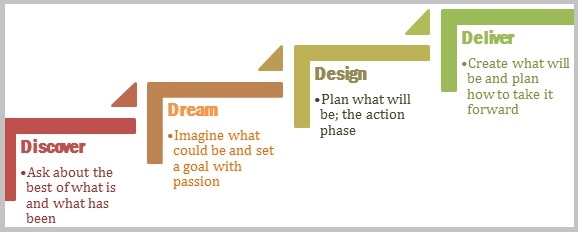
    Usually, there are four stages of AI. The first stage is ‘discovery’, where one evaluates the positives in an individual or a situation.

    Following the identification of all positive attributes, one moves to the ‘dream’ stage. Here, based on the inputs from the discovery stage, one thinks about what can be built further on this — what can one have as a dream. The objective is to discover the strength and then set a goal for the person or the team, which can be pursued with a passion.

    Next comes the ‘design’ stage, which chalks out a game plan to make the dream a reality. It answers questions, such as ‘What is the plan?’; ‘What should be the timeline?’, ‘Who should be responsible?’ and finally ‘What can happen?’ This is the phase of action and the next step to delivery.

    The ‘delivery’ phase, which is the fourth stage, deals with ‘how the entire idea can be taken forward’ and ‘which team members can be the stakeholders of this change, going forward’.

    This simple 4D model helps a team gain from a constructive discussion. For instance, if four people in a team are sitting together to dig into the quantitative data to come to a business proposition, chances are that each one will come up with a different interpretation of the data.

    Instead, if AI is used as a tool, it will allow each member to talk about his or her own experiences and emotions associated with it. As a result, it is likely that they will take less time to come to a consensus. However, there has to be someone to facilitate this process or train the leader on how to use this tool effectively. The tool brings in a whole lot of human elements.

    AI is a multipurpose tool, which can be used in various implementation processes within an organisation, one of them being the employee engagement cycle. It is also useful as an organisation development tool as it is based on how to frame some questions in order to look at the strengths in a given situation.

    Suman Nair

    Suman Nair, managing director, Atiitya Training and HR Consultants, tells HR Katha, “It can also be used for hiring, but managers have to be trained to use it effectively for hiring candidates.”

    AI as a model for analysis and problem solving was first proposed in an article by David Cooperrider and Suresh Srivastava, of Case Western Reserve University, in 1987. They argued that the problem solving approach did not foster analysis and understanding, focussing instead on problems while limiting discussions. They proposed a constructionist approach based on conversation instead, and called the new method appreciative inquiry.

    Since then, AI has gained ground around the world. British Airways, Verizon and NASA have already made it a part of their organizational culture. In India, while many NGOs have adopted it, its uptake in business circles as a management tool has been rather slow.

    However, there are quite a few practitioners, who promote this tool voluntarily through a group called TAPIN (The Appreciative Inquirer’s Network). The group engages frequently on social media. Besides, the positive aspect is that there has been an increasing curiosity around this tool, especially when companies are getting oriented towards and realising the need to engage the employees beyond hikes and promotions.


    Appreciative Inquiry Atiiya Training and HR Consultants British Airways David Cooperrider HR Tool NASA Suresh Srivastava Tapin The Appreciative Inquirer's Network Verizon
    Share. LinkedIn Twitter Facebook WhatsApp
    mm
    Dr. Prajjal Saha | HRKatha

    Dr. Prajjal Saha is a business journalist and the editor-publisher of HRKatha. He writes on the realities of work and organisations, offering a clear-eyed view of how companies translate intent into action—often revealing the gap between the two. With over 25 years of experience, he focuses on interpreting workplace trends and leadership decisions in a way that is both insightful and accessible. He founded HRKatha in 2015 to create a platform for credible, insight-driven analysis of the evolving workplace.

    2 Comments

    1. Sanjay Tikoo on May 19, 2015 9:55 am

      I am looking for a training program on Appreciative inquiry in Mumbai.Kindly help.

      Reply
    2. SAMIR on December 16, 2015 1:07 pm

      Kindly send us the training program on Appreciative inquiry

      Reply
    Leave A Reply Cancel Reply

    Related Posts

    Career myths employees need to stop believing

    July 24, 2026

    Case-in-Point: The salary transparency trap

    July 23, 2026

    herSTORY: Priyanka Anand, VP & Head-HR, Ericsson Southeast Asia, Oceania and India

    July 23, 2026

    AI is not replacing workers. It is replacing the youngest ones first

    July 22, 2026
    zoha
    Editorial

    India’s IT services industry built the talent. Its biggest clients are now hiring it directly through GCCs

    Something significant is happening to India’s technology workforce in 2026. Most people are describing the…

    The interview was never measuring what we thought it was

    I was speaking recently to the HR Head of a mid-sized IT company about hiring.…

    EDITOR'S PICKS

    Career myths employees need to stop believing

    July 24, 2026

    Case-in-Point: The salary transparency trap

    July 23, 2026

    herSTORY: Priyanka Anand, VP & Head-HR, Ericsson Southeast Asia, Oceania and India

    July 23, 2026

    AI is not replacing workers. It is replacing the youngest ones first

    July 22, 2026
    Latest Post

    HCLTech’s Odisha AI data centre to create 6,000 high-skilled jobs

    News July 24, 2026

    HCLTech is set to build its first AI-optimised data centre in India in Bhubaneswar, Odisha,…

    UAE mandates worker insurance for new private sector hires

    Global HR News July 24, 2026

    Private-sector employers in the UAE will now be required to purchase worker insurance for every…

    PepsiCo to cut 184 warehouse jobs at Tulsa facility

    News July 24, 2026

    PepsiCo will eliminate 184 warehouse positions at its Tulsa, Oklahoma, facility, with employee separations scheduled…

    Delhi Police suspends routine leave amid heightened security deployment

    News July 24, 2026

    The Delhi Police has temporarily suspended routine leave for its personnel to ensure adequate manpower…

    Asia's No.1 HR Platform

    Facebook X (Twitter) Instagram LinkedIn WhatsApp Bluesky
    • Our Story
    • Partner with us
    • Career
    • Reach Us
    • Exclusive Features
    • Cover Story
    • Editorial
    • Dive into the Future of Work: Download HRForecast 2024 Now!
    © 2026 HRKatha.com
    • Disclaimer
    • Refunds & Cancellation Policy
    • Terms of Service

    Type above and press Enter to search. Press Esc to cancel.