


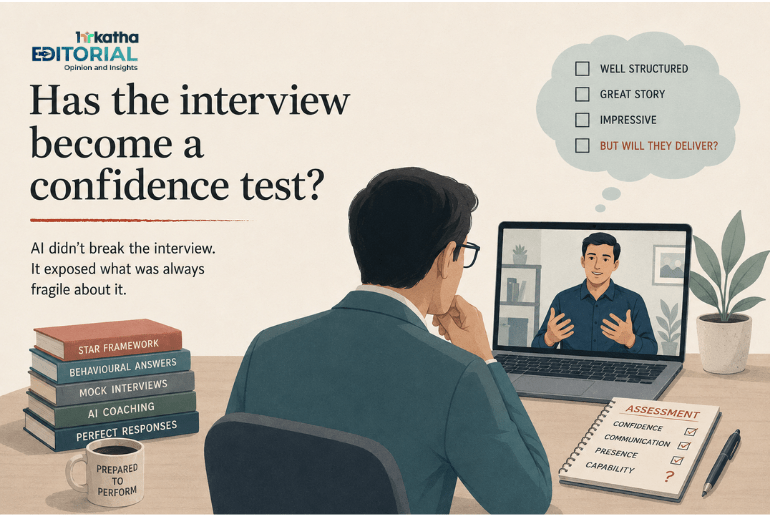
I was speaking recently to the HR Head of a mid-sized IT company about hiring. We were discussing how recruitment had changed when he said something that caught me by surprise.
“Interviews have become much harder.”
The remark sounded odd. Technology was supposed to make hiring easier. Virtual interviews removed the need to travel. Recruiters could schedule more conversations in a day. AI could summarise résumés, generate questions and structure feedback. Everything about the process appeared more efficient.
He smiled. “That’s exactly the problem.”
His concern was not with senior leadership hiring, where years of visible achievement, business judgement and references built over decades still anchor the conversation. His worry was with executive, assistant manager and middle-management roles, where interviews have quietly become a performance in their own right.
“Everyone looks impressive now,” he said. “The camera is positioned well. The background is clean. The answers are structured. Behavioural questions are answered using frameworks candidates have rehearsed dozens of times. Some even use AI tools that listen during virtual interviews and suggest stronger responses in real time.”
“Sometimes the person who joins the organisation bears surprisingly little resemblance to the person who appeared on the screen.”
“Interview performance has become a skill in itself. That is not the same thing as job performance.”
What AI has done to the interview
The preparation industry is not new.
Every generation has rehearsed answers, attended coaching classes and practised in front of mirrors. Universities built placement cells around interview preparation. HR professionals ran mock interviews. Preparation was seen as evidence of seriousness.
What has changed is not the existence of preparation but its scale and precision.
Today, a candidate can upload a job description and receive tailored interview questions within seconds. AI coaches simulate recruiters, analyse tone of voice, suggest stronger responses and identify where to pause or smile. Browser extensions claim to provide live assistance during virtual calls. YouTube channels dissect the perfect answer to almost every behavioural question. Online communities exchange company-specific interview experiences in remarkable detail.
Interview performance has become a skill in itself.
That is not the same thing as job performance.
Virtual interviews compounded this shift. They solved genuine problems: reduced travel, wider access to talent, faster scheduling. But they also flattened the signals that physical interviews had always produced almost invisibly. How someone enters a room. How they treat the receptionist. Whether they remain composed when a meeting starts late. The informal conversation before the formal questions often reveals more about a person than everything that follows.
Inside a virtual rectangle, those signals disappear. The background is curated. Notes sit just below the camera. Confidence is easier to project from the familiarity of one’s own home than inside an unfamiliar boardroom.
The interview became cleaner. Whether it became more accurate is a different question.
“Interviews have always rewarded the wrong signal. AI has simply made that signal far easier to produce.”
What interviewers are actually responding to
Here is where the argument shifts.
Human beings are not naturally good at evaluating other human beings.
When a candidate appears composed, articulate and fluent, the interviewer’s mind makes a rapid and largely unconscious leap. This person must be capable. Presentation becomes a proxy for competence. The candidate who speaks well is assumed to think well, decide well and perform well under pressure. The assumption is rarely examined. It is simply made.
Confidence compounds this further. A candidate who answers without hesitation, who never qualifies their statements, who never says “I am not sure” or “it depends on the situation,” tends to be perceived as more capable than one who thinks carefully before responding. Yet in almost every complex role, the ability to sit with uncertainty, to acknowledge the limits of one’s knowledge, is more valuable than the projection of certainty. Interviews have always rewarded the wrong signal. AI has simply made that signal far easier to produce.
There is another pattern that operates quietly in almost every interview room. Interviewers tend to respond well to candidates who remind them of themselves. Not because they are consciously selecting for familiarity, but because recognition feels like intelligence. When a candidate uses the same frameworks, references similar experiences, or approaches problems the way the interviewer would, it registers as capability. What it may actually be is fluency in a particular professional language that some candidates have simply learnt to speak. AI has made that language available to everyone.
And then there is the story.
Behavioural interviews were designed to get past rehearsed answers by asking candidates to describe what they actually did in specific situations. The assumption was that real experience would produce richer, more credible responses than manufactured ones. What nobody fully anticipated was how powerfully human beings respond to narrative regardless of its content. A modest achievement described with structure, tension, resolution and self-awareness consistently outperforms a significant achievement described plainly. The story matters more than the substance it contains.
AI has simply made everyone a better storyteller.
“Interviews were never designed to reward the best performer. They were designed to identify them. Somewhere along the way, those two things became increasingly difficult to tell apart.”
The irony HR may have created
There is a quiet irony sitting at the centre of this.
For years, HR advised candidates to prepare better. Learn the STAR framework. Structure your answers. Think of strong examples before you walk in. Build your personal brand. Improve your storytelling. None of this advice was wrong. It improved the quality of interviews across the board.
AI has simply scaled everything HR encouraged.
Candidates are doing exactly what organisations taught them to do, only far more effectively and at far greater scale than anyone anticipated. The interview has evolved. Whether the assessment has evolved at the same pace is a different question.
What the interview was always measuring
Interviews were never designed to reward the best performer. They were designed to identify them. Somewhere along the way, those two things became increasingly difficult to tell apart.
For decades, they worked reasonably well because the interviewer possessed far more information than the candidate. Recruiters understood the role, controlled the questions and largely dictated the pace and direction of the conversation. That asymmetry created a genuine information advantage.
It no longer exists.
Candidates know the company. They know the likely questions. They know the competencies being assessed. Increasingly, they also know how those competencies should sound when articulated well. The interview has become less a test of capability and more a test of preparation. And preparation, historically a proxy for seriousness, is now something AI can supply to almost anyone within minutes.
The interview was never a pure measure of competence. It measured competence filtered through confidence, communication and presence. AI has altered each of those variables. Confidence can now be coached. Stories can be rewritten. Weak examples can be reframed into compelling narratives. What appears authentic is increasingly rehearsed.
That does not make candidates dishonest. It makes the interview itself a less reliable signal than it once appeared.
The difficulty is that interviewers, responding to the psychological patterns described above, consistently struggle to distinguish between someone who communicates well because they understand the work deeply and someone who communicates well because they have become exceptionally good at interviews.
The two are often not the same person.
“AI did not create that gap. It simply made it impossible to look away from.”
What some organisations are doing differently
Some organisations have already begun adjusting.
Work simulations. Case discussions. Practical assignments. Trial projects. Assessment centres. Structured reference checks that go beyond the names candidates provide. Multiple conversations with different stakeholders across different settings and formats.
None of these methods is perfect. All of them are imperfect in different ways. But together they often reveal far more than a single polished interview, because they create conditions that rehearsal alone cannot fully prepare for.
The interview is becoming one data point rather than the deciding moment.
That may simply be where honest hiring is headed.
The question worth asking
The HR Head I spoke to was not arguing that interviews have become irrelevant. Nor was he blaming candidates for preparing well.
“If I were looking for a job today,” he laughed, “I’d probably use every AI tool available myself.”
His concern was more fundamental.
“When everyone has learnt how to perform well in interviews, what exactly are we measuring?”
It is the right question. And it is not really a question about AI.
It is a question about what interviews have always measured, whether organisations ever examined that honestly, and whether the gap between interview performance and workplace performance was always larger than they were willing to admit.
AI did not create that gap.
It simply made it impossible to look away from.