


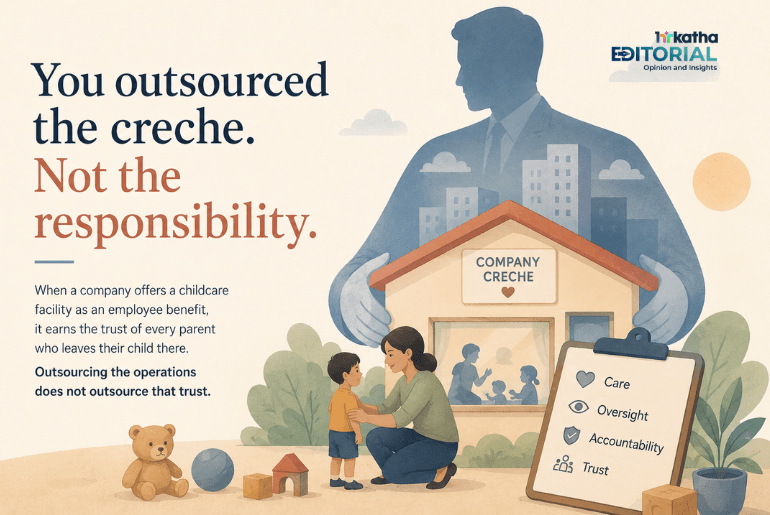
There is a particular kind of trust between an employer and an employee who leaves their child at a company-run creche.
It is not the trust of a consumer choosing a daycare from a directory. It is not an independent decision made after personal research and site visits. It is trust extended because the company offered the facility, placed it on company premises, and implicitly said: we have taken care of this for you.
That is a different kind of promise. And it carries a different kind of responsibility.
The parents of the children at Capgemini’s Brookefield campus creche in Bengaluru did not independently choose Little Scholars as their childcare provider. They used a facility their employer had provided, on its own campus, as part of its commitment to supporting working parents. When they dropped their children there each morning, they were not exercising consumer choice. They were extending institutional trust.
That trust was broken. And the question of who broke it cannot be answered simply by pointing to the vendor.
What outsourcing does and does not transfer
Capgemini’s official statement names “external provider Little Scholars” in the first paragraph. The legal positioning is visible and understandable. The day-to-day management, the hiring, the salary distribution: all of this was outsourced.
But outsourcing operational management does not outsource moral accountability.
The creche was a Capgemini employee benefit. It sat on Capgemini’s campus. It served Capgemini’s employees. The benefit of offering it, the goodwill it generated, the retention it supported, the productivity it enabled by allowing parents to focus on work rather than childcare logistics: all of this accrued to Capgemini.
You cannot take the benefit and transfer the responsibility.
When a company provides a facility as part of its employee proposition, it is not acting as a neutral marketplace connecting employees to vendors. It is making a curatorial decision: we have selected this provider, placed them on our premises, and we stand behind this service as part of what we offer you.
The moment a company makes that curatorial decision, it assumes accountability for the quality of what it has curated.
“You cannot take the benefit and transfer the responsibility.”
Due diligence doesn’t end with vendor selection
Every outsourced service begins with due diligence. References are checked. Compliance documents are reviewed. Contracts are negotiated.
But childcare is not software procurement.
Selecting the right vendor is only the beginning. Governance does not end when the contract is signed. It begins there.
Someone inside the organisation must continue asking difficult questions. Is the facility functioning the way it was promised? Are standards slipping? Are complaints being heard?
Are children actually safe?
A company cannot assume that a good vendor will remain a good vendor forever. Oversight is not an annual audit. It is an ongoing responsibility.
“Accountability becomes blurry the moment ownership does.”
The questions that should have been asked long before the videos appeared
The Capgemini case is not primarily a story about the conduct of five nannies. It is a story about what was not happening around them.
Was the facility being inspected regularly? Not audited annually for compliance paperwork, but physically visited. Were HR professionals or admin teams walking through the creche, speaking to staff, observing how children were being treated?
Who inside the organisation actually owned this relationship? HR? Administration? Facilities? Or did everyone assume someone else was watching?
That question matters because accountability becomes blurry the moment ownership does.
Were parents allowed to visit? Reports confirm that Capgemini employees were prohibited from entering the active care zones of the daycare facility. The operational logic for this exists in childcare settings: external visitors can disrupt routines, create security concerns, and distress children who are settling. But the consequence in this case was total opacity. The people with the most direct interest in the children’s welfare had no visibility into what was happening to them.
Were there feedback mechanisms? Could a parent who noticed a behavioural change in their child, a fear of bathrooms, unusual distress at drop-off, flag a concern to someone inside Capgemini who would take it seriously?
The answers to these questions are not in Capgemini’s statement. The statement explains what happened after the videos went viral. It tells us little about the systems that existed before that.
“The person who tried to protect the children was removed. The system that should have surfaced the problem instead buried it.”
The whistleblower who was fired
There is one detail in this case that deserves more attention than it has received.
Before the videos. Before the arrests. Before the viral spread and the official statements and the reassessment of all facilities across India: someone tried to stop this.
According to publicly reported accounts, a former employee at the creche raised concerns internally about the treatment of children. Those concerns were reportedly dismissed, and she was subsequently dismissed from her job. The abuse continued.
Another employee, on notice after her colleague was let go, secretly recorded what she witnessed and shared the videos. Those videos are the reason this case is now known. She has since been arrested for the act of recording and sharing them, a legal complexity that sits uncomfortably alongside the fact that without her, none of this would have come to light.
This sequence is worth sitting with.
An internal warning mechanism existed. Someone used it. The response was not investigation. It was termination. The person who tried to protect the children was removed. The system that should have surfaced the problem instead buried it.
This stopped being only a vendor problem the moment an internal warning was ignored. This is not something that can be addressed by reassessing daycare providers across India. This is a question about what happens inside organisations when someone raises an uncomfortable truth. It is a question about whether the people closest to a problem are empowered to surface it or punished for doing so.
According to publicly reported accounts, Capgemini’s stated due diligence and compliance processes did not surface what a junior creche employee reportedly recognised first-hand. That gap deserves as much scrutiny as the conduct that eventually came to light.
“You can outsource the operations. You cannot outsource the trust.”
The trust equation employees did not sign up for
Every working parent who uses a company-provided childcare facility is making a calculation.
They are trading convenience and the reassurance of institutional backing for the ability to focus on their work. They are saying, in effect: I trust that my employer has done what I cannot do myself, which is to vet, monitor, and ensure the quality of the people caring for my child.
This is not an unreasonable expectation. It is the expectation the company created when it offered the facility.
When that facility fails, the employee does not experience it as a vendor failure. They experience it as an employer failure. The company they trusted with something as fundamental as the safety of their child did not protect that child.
No amount of legal positioning changes that emotional reality.
The parents of the children at this creche did not sign up for a relationship with Little Scholars. They signed up for a relationship with Capgemini. That is who they trusted. That is who they will hold accountable in every way that matters: in their engagement, in their loyalty, in their willingness to recommend the company to others, in the fundamental question of whether they believe their employer genuinely cares about them.
What this case requires of every company with a corporate creche
The Capgemini case is not an isolated incident. It is a visible example of a vulnerability that exists wherever companies outsource childcare while treating oversight as someone else’s problem.
Every company that operates a corporate creche, directly or through a vendor, needs to ask itself the same questions this case has forced into the open.
Who visits the facility regularly? Not to tick a compliance box. To see what is actually happening.
Are parents allowed access? If not, why not, and what alternative visibility exists?
Is there a mechanism for staff at the facility to raise concerns without career risk? The most important safety mechanism in any care setting is the willingness of people who witness a problem to report it. If that willingness is undermined by the fear of losing their job, the entire system rests on the assumption that nothing will go wrong.
What does the company do when a complaint is raised? The answer in this case, at least at the vendor level, was to fire the person who complained. That answer is not acceptable regardless of which organisation made it.
What Capgemini has done right
The company’s response since the videos became public has been reasonably swift. The facility was closed immediately. A national reassessment was announced. Support was extended to affected families. These are the right actions.
But they are reactive actions. They were triggered by viral videos, not by internal systems that were working.
The harder question is why the systems designed to prevent this never surfaced it sooner.
The promise companies make when they open a creche
Corporate creches exist for a reason. They help working parents stay in the workforce. They reduce attrition. They signal that an organisation understands that employees do not stop being parents when they enter the office.
That is a meaningful promise. It is also one of the most personal promises an employer can make.
The children at that creche were not there because their parents trusted a vendor. They were there because they trusted their employer.
You can outsource the operations. You cannot outsource the trust.