



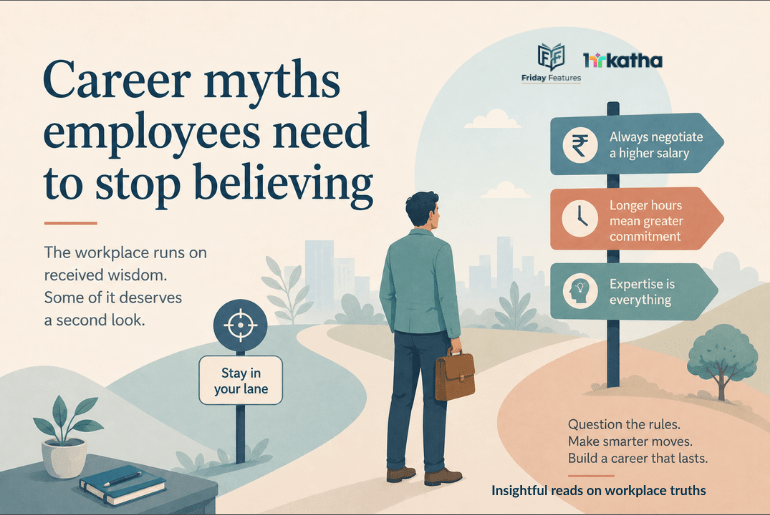
Every workplace has its unofficial career rules. Never accept a pay cut. Stay in your lane. The longer the hours, the stronger the commitment. These ideas pass quietly from experienced colleagues to new joiners, repeated often enough that they begin to sound like facts rather than opinions.
Most contain a grain of truth. That is precisely what makes them persuasive. Advice that works in one situation slowly hardens into a rule for every situation, until people stop asking whether it still applies. Careers, however, are rarely built by following formulas unquestioningly.
Two HR leaders reflect on the pieces of conventional wisdom they believe employees should stop treating as gospel.
Beyond the comfort of specialisation
Sunil Ranjhan, CHRO, Dixon Technologies
The logic behind specialisation is easy to understand. Build deep expertise in one area, become indispensable, and the career will take care of itself. It is sensible advice, particularly in the early years when technical competence is the primary currency. Sunil Ranjhan believes it becomes limiting much sooner than most professionals realise.

Looking back over a career spanning decades, he finds that the roles which shaped him most were rarely the ones that deepened his expertise. They were the assignments that pulled him into unfamiliar functions, different businesses and situations where he had to start learning all over again. Those experiences may not have made him the foremost specialist in one discipline, but they gave him something more valuable: the ability to connect ideas across functions and understand business more broadly.
Salary expectations, he argues, create a similar trap. Many professionals judge a new opportunity almost entirely by the number printed on the offer letter, and the accepted wisdom is clear: unless the increase is substantial, the move is not worth making. Ranjhan challenges that arithmetic. A role’s real value often lies elsewhere, in the quality of leadership, exposure to new markets or technologies, the trajectory of the organisation and the opportunities it creates over time.
The better question, he suggests, is not how much more the role will pay, but what it will allow someone to learn and become. The answer often proves far more valuable than the first year’s salary.
The long-hours illusion
Atul Mathur, Head L&D, Aditya Birla Capital
Almost everyone has stayed at the office long after the useful work was finished. Sometimes deadlines demand it. More often, people remain because leaving on time feels like an admission that they are somehow less committed than everyone else.

Atul Mathur admits he believed that equation early in his career. Longer hours looked like dedication. Busyness looked like productivity. Experience eventually separated the two. As his responsibilities expanded, he found that outcomes depended far less on the number of hours worked than on how those hours were used. Prioritising well, delegating effectively and trusting capable colleagues consistently produced better results than simply staying later than everyone else.
He also questions another assumption many professionals carry. Switching off is not the opposite of commitment. Time spent with family, pursuing interests outside work or simply recovering often returns to the workplace as sharper thinking, greater focus and better judgement. The colleague who leaves on time and comes back energised usually contributes far more than the one who stays late and returns exhausted.
Technology has only strengthened that argument. As automation removes more repetitive work, measuring commitment through hours spent at a desk makes progressively less sense. The conversation is shifting, as it should, from presence to outcomes.
Why career myths survive
Career myths persist because they usually begin as good advice. Hard work matters. Expertise matters. Compensation matters. None of those ideas is inherently wrong. The problem begins when useful guidance is treated as universal law.
The professionals who build the most interesting careers are rarely those who follow conventional wisdom most faithfully. They question it when circumstances demand. They accept roles that promise more learning than immediate reward. They step outside their specialisation before they feel entirely ready. They understand that contribution is measured by impact rather than hours spent in the office.
Experience has a habit of rewarding judgement more than rules. Careers rarely follow the paths people plan for them, and the assumptions that feel safest early on often become the ones worth challenging later.
Which career myth did you believe for years before realising it was holding you back? Share it in the comments.