


A French dairy company needs technical specialists for operations across Southeast Asia.
The traditional search begins in Europe. But European dairy programmes are shrinking. Expertise is ageing. The talent pool is tightening.
Meanwhile, India produces hundreds of qualified dairy technologists annually through specialised institutions. They understand global standards. They are technically strong. And increasingly, they are ready for international deployment.
By 2026, this pattern will extend well beyond dairy.
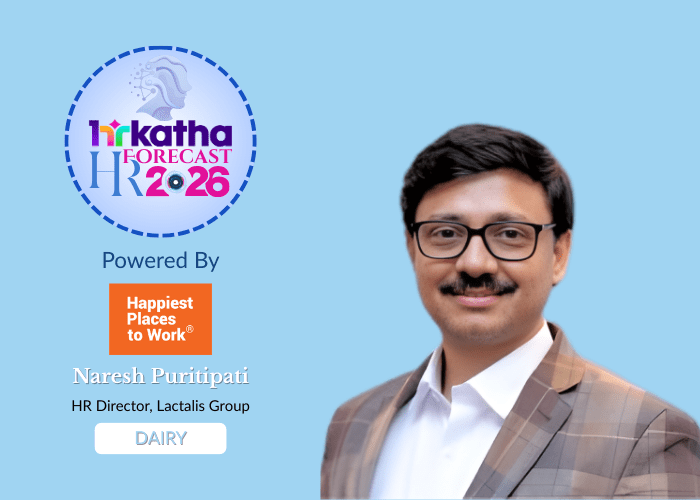
Naresh Kumar Puritipati, HR Director at Lactalis India, believes India is moving towards a structural shift in global talent flows. “India will not only meet domestic industry needs but also become a net exporter of talent for the global dairy ecosystem,” he says.
But this shift will not be demographic by default. It will be capability-led — and it depends on deliberate internal development.
Three forces are shaping this transition.
Signal 1: Internal talent development becomes structural advantage
External talent markets are tightening. Critical capabilities are scarce. Poaching is expensive and often destabilising.
Leading organisations are recalibrating. Instead of competing endlessly in external markets, they are building deeper internal benches.
Puritipati sees this as non-negotiable. “Skill inventories, internal talent development and internal promotions remain top priorities for organisations navigating a rapidly changing business landscape.”
The focus is precise: identify the top 10 per cent of talent and build expert and leadership pipelines around them. This is not about filling vacancies. It is about resilience, continuity and institutional memory.
At Lactalis India, the approach is deliberate. Specialist academies build technical depth. Time-spaced learning journeys reinforce mastery over repetition. Global assignments develop cross-cultural fluency. Expert communities preserve institutional knowledge.
“In an era of disruption, talent is the ultimate differentiator,” Puritipati argues. “Companies that prioritise internal development and succession planning will secure future leadership whilst enhancing engagement and retention.”
The alternative — constant external hiring — weakens culture, inflates cost and limits capability depth.
By 2026, the divide between organisations that build talent and those that buy it will be visible in performance, retention and adaptability.
And those that build effectively will have something else: globally deployable capability.
Signal 2: Hybrid work demands intentional culture design
As organisations invest in internal development, they face another test: sustaining culture in distributed environments.
Hybrid work offers flexibility. But in manufacturing and operations-heavy sectors, frontline employees remain on-site while corporate teams often work remotely.
“This imbalance is stark,” Puritipati notes. “Corporate teams enjoy flexibility while frontline employees remain on-site, raising fairness concerns and eroding the ‘one team, one culture’ ethos.”
The risk is subtle but serious: cultural fragmentation.
Distributed teams lose shared experiences. Values become abstract. New employees struggle to absorb norms organically.
Puritipati expects 2026 to bring more intentional design. Virtual onboarding must reinforce core values. Hybrid rituals must include structured in-person anchor days. Engagement must deliberately bridge physical and digital teams. Milestones must be celebrated across formats.
“Culture thrives on shared experiences,” he says. “In a hybrid world, these must be intentional to keep teams connected and values intact.”
The goal is not maximising flexibility. It is balancing individual needs with collective strength.
Organisations that solve this equation will attract globally mobile talent seeking flexibility without sacrificing cohesion. Those that ignore it may experience gradual cultural erosion — harder to detect than crises, but more damaging over time.
Signal 3: Reverse mentoring accelerates in hierarchical cultures
A third shift is reshaping organisational dynamics: reverse mentoring.
Younger employees coaching senior leaders on digital tools, emerging technologies and evolving workforce expectations is moving from experiment to norm.
In India’s traditionally hierarchical workplaces, this is significant.
“With rapid digital transformation and a workforce dominated by millennials and Gen Z, organisations are recognising the value of tapping into younger employees’ insights to stay agile and relevant,” Puritipati explains.
IT, BFSI and e-commerce sectors have piloted such models. Manufacturing is following.
The benefits extend beyond digital fluency. Reverse mentoring builds openness, gives younger professionals increased exposure and exposes senior leaders to emerging behaviours and innovation patterns.
“By 2026, this practice is likely to move from experimental to mainstream,” Puritipati predicts.
For sectors integrating automation, AI and advanced systems, practical learning from digital natives can accelerate organisational adaptation more effectively than traditional classroom interventions.
Reverse mentoring is not symbolic. It is an accelerator for organisational learning.
Progress with pragmatism: The DEI context
These developments unfold within a complex diversity landscape.
Globally, DEI initiatives face political scrutiny and policy reversals. Many organisations are rebranding programmes while maintaining core commitments.
In India, the focus remains narrower.
“Corporate DEI initiatives remain largely centred on gender diversity, with limited traction across other dimensions such as disability, LGBTQ+ and socio-economic inclusion,” Puritipati observes.
Gender diversity will remain prioritised, driven by rising female workforce participation and business imperatives. Broader inclusion efforts will expand more gradually.
This reflects practical bandwidth constraints. Organisations prioritise where progress is measurable and momentum exists.
By 2026, leading companies may broaden inclusion dimensions. But most will continue strengthening gender-focused pipelines as foundational work.
The talent export opportunity
These forces converge into a larger opportunity.
India holds structural advantages: strong institutional infrastructure, steady production of skilled professionals and cost-effective talent development.
But credentials alone will not create export capability.
Lactalis India has adopted a proactive approach — identifying high-potential talent early and investing in structured capability-building across technical expertise, leadership readiness and cross-cultural adaptability.
“Our vision is clear,” Puritipati says. “India will not only meet domestic industry needs but also become a net exporter of talent for the global dairy ecosystem.”
This is not limited to dairy. Engineering, pharmaceuticals and technology already demonstrate similar patterns. By 2026, more sectors are likely to formalise deliberate talent export strategies — building capabilities domestically for global deployment.
The implications are significant.
Indian professionals gain global exposure and career acceleration. Organisations access high-quality talent at scale. India strengthens its position as a source of capability, not merely cost advantage.
The shift, however, requires intentional design.
Internal development must be rigorous. Culture must remain cohesive in hybrid environments. Leadership must adapt through cross-generational learning. Inclusion must deepen progressively.
Talent export will not be accidental.
It will be built.
Three Strategic Imperatives
Internal Development: Build globally deployable capability through specialist academies, expert communities and structured succession planning — not just domestic talent management.
Hybrid Culture: Design intentional practices that preserve cohesion in distributed environments — balancing flexibility with fairness and shared experience.
Reverse Mentoring: Accelerate organisational learning by systematically pairing digital natives with senior leaders — especially in sectors undergoing rapid technological change.
The capability advantage
The next phase of global talent competition will be defined less by recruitment and more by development.
External hiring will remain necessary. But organisations that master internal capability building, preserve culture in distributed settings and accelerate learning through reverse mentoring will operate with structural advantages.
By 2026, the difference will be clear. Some organisations will have deep, globally deployable benches of internally developed talent. Others will remain dependent on expensive external markets and reactive hiring. The former will adapt faster, retain stronger performers and shape global talent flows. The latter will respond to them. India has the institutional base. The opportunity is visible. The decisive factor now is execution.
By 2026, India will not just supply talent to global industries. It will export capability — deliberately, strategically and at scale.
#HRForecast2026 is powered by ‘Happiest Places to Work’