


The idea of leadership is being fundamentally rewritten.
Organisations were long designed around authority, control and decision-making hierarchy. That model is now under sustained pressure—from technology, workforce expectations and the nature of work itself.
As organisations navigate geopolitical uncertainty, economic volatility and rapid technological disruption, leadership is no longer about directing effort. It is about enabling outcomes in increasingly complex, distributed environments.
At the centre of this shift are two powerful forces: the rise of agentic AI—where systems can plan, decide and execute—and a workforce that expects autonomy, purpose and continuous growth.
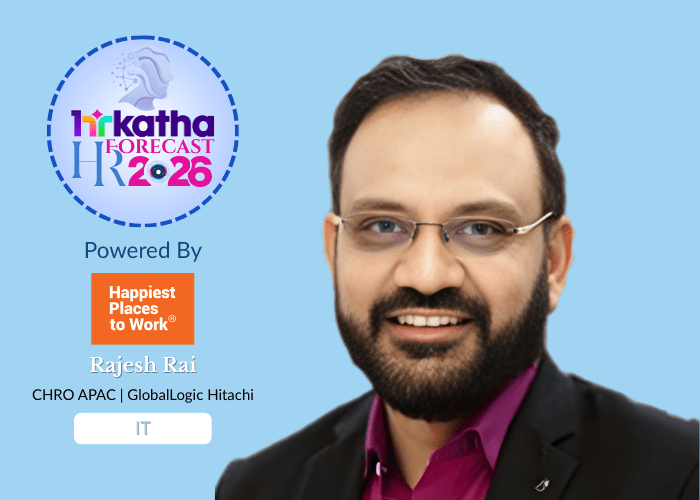
Rajesh Rai, CHRO & SVP–APAC at GlobalLogic Hitachi, believes these forces are not just reshaping work—they are redefining what effective leadership looks like.
“Leadership is clearly moving away from command-and-control toward coaching, empowerment and service,” he says.
Looking ahead to 2026, several signals suggest that leadership itself is entering a phase of structural reinvention.
Signal 1: Leadership behaviour—not language—will determine credibility
The shift away from command-and-control is already visible. Coaching, empowerment and servant leadership are widely discussed and increasingly expected.
But the real shift is not in language. It is in behaviour.
While many leaders have adapted to what needs to be delivered, the how—how decisions are made, how power is shared and how teams are enabled—is still evolving.
This transition is being accelerated by two forces.
First, a multigenerational workforce, particularly Gen Z, expects autonomy, continuous learning and meaningful work—not directives.
Second, AI is changing the leader’s role from directing tasks to orchestrating outcomes—a shift that cannot succeed in rigid, hierarchical environments.
“Building truly empowering cultures takes intent and unlearning,” Rai notes.
The real challenge lies in unlearning decades of command-driven habits while maintaining performance under pressure. This requires more than training programmes—it demands rethinking accountability, decision rights and performance expectations.
By 2026, leadership credibility will depend not on stated intent but on consistently demonstrated behaviour—especially under pressure.
Signal 2: Human judgment will become the differentiator in the AI age
As organisations move deeper into the era of agentic AI, the nature of human contribution is changing.
Technical execution will increasingly be automated. What remains—and becomes more valuable—is human judgment.
Empathy, critical thinking, creativity and contextual decision-making will shift from being labelled “soft skills” to being recognised as core business capabilities.
Humans will play critical roles in interpreting nuance, managing bias, providing ethical oversight and curating meaning from AI-generated outputs.
“The question will shift from ‘Can AI do this?’ to ‘How do humans elevate AI outcomes?’” Rai says.
This has significant implications for talent strategy.
Organisations hiring primarily for technical capability may find themselves competing on a dimension that AI increasingly commoditises. Those investing in judgment, contextual understanding and ethical reasoning will build advantage that is harder to replicate.
In this environment, competitive advantage lies not in adopting AI, but in how effectively organisations combine human and machine intelligence. Leadership development must adapt accordingly—building fluency in AI capabilities not just to deploy technology, but to understand where human judgment remains essential.
Signal 3: Benefits will become personalised, portable and employee-driven
The workforce now spans multiple generations, each with distinct priorities—from financial security and health to flexibility, learning and wellbeing.
One-size-fits-all benefits are becoming increasingly irrelevant. Employees expect choice, transparency and control.
Flexible, self-service models are gaining ground, allowing employees to curate benefits aligned to their life stage and personal needs.
Looking ahead, portability will become a defining feature—especially as hybrid work and gig models expand.
Organisations that enable this flexibility will be better positioned to attract and retain diverse talent.
“Personalisation in benefits is no longer optional,” Rai says. “Different generations value different outcomes—and expect choice.”
Personalisation, in this context, is no longer a perk. It is becoming a baseline expectation. This shift requires HR systems sophisticated enough to manage individual customisation at scale whilst maintaining governance and cost control.
Signal 4: Data governance will become central to HR credibility
As HR systems become more data-rich, they are also becoming more sensitive—and more scrutinised.
From biometrics to AI-driven insights, organisations now handle deeply personal employee data, raising both ethical and regulatory stakes.
With frameworks such as India’s DPDP Act and the EU AI Act, consent, explainability and accountability are becoming non-negotiable.
HR will be expected to explain AI-driven decisions—whether in hiring, performance or engagement—to both employees and regulators.
At the same time, employees are becoming more aware and assertive about how their data is used.
“Employees will increasingly expect to know how their data is used and to retain ownership of it,” Rai notes.
One of the most significant risks is bias in AI-driven decision-making—not just regulatory penalties, but the long-term erosion of trust when employees believe algorithms are unfair or unaccountable.
“The smartest approach is disciplined restraint—collect only what is necessary, protect it rigorously, and use it responsibly,” Rai emphasises.
In the AI-driven workplace, trust will become HR’s most valuable currency—and data governance the mechanism through which it is earned.
Signal 5: Leadership development will be reimagined for digital-first environments
Distributed and hybrid work models are no longer transitional. They are structural.
This is forcing a fundamental rethink of how leaders are developed.
Traditional leadership programmes do not translate effectively into virtual contexts. Leaders must now build influence without proximity—through clarity, communication, empathy and inclusion.
These capabilities require deliberate development.
“Leaders must build influence through clarity, empathy, inclusion and strong virtual presence,” Rai says.
By 2026, leadership development will increasingly include AI-enabled learning, micro-learning in the flow of work, digital coaching and real-time feedback.
Effective leaders will be those who combine human connection with digital fluency—consistently and at scale.
The leadership reset
Taken together, these signals point to a deeper shift in how leadership is defined and practised.
Leadership is being redefined:
Coaching over control.
Judgment over execution.
Trust over surveillance.
Enablement over authority.
In this environment, HR’s role expands—from developing leaders to redesigning leadership systems for a fundamentally different world of work.
Three Strategic Imperatives
Behavioural Leadership: Move beyond frameworks and ensure consistency between stated values and everyday actions—especially under pressure.
Human + AI Integration: Prioritise judgment, empathy and critical thinking as capabilities that amplify AI rather than compete with it.
Trust Through Governance: Design data and AI governance frameworks that ensure transparency, fairness and accountability—treating trust as strategic asset requiring consent management, bias audits and explainable AI.
The Judgment Advantage
The future of leadership will not be defined by titles or authority.
It will be defined by the ability to navigate complexity, enable people and build trust at scale.
Agentic AI, multigenerational expectations, data transparency and distributed work are converging to reshape leadership in real time.
Some organisations will adapt—redefining leadership around empowerment, judgment and trust.
Others will retain the language of modern leadership whilst continuing to operate with legacy behaviours.
By 2026, that gap will be structural.
Because leadership is no longer about controlling outcomes.
It is about enabling them—consistently, ethically and at scale.
And that is what will separate effective leaders from the rest.