


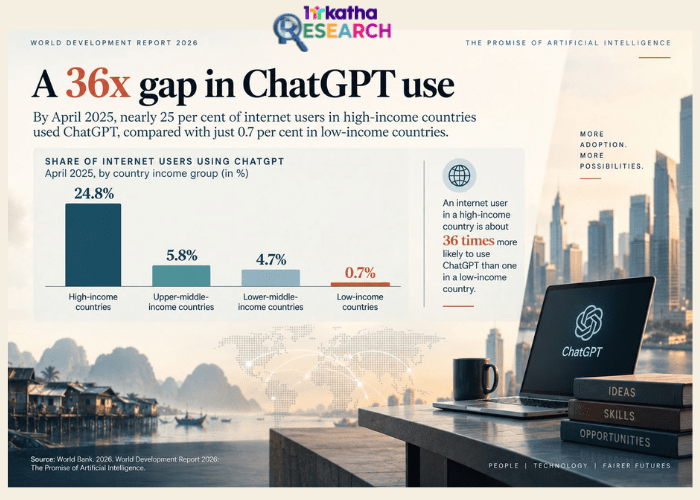
By April 2025, nearly 25 per cent of internet users in high-income countries had adopted ChatGPT, compared with 5.8 per cent in upper-middle-income countries, 4.7 per cent in lower-middle-income countries and just 0.7 per cent in low-income countries, according to the ‘World Bank’s World Development Report 2026: The Promise of Artificial Intelligence’.
Put those numbers together and ChatGPT use among internet users in high-income countries was about 36 times that in low-income countries.
The difference in exposure to generative AI is nowhere near as large. The report estimates that 14.2 per cent of jobs in high-income countries are amenable to automation by generative AI, compared with 4.5 per cent across low- and middle-income countries. Another 16.2 per cent of jobs in low- and middle-income countries are amenable to being complemented by AI.
That distinction matters. The global AI divide cannot be explained simply by richer economies having more jobs that AI can touch. The report’s own conclusion is that lower exposure explains only part of the adoption gap. The rest lies increasingly in the conditions surrounding the technology: digital infrastructure, management capability, productivity, skills and the technologies firms had already adopted before generative AI arrived.
The divide gets wider as AI gets more sophisticated
The report’s firm-level surveys show what that looks like inside businesses.
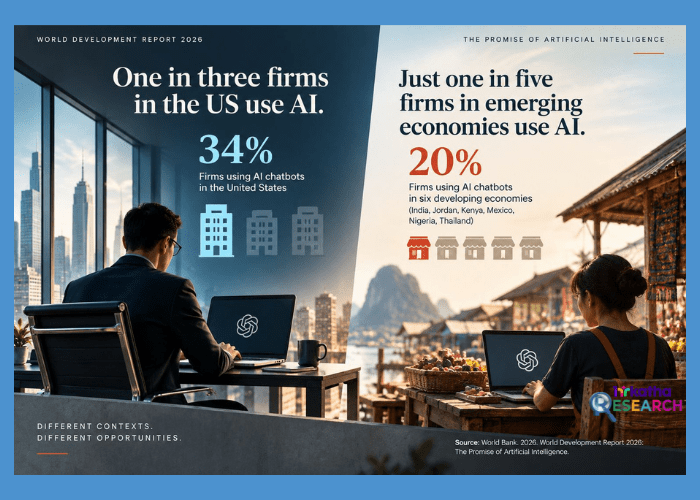
Across India, Jordan, Kenya, Mexico, Nigeria and Thailand, an average of about one in five firms already uses AI chatbots, only modestly below the 34 per cent share in the United States. But adoption becomes much less even as firms move towards more sophisticated applications.
That is an important complication to the familiar story of an AI divide between rich and poor countries. At the simplest level, the gap can look surprisingly modest. Once AI begins moving deeper into business processes, the distance grows.
Firm size adds another divide. The report finds that gaps in AI adoption and sophistication between surveyed developing economies and the US are wider among medium and large firms than among small ones. In other words, scale does not automatically erase the disadvantage. The businesses that may be expected to have the resources to catch up can still face a substantial capability gap.
AI rewards firms that were ready before AI arrived
What predicts adoption is revealing.
A firm above the median in structured management practices is 17 per cent more likely to adopt AI than one below it. A 1 per cent increase in labour productivity is associated with a 1.2 per cent increase in the likelihood of AI adoption. Firms with better market access, previous product or process innovation and stronger management capabilities also report higher adoption and more sophisticated use.
The pattern predates generative AI. The report finds that firms already more technologically sophisticated, including those using complementary technologies such as cloud computing, have subsequently adopted generative AI at much higher rates.
Digital readiness therefore compounds. The firms best placed to exploit the latest technology are disproportionately those that had already done the less glamorous work of becoming technologically capable organisations.
That turns the AI divide into something more difficult than an access problem. Giving two firms access to the same model does not give them the same ability to extract value from it.

Lower adoption also means lower disruption
The labour-market consequences are already visible.
Across South Asia, job postings declined by 1.6 per cent after ChatGPT’s release in November 2022. The slowdown was greater among globally connected firms, including multinational affiliates and global-value-chain suppliers, which have greater flexibility to relocate or substitute tasks across borders. The effect was smaller among local firms, a pattern the report says could also reflect their slower adoption of AI.
In India specifically, the report notes that the arrival of generative AI reduced monthly job postings for white-collar occupations that were most amenable to automation and least likely to be complemented by AI, with the impact falling disproportionately on entry-level workers.
The aggregate number hides much sharper effects in particular occupations. Emerging evidence cited in the report indicates that monthly job listings in South Asia fell by about 20 per cent for the most exposed white-collar occupations with ready AI substitutes.
The same asymmetry appears internationally. Across 84 economies between 2021 and 2025, the estimated effect of ChatGPT on job postings was considerably stronger in high-income countries than elsewhere. The report cautions, however, that evidence for low- and middle-income economies remains incomplete and that displacement could intensify as adoption spreads.
That produces one of AI’s stranger development paradoxes: countries that are slower to adopt the technology are, for now, also experiencing less of its disruption.
But protection through non-adoption is hardly an economic advantage.
The productivity divide follows the adoption divide
Where AI is being used, the productivity gains can be substantial. Studies reviewed by the report find task-level improvements ranging from about 6 to 88 per cent, with some of the largest effects in coding. The report also cites evidence that AI adoption increased average labour productivity by 4 per cent across 12,000 European firms between 2019 and 2024.
This is the other side of lower AI adoption.
An economy that is less exposed to AI can experience less immediate displacement. But if its firms are also less able to adopt the technology, they capture less of the productivity improvement that accompanies it. The same readiness gap therefore governs both sides of the equation: how much disruption AI causes and how much economic value it creates.
The report warns that this uneven pattern of adoption could widen productivity differences
both between countries and between firms within them.
The AI divide existed before AI
This is what makes the divide harder to close than the headline adoption numbers suggest.
AI arrived in economies that were already unequal in management quality, digital infrastructure, productivity, skills and access to complementary technologies. It did not erase those differences. It began building on them.
That helps explain why the gap between 25 per cent ChatGPT adoption in high-income countries and 0.7 per cent in low-income ones is so much larger than differences in the underlying exposure of work to AI. The technology is not being distributed across a blank economic map. It is landing on top of capabilities accumulated over decades.
For workers, that produces an uncomfortable asymmetry. Labour markets that adopt AI fastest encounter more immediate disruption, particularly in exposed white-collar work.
Those that adopt it slowly escape some of that pressure, but also risk missing the productivity gains and new opportunities that accompany adoption.
The countries least disrupted by AI today are not necessarily the countries best protected from it. They can also be the countries least prepared to benefit from it tomorrow.
