


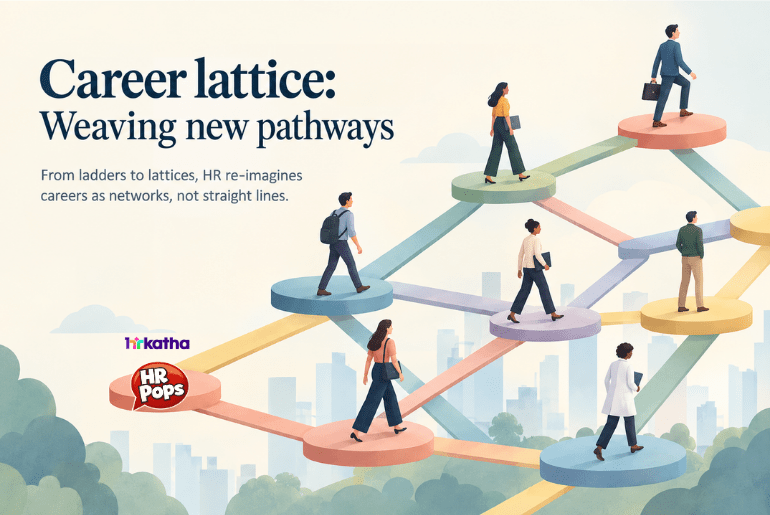
What does ‘career lattice’ mean?
The career lattice replaces one of the most enduring images of professional life: the ladder.
A ladder offers one direction. Up.
A lattice allows movement sideways, diagonally and across functions, with employees building careers through different roles, disciplines, geographies and skill domains rather than through promotion alone.
An employee might move from operations into strategy, take an international assignment, shift from management back into a specialist role, or cross functions to acquire experience that becomes valuable much later. Not every move brings a bigger title. Some build breadth, others deepen expertise, and occasionally a step sideways creates the experience required for a much larger step forward.
The metaphor reflects a change in organisational reality. Flatter structures provide fewer management positions. Skills change more quickly. Jobs themselves are being redesigned. Employees increasingly need to accumulate capabilities rather than merely seniority.
The ladder has not disappeared.
It is simply no longer the only useful way to think about a career.
Where did the idea come from?
The career lattice emerged from a broader rethink of the traditional organisational career as companies became flatter and careers less predictable towards the end of the 20th century.
The language gained greater prominence in the 2000s and 2010s as organisations and management thinkers contrasted the traditional career ladder with models that allowed greater movement across functions, roles and life stages. Deloitte, among others, helped popularise the lattice metaphor in discussions about careers and talent.
Several forces made the idea increasingly relevant. Globalisation created careers spanning markets and geographies. Delayering reduced the number of management rungs available.
Project-based work allowed employees to develop outside their formal functions. Technology repeatedly changed which skills organisations valued.
The lattice offered a different interpretation of progression. A lateral move no longer had to mean a career had stalled. It could be an investment in capabilities that the next vertical move required.
That was an important conceptual change.
Making employees believe it has proved considerably harder.
Why is it relevant for HR?
The mathematics of the traditional career ladder is becoming increasingly difficult.
Organisations want employees to keep growing, but flatter structures mean they cannot keep promoting everyone who develops. At the same time, AI and changing business models are altering jobs quickly enough that experience in one narrow function may not prepare someone for what comes next.
The lattice gives HR more possibilities.
Internal mobility can move talent towards areas where skills are needed. Cross-functional assignments can develop future leaders more effectively than repeatedly promoting them within one silo. Specialist careers can offer progression without forcing excellent technical employees into people management. Employees can continue developing even when there is no vacancy immediately above them.
This matters for retention too. When promotion is the only recognised form of progress, an employee who cannot move upwards eventually has to look elsewhere to keep moving. A credible lattice creates alternatives within the organisation.
There is also a leadership argument. Senior roles frequently require people to understand problems that cut across functions. Someone who has spent an entire career moving vertically through one silo may possess considerable depth but little experience of how the rest of the organisation actually works.
A sideways move can sometimes prepare someone for leadership better than another step upwards.
The uncomfortable reality
The career lattice has a problem: organisations may celebrate lateral movement while employees continue to experience hierarchy vertically.
Titles still matter. Pay grades still matter. Reporting relationships still matter. Prestige still matters. In many companies, the easiest way to demonstrate that a career is progressing remains a promotion.
Employees understand this perfectly well.
A lateral assignment may offer tremendous development, but if it brings no increase in pay, status or recognised career value, describing it as “growth” can sound suspiciously like HR asking an employee to accept less and call it opportunity.
Managers create another obstacle. Internal mobility sounds attractive at organisational level but can be painful at team level. A manager who develops an excellent employee may lose that person to another function, while the manager who prevents the move gets to keep a proven performer.
Unless organisations reward managers for developing and exporting talent, talent hoarding is entirely rational.
Then there is navigation.
Ladders are wonderfully clear. Employees can see the next rung and usually understand what is required to reach it. Lattices offer more possibilities but less certainty. A lateral move into another function may broaden someone’s capabilities, or it may take them away from the path to the roles they ultimately want.
The more directions a career can take, the more important good career guidance becomes.
HR therefore faces an interesting paradox. The lattice promises employees greater freedom to navigate their careers, but making that freedom useful requires considerably more organisational architecture around skills, opportunities, mobility and career pathways.
A lattice without signposts is simply harder to climb.
What HR needs to make it work
For the lattice to become more than a metaphor, organisations have to change what counts as career progress.
That starts with rewards and recognition. If only promotions produce meaningful increases in compensation, status and opportunity, employees will quite reasonably continue chasing promotions. Lateral moves need visible career value, whether through expanded scope, new skills, differentiated rewards or stronger access to future opportunities.
Internal talent marketplaces and transparent role opportunities can help employees see possibilities outside their immediate functions. Skills frameworks can show which capabilities different moves develop. Career conversations need to explore directions rather than merely discuss the next designation.
Managers matter just as much. Organisations cannot promote internal mobility while penalising managers who lose good people. Talent development has to include the ability to produce people capable of succeeding elsewhere in the business.
Most importantly, employees need evidence that lattice careers actually lead somewhere. They need to see people who moved sideways, took unconventional assignments or changed functions and subsequently advanced because of those experiences.
A career model becomes credible when employees can point to careers that prove it works.
The takeaway
The career lattice captures something important about modern work: progress and promotion are no longer necessarily the same thing.
But changing the geometry of careers is easier than changing the incentives around them.
Organisations can draw pathways across functions, encourage internal mobility and tell employees that sideways moves build valuable capabilities. None of it will matter if the biggest rewards still belong exclusively to those who move upwards.
The lattice will become real when an employee can move sideways without feeling that their career has stopped.
Until then, the organisation may have redesigned the map.
The ladder will still determine where everyone wants to go.