


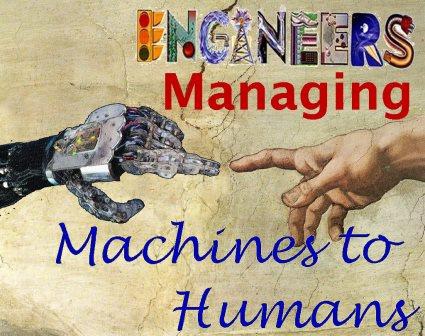
Engineers have an eclectic mix of business sense, analytical skills and even people management but do these qualities make them able HR professionals.
One of the questions on Quora is, “What would happen if engineers ran HR?” and the answers range from how HR needs a human touch that engineers might lack, to how engineers have that innate analytical and data crunching capabilities that most HR professionals struggle to have. Amongst the responses, there are some funny bones as well! One of the responses reads, ‘They would engineer an online feedback and interaction programme so they never have to speak face to face with their employees ever again.’
Well, to decipher the code, HRKatha spoke to a few people who have tasted the best of both the worlds.
A unanimously resounding response was that engineers have an eclectic mix of business sense, analytical skills and even people management through their experiences managing people and projects at the shop floor.

Substantiating the belief, Richard Lobo SVP & head-HR, Infosys says, “For any engineer working on a shop floor, people management is a full-time job in addition to running the assembly line. You get a close-up view of human behaviour, have to deal with multiple people issues as well as handle complex situations involving unions and government bodies. Any engineer with a couple of years’ experience on the shop floor would qualify as a people manager, and with more years, become an expert.”
Besides, there are certain HR-specific skills that even engineers these days are eager to acquire. Aditya Narayan Mishra, CEO-CIEL HR Services, shares that “Engineers in our country do not receive training on understanding human behaviour. In the field of design of products — physical as well as virtual— such as apps in smart phones, designers have pointed to the acute need of learning human behaviours and applying them in the design process.”
This inevitable need for being adept at understanding human nature has led to the increasing preference and orientation of many engineers to study human behaviour.
Any engineer with a couple of years’ experience on the shop floor would qualify as a people manager, and with more years, become an expert.
Engineers, by training, are good at analytics, logical reasoning and innovative problem solving — the desirable qualities of a successful manager. Add to this mix — people skills and a basic knowledge of human behaviour, and there you get a successful HR professional!
Human resources management also requires a few technical aspects, such as knowledge of legislations that govern the employment of people, as well as the techniques and methods to design roles, structure organisations, build systems and create processes. All of these are easily imbibed by engineers who have a strong foundation in reasoning and observation.
Engineers, by training, are good at analytics, logical reasoning and innovative problem solving — the desirable qualities of a successful manager. Add to this mix — people skills and a basic knowledge of human behaviour, and there you get a successful HR professional!
Amongst the existing league of engineers-turned-HR professionals, while some have been able to learn by observation, some have also taken advanced formal training in HR.
A few decades ago, it was strongly believed that a person needs to be trained and educated in a field to get a particular job, but it does not hold much water now. Organisations nowadays need professionals who can foresee circumstances and act accordingly. Each skilled expert is expected to play new roles, for which they need to continuously learn and build new competencies.
Organisations are now also more open to job rotations. Hence, a lot of people have been able to move from their technical roles to people-oriented ones.
Many senior HR professionals of the day started their careers as engineers and gradually entered the world of HR.

Lobo, being one himself, believes, “A healthy organisation is one that challenges people with new roles, as that brings in new ideas and a different way of looking at things.”
With the role of HR evolving from being a support function to a mainline, making the HR landscape more complex in terms of competition for talent, organisations are also seeking HR leaders who can work closely with business and customers to build a talent pipeline for the future. At the same time, they need the ability to be close to people, to anticipate needs and deliver on aspirations.
Lobo says, “At Infosys, we have always prided ourselves on hiring for learnability and not for education. This has allowed us to bridge the talent gap, as well as find leaders for tomorrow. One key area of learning in this process has been that qualification is just a start, education is what counts and that is achieved at work with business being the curriculum.”
Although, the industry stalwarts themselves are highly convinced that engineers have immense potential to make successful HR leaders, an interesting precise response on Quora sums it up well – they ‘probably would be the coolest HR people ever!’
2 Comments
Every Manager has to be an HR Manager to be successful. There are certain in herent qualities in human personality which make a person have HR skills. Formal HR education is needed but for complex situatioins. A farmer -illiterate-controlling 50 labourers in his farm, knows how to get work done. Human Relations is the foundation of Industrial Relations. If you know certain preventives like not getting angry, not jumping to conclusions, not giving decisions without understanding the problem etc, you will be a successful HR manager-whether you are an engineer, CA, or belong to any other profession.
I am a mechanical engineer: a succesful HR manager, entrepreneur & running a HR services company rated 10/10 by select greats of the global corporates.
Some of the points given in the article are very cliched & stereotype & have no depth.
It is very subjective & individual specific: the way a person wants to use the life & professional skills. Education matters to a great extent, Indian engineers are working succesfully in the most diverse domains/functions/specialisations & geographies.