


Degrees are being questioned. Employment models are diversifying. Benefits are fragmenting. Well-being is becoming strategic. The instinct is to call it disruption.
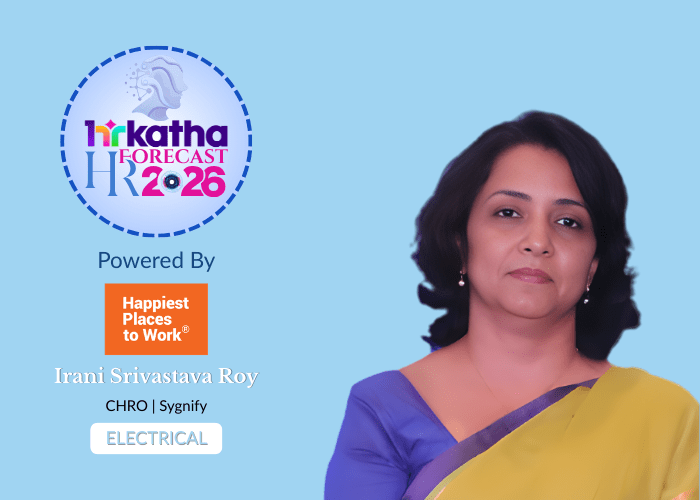
Irani Srivastava Roy sees something else. “This is not a sudden disruption,” she says. “It is a progressive rebalancing.”
As CHRO, Signify Greater India, Roy believes 2026 will not be defined by rupture. It will be defined by recalibration — of how organisations hire, structure work, design benefits and measure performance.
Nothing disappears overnight. This is not replacement. It is redesign. Three structural signals define the shift.
Signal 1: Skills will gain ground — but degrees will not disappear
India’s hiring landscape is clearly shifting from credentials to capabilities.
“Significant evidence from surveys shows that employers increasingly prioritize practical skills, adaptability and job-readiness over formal degrees alone,” Roy observes.
Technology cycles are shortening. Roles are evolving faster than academic curricula. Static qualifications can no longer act as sole proof of readiness.
Yet degrees still carry signalling power — particularly in early-career hiring at scale. They offer employers a proxy for discipline and baseline competence.
That signal will not vanish.
“The future is not degree versus skills,” Roy explains. “It is degree plus skills — with increasing emphasis on what an individual can actually do, learn and adapt.”
AI-enabled assessments and maturing skills frameworks are accelerating this shift. The real barrier is not infrastructure. It is mindset and risk appetite.
2026 will not be a tipping point.
It will be an inflection — where hiring decisions weigh demonstrated capability more heavily than credential prestige.
Signal 2: The workforce will become a mosaic — and HR must design for it
Full-time employment is no longer the only organising principle of work.
“Organisations are increasingly breaking work down into projects, outcomes and specialized interventions,” Roy says.
This makes it logical to bring in contract, gig and fractional talent alongside permanent employees — particularly for niche skills or rapid scale-up.
Demand for project-based talent is rising sharply across technology, finance, strategy and consulting. Work is being structured around outcomes, not job titles.
But blending models introduces complexity.
Traditional workforce systems — performance management, engagement, culture — were built around stable employment categories.
A mosaic model forces harder questions:
Who owns outcomes?
How is belonging created?
How are compliance and data security maintained?
How is culture protected?
“The real challenge for HR is not sourcing this talent but managing the complexity it creates,” Roy cautions.
The workforce will not fragment into competing models. It must operate as an integrated architecture — with clear role expectations, accountability norms and ethical safeguards across categories.
Signal 3: Benefits will flex — but structure will anchor them
Five generations now coexist in the workplace.
A uniform benefits package no longer reflects lived realities.
At the same time, fully unbundled self-service systems risk confusion and inequity.
“What makes the most sense is a strong core benefits framework anchored in equity, care and protection, complemented by flexible choices that reflect different life stages,” Roy explains.
The shift is less about age — and more about context.
Younger employees may value mobility and learning. Others may prioritise healthcare, caregiving or retirement planning.
Flexibility without governance creates inefficiency.
Standardisation without adaptability creates disengagement.
By 2026, benefits design will be judged on how well it balances fairness with personalisation.
Signal 4: Well-being will prove ROI — if embedded into work
Well-being is no longer a peripheral perk.
There is growing evidence that investments in mental health, financial stability, family support and preventive care influence engagement and retention.
But returns are rarely immediate.
“Wellbeing outcomes tend to be cumulative and indirect,” Roy notes. “Their impact is reflected in lower attrition, reduced absenteeism, improved engagement and stronger organisational resilience.”
The key differentiator is integration.
“Wellbeing delivers the strongest returns when it is embedded into everyday work design rather than positioned as a set of isolated perks.”
If it remains a programme, it remains marginal.
If it shapes manager capability, workload planning and performance expectations, it becomes strategic.
In 2026, measurable ROI will emerge — but only for organisations that integrate well-being into operating models, not just communications decks.
What HR must abandon — and urgently embrace
These four shifts converge on a deeper requirement: organisational learning itself must transform.
Looking ahead, Roy is clear about one shift that cannot wait.
Organisations must move away from static, one-time learning models.
“The agility required today is evolving at a step-changing level,” she says. “Traditional practices built around periodic training and fixed skill sets must evolve.”
What must replace them is continuous, real-time learning — including the ability to unlearn.
“Success will depend on how quickly teams can adapt, relearn and apply new capabilities.”
Leadership, in this context, shifts from supervision to value creation — building environments where experimentation and growth are encouraged.
Alongside this, HR must adopt an outside-in lens.
“Relevance today is driven by authenticity and responsiveness,” Roy emphasises.
Listening to employees’ lived experiences.
Understanding societal and generational shifts.
Designing policies based on reality — not legacy.
In 2026, relevance will be defined by responsiveness.
Three Strategic Imperatives
Reweight Hiring: Integrate degree credibility with demonstrated capability. Move beyond binary debates.
Architect the Mosaic: Build systems that align permanent and contingent talent around shared outcomes, accountability and culture.
Embed Well-being and Learning: Integrate resilience and continuous learning into daily work design, not annual initiatives.
The Rebalancing Moment
Roy’s forecast is measured — but decisive.
Degrees remain — but carry less weight alone.
Permanent roles remain — but coexist with specialists.
Core benefits remain — but flex around life context.
Well-being remains — but must integrate into performance.
The system will not collapse. It will recalibrate.
In 2026, the organisations that thrive will not be those chasing dramatic disruption.
They will be those designing deliberate balance. The workforce will not be replaced. It will be rebalanced.