


The future of work is being shaped by a fundamental rethink of how organisations define sustainability, flexibility and human value.
For years, organisations spoke the language of progress while continuing to operate through systems built on constraint. Internal mobility was celebrated in presentations but restricted in practice. Burnout was acknowledged but quietly rewarded. Compensation structures remained rigid despite economic volatility. Benefits stayed standardised despite increasingly diverse workforce needs. And human skills were often treated as secondary to technical capability.
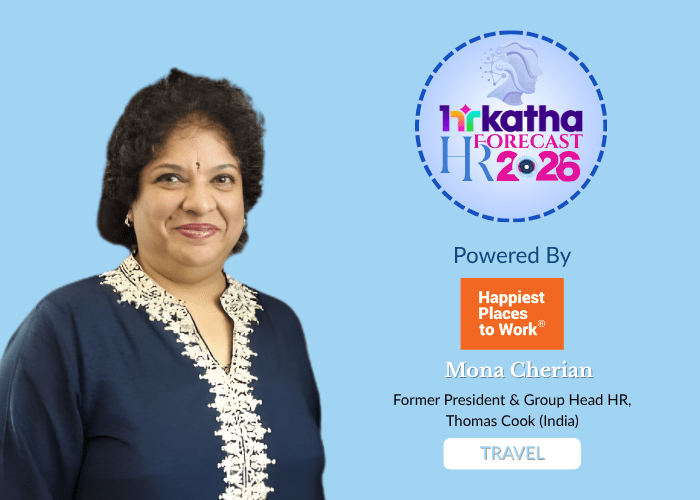
Mona Cheriyan, former President & Group Head Human Resources at Thomas Cook (India), believes in 2026 organisations will be judged less by the policies they announce and more by whether they are willing to fundamentally redesign how work operates.
“The organisations that win will not be the ones with the loudest slogans, but the ones that redesign how work itself is structured.”
Several signals suggest how this transformation may unfold.
“AI excels at answers. Humans excel at questions.”
Signal 1: Internal mobility will shift from talent hoarding to talent exporting
For years, internal mobility has been constrained by managers reluctant to lose top talent and systems designed for control rather than movement.
That dynamic is beginning to change.
“We are beginning to see a shift from ‘jobs’ to ‘work portfolios’,” Cheriyan notes. “Instead of rigid roles, employees move between projects, gigs and missions aligned to business priorities.”
AI-enabled talent marketplaces are increasingly surfacing opportunities across functions, making skills rather than hierarchy the basis of movement.
But technology alone will not dismantle silos. The real shift is cultural.
“Progressive organisations are rewarding leaders not for hoarding talent, but for exporting it. Performance metrics increasingly include how leaders develop people for roles beyond their teams.”
Career journeys are evolving from ladders to lattices, becoming more nonlinear, fluid and individualised.
Highly regulated and legacy-driven organisations may move slower. But the direction is becoming clearer.
“Where talent flows freely, innovation follows.”
In 2026, organisations that genuinely redesign how work is allocated and how leaders are evaluated for developing talent will operate with significantly greater agility than those still protecting talent within silos.
“High-performing cultures will not be the loudest or fastest. They will be the most disciplined.”
Signal 2: Burnout will lose its badge of honour, but only where leaders redesign work
The post-pandemic burnout crisis exposed a difficult reality: productivity models built on constant availability are unsustainable.
Some organisations will continue speaking about wellbeing while quietly rewarding exhaustion. In such environments, always-on culture will persist beneath wellness campaigns and resilience workshops.
But others are taking a different route.
“They are shifting from measuring effort to measuring impact. From hours logged to outcomes delivered. From urgency to intentionality.”
Sustainable performance is increasingly becoming a leadership discipline rather than an HR initiative.
Leaders are learning to design work with recovery built in, model healthy boundaries and treat human energy as a finite organisational resource.
“High-performing cultures will not be the loudest or fastest. They will be the most disciplined. Employees are expected to bring their best thinking, not their constant presence.”
The shift is subtle but significant. Burnout may not disappear immediately, but it increasingly loses its status as proof of commitment.
In 2026, organisations that outperform will not necessarily be those extracting the highest visible effort. They will be those designing work for sustainable impact, where discipline replaces relentlessness.
Signal 3: Pay will become more responsive to economic volatility
Inflation and cost-of-living pressures have disrupted the logic of traditional annual pay cycles.
The once-standard increment cycle increasingly feels disconnected from employees’ lived realities.
“We are seeing early movement toward more responsive pay practices,” Cheriyan observes.
Not every organisation will move toward real-time compensation adjustments. But the assumption that pay structures should remain static regardless of economic conditions is beginning to weaken.
Some organisations are experimenting with mid-year corrections, inflation buffers and location-sensitive allowances for critical talent segments.
The deeper shift is philosophical.
“Compensation is no longer viewed purely as a reward for past performance, but as a mechanism for financial security and trust.”
Employees increasingly want transparency, not just around what they earn, but around how organisations respond to external economic shocks.
“Inflation-indexed salaries may remain niche, but dynamic pay will become more common, especially in competitive talent markets.”
Fairness is gradually moving away from uniform increments toward contextual equity.
“Organisations that listen, adapt and communicate clearly will retain trust. Those clinging rigidly to old cycles may find their pay structures quietly eroding engagement.”
“Progressive organisations are rewarding leaders not for hoarding talent, but for exporting it.”
Signal 4: Benefits will evolve from packages to platforms
When one workforce spans five generations, a single definition of value becomes impossible.
The question is no longer whether benefits should become flexible, but how flexibility can exist without fragmenting the employee experience.
“We are moving steadily toward self-service, modular benefits ecosystems.”
Employees increasingly expect to shape benefits around their stage of life and priorities, whether childcare, elder care, financial planning, mental health support or learning allowances.
At the same time, standardised protections will continue to matter.
“Core protections such as healthcare, retirement security and insurance remain the backbone of organisational responsibility. What changes is the layer built on top.”
The most thoughtful organisations are beginning to design benefits as platforms rather than fixed packages, creating structured choice without sacrificing equity.
“They also invest in education, helping employees make informed choices rather than overwhelming them with options.”
In a workforce shaped by multiple generations and varied realities, benefits increasingly become a conversation rather than a policy document.
“Flexibility signals respect. And in an era where employees evaluate employers through the lens of life support, not just career growth, benefits strategy becomes a quiet but powerful statement of values.”
Signal 5: Human skills will become the true differentiator in the AI age
As AI absorbs more technical and repetitive work, it is reshaping what organisations value most in people.
“What we are witnessing is not the decline of skills, but their rebundling.”
Technical expertise remains important, but increasingly insufficient on its own.
“Emotional intelligence, critical thinking, ethical judgment, creativity and contextual decision-making are becoming the true differentiators, especially in leadership roles.”
Forward-looking organisations are beginning to embed these capabilities into everyday work rather than treating them as workshop topics.
Human skills are being developed through cross-functional problem-solving, scenario planning, reflection-led leadership development and human-AI collaboration.
“AI excels at answers. Humans excel at questions.”
The most valuable employees are becoming those who can navigate ambiguity, challenge assumptions and apply judgment with empathy and context.
“The renaissance of human skills is not a retreat from technology. It is a response to it.”
Organisations that invest in these capabilities will find AI amplifying human judgment rather than replacing it.
“Those that don’t may automate efficiently, but struggle to lead wisely.”
“Compensation is no longer viewed purely as a reward for past performance, but as a mechanism for financial security and trust.”
The Redesign Imperative
These signals, internal mobility as business capability, sustainable performance as leadership discipline, responsive compensation, benefits built around choice and human skills as competitive advantage, point to a broader shift.
The organisations succeeding in 2026 will not necessarily be those with the most progressive language.
They will be the ones willing to redesign how work actually functions.
“The organisations that win will not be the ones with the loudest slogans, but the ones that redesign how work itself is structured.”
“High-performing cultures will not be the loudest or fastest. They will be the most disciplined.”
“AI amplifies, rather than replaces, human judgment.”
These are not symbolic changes. They are operational decisions that determine whether organisations can sustain performance without exhausting people in the process.
Three Strategic Imperatives
Restructure Work for Mobility: Move from rigid job hierarchies to work portfolios and talent marketplaces, rewarding leaders for developing talent beyond their own teams.
Design Sustainable Performance: Shift from measuring visible effort to measuring meaningful impact, treating recovery and energy management as part of work design.
Build Human Capability Alongside AI: Develop emotional intelligence, judgment and contextual decision-making with the same rigour applied to technical skills.
The Redesign Test
The question in 2026 is not whether organisations have progressive policies.
Most already do.
The real differentiator is whether those policies meaningfully shape how work happens every day.
Do leaders genuinely export talent or continue hoarding it behind performance systems?
Do organisations reward outcomes or visible exhaustion?
Does compensation adapt to economic reality or remain locked in outdated cycles?
Do benefits offer meaningful choice or simply the appearance of flexibility?
Are human skills truly developed or merely discussed?
The organisations that succeed will be those where internal mobility becomes a business capability rather than a retention slogan, where sustainable performance is designed into work rather than layered on as wellness messaging, and where human judgment grows stronger alongside technology.
Because employees are becoming increasingly skilled at recognising the difference between organisations that redesign work and those that merely rebrand it.
And in 2026, that distinction will increasingly determine who they choose to stay with.