


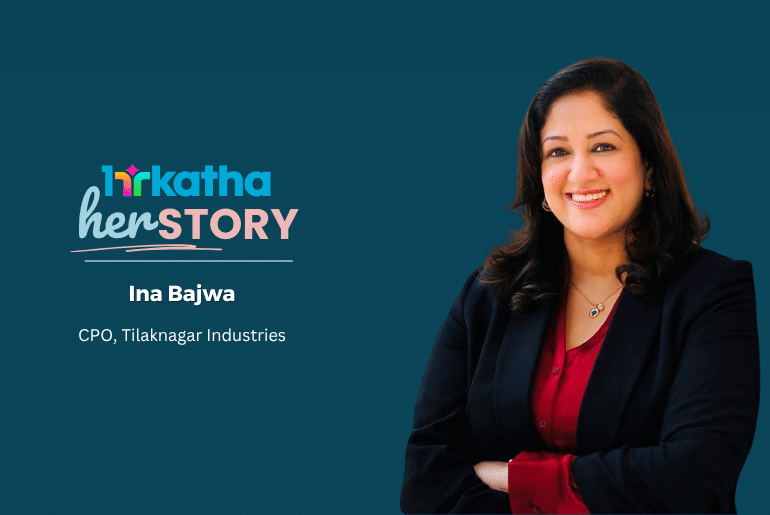
The fascinating part of HR
For Ina Bajwa, chief people officer, Tilaknagar Industries, one of the earliest surprises about HR was how much commercial understanding the function actually demanded.
To advise a business leader credibly, she realised, she needed to understand the business model, its economics, customers and competitive environment, as well as the consequences of the decisions being made.
More than two decades later, that is still what holds her interest.
Bajwa does not wake up thinking about HR programmes. She thinks about business problems and what needs to be true about the organisation for the business to win. Sometimes the answer is talent. Sometimes it is structure or leadership. And sometimes it is simply having the courage to say what everyone already knows but nobody wants to raise.
That, for her, is the fascinating part of being in HR.
It did not take Bajwa long to realise that HR was never really about people in isolation. It was about people in the context of a business.
She remembers situations where what initially appeared to be a “people problem” was actually a business problem: the wrong structure, unclear accountability, a leadership gap or simply the wrong person in the wrong role.
That changed how she viewed the function. Organisational problems, she learnt, cannot be solved by staring at the org chart alone. First understand what the business is trying to achieve and what is getting in its way. Only then ask what needs to change in the organisation and its leadership.
“Careers are built through opportunities, not slogans.”
Standing her ground
Having encountered gender bias at different points in her career, Bajwa became increasingly interested in how subtly it can surface.
It is rarely expressed as an explicit statement that a woman cannot do something. More often, she believes, it appears in how identical behaviour is interpreted.
A man who is clear about his position may be described as decisive. A woman displaying the same behaviour can be described as aggressive or difficult. A man pushing hard for a business outcome may be considered ambitious. A woman doing the same can find the judgement becoming far more personal.
Bajwa was certain about one thing: she did not want to spend her career making herself smaller so other people could feel more comfortable.
But experience also taught her that recognising bias does not make every strong opinion automatically right.
She learnt to distinguish between being clear and being unnecessarily forceful, between standing her ground and merely wanting to win an argument.
Today, when she believes a decision deserves to be challenged, she brings the conversation back to the facts, the criteria being applied and the outcome the organisation is trying to achieve.
“I have also become more self-aware about the impact of my own style. Leadership is not just about what you intend. It is also about what people experience,” she admits.
“The answer to bias isn’t to become harder. It is to become more grounded, more evidence-led and more comfortable with who I am as a leader.”
For organisations, she believes the test of inclusion lies beyond statements and policies. Look instead at who receives the difficult assignments, sponsorship and visibility, and who gets invited into the rooms where consequential decisions are made.
Careers, after all, are built through opportunities, not slogans.
Being liked versus being respected
“Leadership is not a popularity contest,” says Bajwa.
It is a lesson that became clearer as she grew more senior. Some decisions will inevitably disappoint people she genuinely likes. There will be moments when she needs to challenge someone far more senior. And even the most talented people cannot have every expectation met.
Bajwa has learnt that being respected does not mean being feared, just as being liked does not necessarily mean being effective.
When confronted with a difficult decision, she uses a simple test.
“When I have to make a difficult call, I ask myself three questions: Is the decision right for the business? Is it fair and consistent? And can I look the person in the eye afterwards and explain honestly why I made it? If the answer to those three is yes, I can live with disagreement,” she says.
Experience has also taught her not to postpone difficult conversations.
Earlier in her career, Bajwa sometimes gave people more time than they needed because she wanted to preserve the relationship or hoped the problem would correct itself. Often, it did not.
Avoiding a difficult conversation can feel humane in the moment, she learnt, but sometimes it is the less humane choice. People, teams and businesses all deserve clarity.
She now tries to be direct without becoming disrespectful, and compassionate without becoming ambiguous.
“I don’t need everyone to agree with me. I do want people to know that I will be fair, that I will listen, and that I will not avoid a difficult truth simply because it is uncomfortable.”
Dignity over success
Dignity is non-negotiable for Bajwa.
“We can ask a great deal from people. We can expect excellence, but we should never make someone surrender their dignity in exchange for success,” she says.
For her, high performance and humane treatment are not competing choices.
Demanding targets, difficult conversations, poor-performance discussions, speed and accountability are all legitimate parts of organisational life. None requires humiliating another person.
The more revealing test of culture comes when the pressure is on.
Bajwa pays particular attention to what happens around high performers. If someone produces exceptional results but repeatedly diminishes colleagues, and the organisation continues rewarding that person regardless, employees receive a message far more powerful than anything written in a values statement.
Results, they learn, matter more than behaviour.
People do not learn culture from words printed on a wall, Bajwa argues. They learn it by watching what leaders tolerate, whom they protect, whom they promote and how they behave when things go wrong.
Quick fire round
What’s the best career advice you’ve ever received?
Learn how the business makes money. It will change the quality of every people decision you make.
Morning ritual that sets you up for success?
A few quiet minutes before the day takes over: gratitude, a little reflection, and reminding myself what really matters. It helps me enter a demanding day with perspective rather than just urgency.
If not HR, what career path would you have pursued?
Probably something entrepreneurial. I have always enjoyed building things, solving problems and creating something that wasn’t there before.
What energises you most about your work?
Watching a person grow into a bigger version of themselves, and then seeing the business benefit from it. Leadership has a much longer tail than we realise. A decision that takes ten minutes can influence someone’s career for ten years.
Best investment you’ve made in yourself?
Learning, and the willingness to keep unlearning. I have also invested in self-awareness. The more senior you become, the easier it is to believe that the behaviours that made you successful yesterday will automatically make you successful tomorrow. They won’t always.
The ability to pause, listen, take feedback and ask, “How am I landing on the other side?” has been one of the most valuable investments I’ve made in myself. Because ultimately, leadership isn’t only about the impact you intend to create. It is about the impact you actually leave behind.
Preparing for the organisation ahead
At Tilaknagar Industries, Bajwa and her team are preparing for a business that is expected to become significantly larger and more complex.
That makes her definition of the future of work quite practical.
Rather than trying to predict which jobs will disappear, she starts with another question: what kind of organisation needs to be built to execute the ambition the business has set for itself?
Part of the answer lies in organisational design. Roles, accountability and decision rights need to evolve as a business scales.
Another part is leadership depth. Growth can create larger mandates quickly, and leaders who were highly effective at one scale may need to evolve considerably to lead at the next.
The third element is people-process maturity and technology. Bajwa and her team are working to strengthen people architecture, data and HR technology so that decisions can increasingly be supported by reliable information rather than intuition or fragmented processes.
Integration matters too, particularly after a period of change and growth.
For Bajwa, integration does not mean simply putting people under the same org chart. It requires clarity about how work gets done, what people should expect of one another and what kind of leadership the new organisation requires.
Technology adds another layer to those questions. Which work can be automated? Where does human judgement matter most? What skills will managers need? And how should jobs themselves change rather than simply having new technology bolted onto old ways of working?
For Bajwa, HR adds the most value when it sits close enough to the business to identify organisational friction before that friction becomes a business problem.
“The moment you understand the business, you stop being the person who comes into the room with an HR answer, and become the person who can help solve a business problem.”
Opting for the unfamiliar
To young women starting careers in HR, Bajwa’s first piece of advice is to learn the business, not just the people numbers.
“The moment you understand the business, you stop being the person who comes into the room with an HR answer and become the person who can help solve a business problem,” she says.
That means understanding how the company makes money, its customers and competitors, its economics and balance sheet, and what actually drives growth.
Her second piece of advice is not to wait for complete readiness before putting a hand up.
“You will rarely feel 100 per cent ready for the next big assignment. Take the difficult mandate. Take the unfamiliar industry. Take the role that stretches you. Build the confidence to have a point of view, and then build the judgement to know when to change it.”
Bajwa also encourages women to become financially literate, not only about the businesses they work for but about their own lives. Understand compensation, investments and wealth creation, as well as the financial language of the organisation.
And choose the people around you carefully.
Find mentors willing to tell you uncomfortable truths. Find sponsors who will open doors. But also find colleagues prepared to challenge your thinking.
A difficult chapter should not become the judgement on an entire career. Bajwa instead advocates building capability, credibility and relationships over time.
“Don’t lose yourself while building the career,” she says.
Lessons from a mother
Some of Bajwa’s thinking about leadership comes from much closer to home.
She watched her mother navigate life with a combination of resilience, warmth and quiet strength. From her, Bajwa learnt that strength is not necessarily about having the loudest voice in the room. Sometimes it is about remaining steady when circumstances are not.
More importantly, she learnt that it is possible to be strong without becoming hard.
That distinction has become increasingly important as Bajwa has grown more senior.
Seniority gives leaders influence over people’s careers, confidence and sometimes even their sense of self-worth at work. A single conversation with a leader can remain with someone for years. So can an opportunity, or a moment when somebody believes in them before they fully believe in themselves.
That awareness has made Bajwa conscious of how she uses her own influence.
She wants people working with her to feel stretched, not diminished. Challenged, not intimidated. Held accountable, but also supported.
She admits that she does not always get the balance perfect. But she cares deeply about getting it right.
It is perhaps the most enduring lesson she took from her mother: there is no need to choose between being strong and being human.