


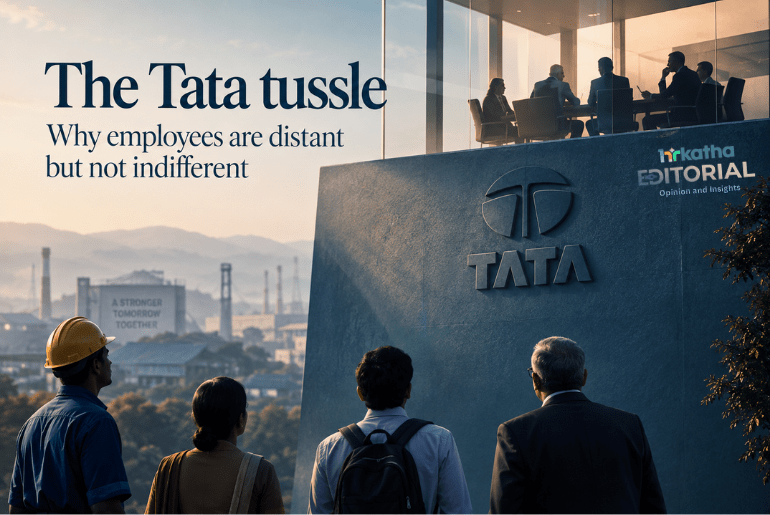
In the space of five weeks, the chairman of one of India’s most storied conglomerates announced that he would not seek another term, reversed that decision after a 4:1 board vote, and saw that reappointment challenged as illegal by the trusts that own 66 per cent of the holding company.
N Chandrasekaran had said in August that he would not offer himself for reappointment when his current term ends in February 2027. On September 17, the Tata Sons board voted to give him another five-year term, with Noel Tata, chairman of Tata Trusts, opposing the resolution. Tata Trusts subsequently declared the reappointment legally invalid, arguing that the company’s articles require the support of both Trust-nominated directors.
The disagreement comes at a complicated moment, as the group contends with losses in newer businesses, large bets in aviation, electronics and semiconductors, and the unresolved question of whether Tata Sons should be publicly listed.
Much of the dispute is being examined through governance, ownership and strategy. Far less is being asked about what it might mean for the people who work there.
“For most employees, that manager is the company. The chairman of the holding company is something closer to a public figure than an employer.”
The distance is real
Tata Group companies collectively employ more than a million people. Most will experience this dispute, if they follow it at all, as something happening several layers above their daily working lives.
The chairman of Tata Sons does not set team targets. He does not conduct appraisals. He does not decide who gets promoted in a TCS delivery centre in Pune or on a Tata Steel shop floor in Jamshedpur. The holding company and its boardroom disputes are, for most employees, genuinely remote.
This distance is not necessarily apathy. It is partly how a conglomerate of this scale is structured. Tata companies operate independently under their own boards, with their own management and cultures. The group provides a name, a value system and a certain kind of reputational inheritance. It does not provide the manager who gives feedback on a Friday afternoon.
For most employees, that manager is the company. The chairman of the holding company is something closer to a public figure than an employer.
“A worker in Jamshedpur may be organisationally several layers further from Tata Sons than a corporate executive in Mumbai, yet culturally much closer to the Tata name.”
But the distance has limits
There are employees for whom the distance is smaller.
Tata Electronics is building businesses that sit close to the group’s strategic centre, including its enormous semiconductor ambitions. Employees who joined such ventures did so while the Tata Group was making unusually large, long-term bets under Chandrasekaran’s leadership. A public disagreement over who leads the group inevitably carries greater significance when the business itself is still being built than when someone works inside a mature operating company with decades of institutional continuity.
Air India’s employees present another example. They have lived through a turbulent transformation since the airline returned to the Tata Group in 2022. That transformation has been closely associated with Chandrasekaran and is still far from complete.
For employees inside such businesses, a dispute at Tata Sons may still be distant from the everyday job, but it is less abstract. They are close enough to the group’s strategic bets for events at the centre potentially to matter, yet far enough from the boardroom to have little influence over what happens there.
“An employee does not need to understand the boardroom dispute in order for the institution behind that dispute to matter.”
The brand is the deeper issue
For the majority of Tata employees who remain operationally distant from this dispute, the more interesting effect is harder to measure. It sits at the level of the brand under which they work.
Tata has historically offered employees something beyond a transactional relationship. Its proposition is not simply salary and designation. The group has spent generations associating its name with trust, ethics, responsibility and long-term stewardship.
A boardroom disagreement is not in itself inconsistent with those values. Large institutions disagree, and boards are supposed to debate consequential decisions. What makes this episode different is that the disagreement has become public enough for employees, investors and customers to see some of the machinery behind an institution whose reputation has long rested partly on stability.
We do not know how most Tata employees view the dispute, or whether many care about it at all. But it creates the possibility of a gap between the institutional identity associated with Tata and the untidier reality of how large organisations negotiate power, strategy and succession. Such gaps can matter even when they never appear in an engagement survey.
“Identification works in both directions.”
Not every Tata employee will see the same Tata
For an older employee in Tata Steel, Tata Motors or another traditional group company, the current dispute may raise a question that has little to do with the legality of a board resolution: what is happening at the top? The discomfort, if there is any, may come not from disagreement itself but from seeing an institution associated with stability conduct that disagreement so publicly.
A younger employee may see the same episode differently. Someone building a career in technology, digital services or one of the group’s newer businesses operates in a labour market where mobility is normal and professional identity travels more easily between employers. Tata may still be a prestigious name without representing a lifelong institutional relationship. An older employee may experience the dispute as a disturbance in an institution they trusted; a younger employee may treat it as information about an employer they are continually evaluating.
The distinction becomes more interesting on the shopfloor. A worker in Jamshedpur may be organisationally several layers further from Tata Sons than a corporate executive in Mumbai, yet culturally much closer to the Tata name. The technical arguments over board votes, listing requirements and shareholder rights may have little bearing on the working day. But the simpler question of whether everything is all right at Tata can travel much further.
This is why distance and indifference are not the same thing. An employee does not need to understand the boardroom dispute in order for the institution behind that dispute to matter.
“Employees were never in the room where these decisions were made. They may be distant from that room. They are not entirely separate from what it represents.”
What large conglomerates ask of their employees
For generations of Indians, particularly those who built careers in businesses such as Tata Steel and Tata Motors, a Tata job carried some of the social meaning once associated with a government job. It suggested stability, respectability and the possibility of spending an entire career with an institution whose name would still mean something decades later.
Among long-serving employees, that trust could become intergenerational. Many wanted their children to find careers within the group too. Few endorsements of an employer are stronger than wanting the next generation of your family to work there.
That relationship is less easily generalised to TCS or the group’s newer ventures, whose employees have built careers in much more mobile labour markets. But in the traditional Tata companies, employment could become more than a job. It could become part of a family’s sense of security, identity and social standing.
That identification has value on both sides. The employee receives the reputational inheritance of a trusted institution. The organisation receives something more durable than transactional attachment: pride, affiliation and a willingness to associate one’s own professional identity with the group.
But the exchange is not between equals.
The employee is invited to identify with the larger institution. Decisions at the centre are made by a relatively small number of people whose competing interests the employee may have little visibility into and no role in shaping.
When the institution functions smoothly, that asymmetry is almost invisible. A public dispute makes the distance visible.
Tata has historically asked for more identification than many employers because the Tata name itself has meant more than employment at a single company. The strength of that inheritance is an organisational asset. It also means that visible disagreements at the centre can travel further than their immediate operational consequences.
An organisation cannot ask employees to identify with the institution when things are going well and then assume that events at the institutional level become irrelevant when they are uncomfortable.
Identification works in both directions.
The employees were never in the room
The Tata boardroom dispute will eventually resolve itself. The group will continue. Its companies will continue. Its employees will continue.
For most of those employees, daily working life may barely register the dispute. Targets will not change because of a Tata Sons board vote. Appraisals will not suddenly be conducted differently. The manager waiting on Monday morning will be the same manager who was there on Friday.
That is the distance built into a conglomerate of this scale.
But Tata has spent generations making the group name mean something beyond the individual company that appears on an employee’s payslip. That is one of its great institutional assets. It also means that what happens at the centre cannot be assumed to remain entirely at the centre.
Employees were never in the room where these decisions were made.
They may be distant from that room.
They are not entirely separate from what it represents.