

Close Menu
    Facebook X (Twitter) Instagram
    • Our Story
    • Partner with us
    • Reach Us
    • Career
    Subscribe Newsletter
    HR KathaHR Katha
    • Exclusive
      • Exclusive Features
      • Perspectives
      • Friday Features
      • herSTORY
      • Rising Stars
      • Case-In-Point
      • Point Of View
      • Research
      • HR Pops
      • Dialogue
      • Movement
      • Profile
      • Beyond Work
      • By Invitation
    • News
      • Global HR News
      • Compensation & Benefits
      • Diversity
      • Events
      • Gen Y
      • Hiring & Firing
      • HR & Labour Laws
      • Learning & Development
      • Merger & Acquisition
      • Performance Management & Productivity
      • Talent Management
      • Tools & Technology
      • Work-Life Balance
    • Special
      • HR Forecast 2026
      • Cover Story
      • Editorial
      • HR Forecast 2024
      • HR Forecast 2023
      • HR Forecast 2022
      • HR Forecast 2021
      • HR Forecast 2020
      • HR Forecast 2019
      • New Age Learning
      • Coaching and Training
      • Learn-Engage-Transform
    • Magazine
    • Reports
      • Whitepaper
        • HR Forecast 2024 e-mag
        • Future-proofing Manufacturing Through Digital Transformation
        • Employee Healthcare & Wellness Benefits: A Guide for Indian MSMEs
        • Build a Future Ready Organisation For The Road Ahead
        • Employee Experience Strategy
        • HRKatha 2019 Forecast
        • Decoding and Driving Employee Engagement
        • One Platform, Infinite Possibilities
      • Survey Reports
        • Happiness at Work
        • Upskilling for Jobs of the Future
        • The Labour Code 2020
    • Conferences
      • Leadership Summit 2025
      • Rising Star Leadership Awards
      • HRKatha Futurecast
      • Automation.NXT
      • The Great HR Debate
    WhatsApp LinkedIn X (Twitter) Facebook Instagram
    HR KathaHR Katha
    Home»Exclusive Features»Major job-market transformation in five years: World Economic Forum
    Exclusive Features

    Major job-market transformation in five years: World Economic Forum

    mmBy Dr. Prajjal Saha | HRKathaJanuary 19, 20163 Mins Read3882 Views
    Share LinkedIn Twitter Facebook WhatsApp
    Share
    LinkedIn Twitter Facebook WhatsApp

    New skillsets will be required to thrive in the new landscape, attributed to new fields, such as artificial intelligence, machine-learning, robotics, nanotechnology, 3-D printing, genetics and biotechnology.

    The Fourth Industrial Revolution coupled with other socio-economic and demographic changes is expected to transform the job market in the next five years.

    A result of new fields, such as artificial intelligence and machine-learning, robotics, nanotechnology, 3-D printing, and genetics and biotechnology, new skillsets will be needed to thrive in this new landscape.

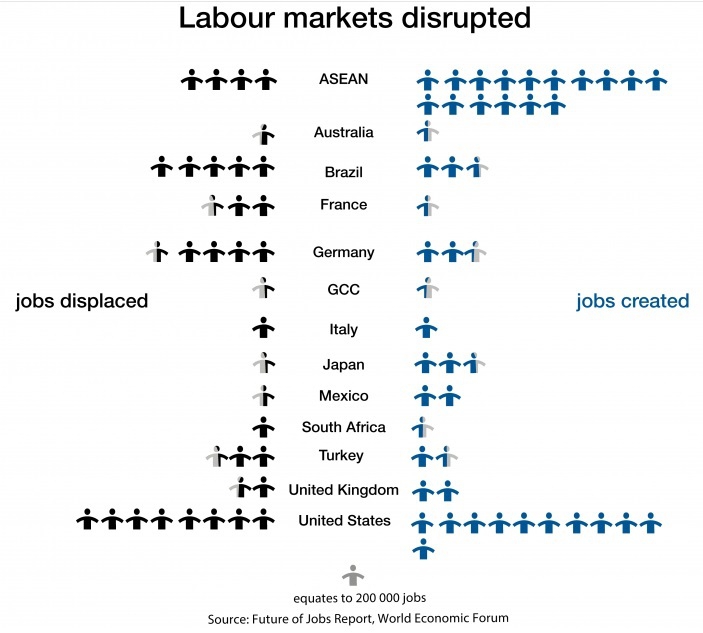
    According to the World Economic Forum, the transformed job market in the next five years, will lead to a net loss of over five million jobs in 15 major developed and emerging economies.

    Though the total jobs lost will be many as 7.1 million due to redundancy, automation or disintermediation, it will be partially offset by the creation of 2.1 million new jobs. The new jobs will mainly be in more specialised ‘job families’, such as computer and mathematics or architecture and engineering. The greatest losses will be witnessed in white-collar and administrative roles.

    Though the loss of jobs will be almost equal for men and women — 52:48—the effect will be more on women as men represent a larger share of the overall job market. This will further widen the employment gender gap, with women losing five jobs for every job gained, compared to men losing three jobs for every job gained.

    There is already a low participation of women in industries that are expected to grow, such as computers and mathematics. This makes it important for leaders to address the chronic problem of getting more women into STEM (science, technology, engineering, mathematics) professions.

    The report says that the skills and jobs displacement will affect every industry and geographical region. However, losses can be offset by job growth in key areas.

    Organisations believe that the future lies in investing in skills, rather than hiring short-term or virtual workers.

    These predictions are likely to be relatively conservative and leave no room for complacency. Yet, the impact of disruption will vary considerably depending on the industry, gender as well as job type.

    For instance, healthcare is expected to experience the greatest negative impact in terms of jobs in the next five years, followed jointly by energy and financial services and investors.

    The industries that stand to create the most jobs are information and communication technology, followed by professional services and media, entertainment and information professionals.

    The new research by the World Economic Forum is the first of its kind, and represents over 13 million employees in nine industry sectors and 15 economies. It aims to guide business and policy-makers on how to equip labour forces with the skills to navigate the disruption of the Fourth Industrial Revolution.

    The report is based on a survey of chief HR officers and top strategy executives from companies across nine broad industry categories, covering 15 of the world’s largest economies. Together, these economies account for 65 per cent of the global workforce.

    3D printing artificial intelligence biotechnology genetics Job Market machinelearning nanotechnology robotics science, technology, engineering, mathematics STEM World Economic Forum
    Share. LinkedIn Twitter Facebook WhatsApp
    mm
    Dr. Prajjal Saha | HRKatha

    Dr. Prajjal Saha is a business journalist and the editor-publisher of HRKatha. He writes on the realities of work and organisations, offering a clear-eyed view of how companies translate intent into action—often revealing the gap between the two. With over 25 years of experience, he focuses on interpreting workplace trends and leadership decisions in a way that is both insightful and accessible. He founded HRKatha in 2015 to create a platform for credible, insight-driven analysis of the evolving workplace.

    1 Comment

    1. Prof S P Garg on January 21, 2016 4:57 am

      THIS IS A CHALLENGE. INDIA WOULD STRENTHEN ITS POSITION BT IMPARTING RIGHT SKILLS TO NEW GENERATION OF WORKERS .

      Reply
    Leave A Reply Cancel Reply

    Related Posts

    Passing the torch is no longer enough: Why BFSI is rethinking succession

    August 11, 2026

    Genpact wants 100% of its workforce using AI by 2027

    August 11, 2026

    Change agility: The skill organisations claim to have and rarely do

    August 11, 2026

    POV: Should HR have veto power over business decisions?

    August 10, 2026
    zoha
    Editorial

    The certification that nobody questioned

    Every year, organisations spend considerable money and management time pursuing workplace certifications. Employees are surveyed,…

    Why every organisation eventually becomes the company it rewards

    There is a test that every employee in every organisation applies, usually without naming it.…

    EDITOR'S PICKS

    Passing the torch is no longer enough: Why BFSI is rethinking succession

    August 11, 2026

    Genpact wants 100% of its workforce using AI by 2027

    August 11, 2026

    Change agility: The skill organisations claim to have and rarely do

    August 11, 2026

    POV: Should HR have veto power over business decisions?

    August 10, 2026
    Latest Post

    Karnataka plans one-year menopause fellowship to build specialised healthcare workforce

    News August 11, 2026

    Karnataka is planning to introduce a one-year fellowship in menopause care to train medical practitioners…

    Raychem RPG appoints Abhishikta Tripathi as CHRO

    Movement August 11, 2026

    Raychem RPG has appointed Abhishikta Tripathi as chief human resources officer (CHRO). She brings over…

    Vijay Sethi joins SK Finance as CHRO

    Movement August 11, 2026

    SK Finance has named Vijay Sethi as its new chief human resources officer as the…

    Titan Company names Priya Mathilakath Pillai as CPO from April 2027

    Movement August 11, 2026

    Titan Company has appointed Priya Mathilakath Pillai as chief people officer (CPO), with effect from…

    Asia's No.1 HR Platform

    Facebook X (Twitter) Instagram LinkedIn WhatsApp Bluesky
    • Our Story
    • Partner with us
    • Career
    • Reach Us
    • Exclusive Features
    • Cover Story
    • Editorial
    • Dive into the Future of Work: Download HRForecast 2024 Now!
    © 2026 HRKatha.com
    • Disclaimer
    • Refunds & Cancellation Policy
    • Terms of Service

    Type above and press Enter to search. Press Esc to cancel.